
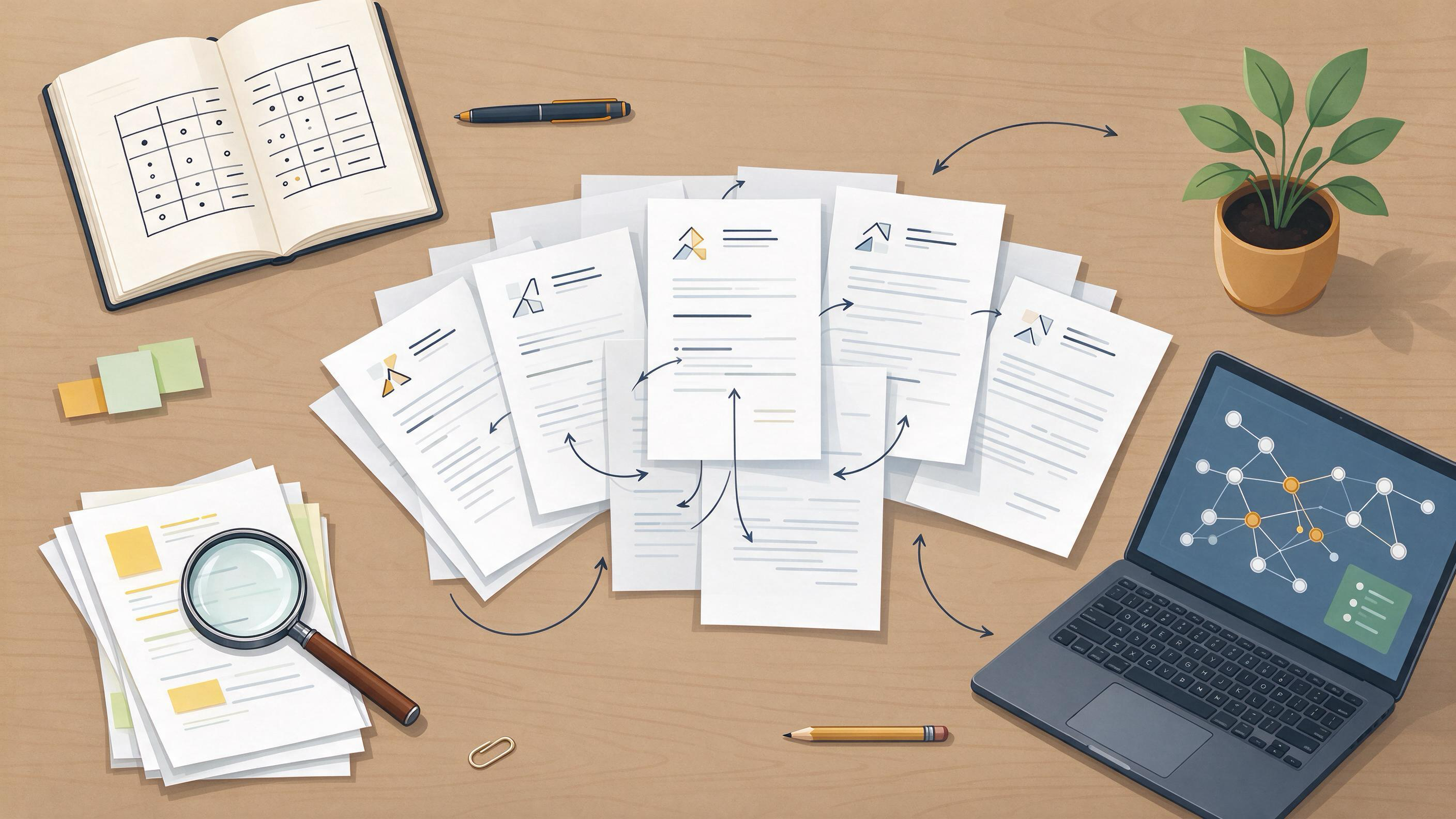
Every field has a small set of papers that keep surfacing: in introductions, in method sections, in the reference list of the review you were just handed, and in the polite aside from a coauthor who says "you've read the obvious ones, right?" Identifying those papers is not about finding the most results. It is about building a defensible, auditable shortlist that you can explain to a coauthor, a reviewer, or the next person who inherits the project.
The practical answer is to treat the task as a small systematic search. Start from what the field actually cites, triangulate across more than one source, record how each candidate entered your list, and stop only when new searches stop changing the core set. This guide walks through that sequence with checkpoints, a worked example, a reusable checklist, and clear rules for when to stop or escalate.
Diagnose your starting state before you search
Most people arrive at this task in one of a few states, and each needs a different first move:
- You have a topic but no seed papers. You need a discovery pass to find a handful of anchor works before you can trace citations.
- You have a few seed papers but no map. You need to move forward and backward through citations and related-article links.
- You have a long, messy list. You need deduplication, screening, and a record of why each item stayed or left.
- You are revising a manuscript or closing a project. You need to confirm the core set is still current and that your evidence trail is intact.
Write one sentence describing your state and the artifact you must produce: a shortlist for a manuscript, a reading list for a lab handoff, or a reproducible search record. That sentence becomes the scope statement you return to when the search starts to sprawl.
Turn the question into eligibility criteria
The Cochrane Handbook's guidance on searching for and selecting studies begins with planning searches from eligibility criteria. That principle applies even to a lightweight "what does everyone cite" task. Before you open a database, decide:
- Field boundaries. Which subfield, method, or application area counts? A paper that is central to a neighboring field may be background rather than core.
- Time window. Are you mapping the foundational canon, the current consensus, or both?
- Document types. Reviews, primary studies, methods papers, or all three?
- Language and access. Will you include works you can only read in translation or abstract form?
Keep these criteria short enough to fit on one screen. They are the test every candidate must pass, and they are the first thing a coauthor will ask about.
Build a seed set from more than one source
A single database will give you a single view of the field. Cochrane's guidance recommends using multiple sources, and the same logic protects you here. Combine:
- Free-text terms with subject headings. PubMed supports field tags, phrase searching, filters, and Advanced Search, and its search details show how terms were translated and combined. That translation view is useful for catching a term that silently matched the wrong concept.
- Citation trails. Google Scholar documents Cited by and Related articles, which let you move from a known paper to the works that cite it and the works adjacent to it.
- Author and title searches. When you know a key author or a half-remembered title, author and title search modes narrow the field quickly.
- Alerts. Google Scholar email alerts and PubMed saved searches let you catch new citing works without repeating the whole search by hand.
At this stage you are collecting candidates, not judging them. Record the source and the query that produced each one. That record is what makes the method auditable later.
If you want a single scholarly search interface to run these passes, WisPaper search is built for finding academic papers, and the public Scholar Search page explains the entry point for readers new to the tool.
Use citation counts as a signal, not a verdict
Citation counts are the most visible proxy for "everyone cites this," and tools make them easy to sort by. Google Scholar supports date sorting and date limits alongside Cited by, which helps you separate a paper that accumulated citations over decades from one that is rising fast right now.
Treat the count as a filter, not a conclusion:
- A high count in a broad database may reflect a different field than yours.
- A methods paper can be heavily cited without being conceptually central.
- A recent consensus paper may be under-cited simply because it is new.
Use counts to order your reading, then confirm centrality by checking whether the paper appears in the introductions and method sections of works you already trust.
Screen in stages and deduplicate
Cochrane recommends deduplicating records and screening in stages. A workable version for a citation shortlist:
- Deduplicate. The same study often appears as a preprint, a conference version, and a journal article. Cochrane also notes the need to link multiple reports of one study, so decide early whether you are counting reports or studies.
- Title and abstract screen. Apply your eligibility criteria. Mark each record include, exclude, or maybe, with a one-line reason.
- Full-text screen. Confirm that the paper actually does what the abstract implies.
- Link versions. Collapse multiple reports of the same study into one entry so your counts are honest.
Keep the reason codes consistent. "Out of scope," "wrong method," and "duplicate report" mean different things when you audit the list later.
Record the trail as you go
An auditable method trail is the difference between a shortlist and a pile. For each candidate, capture:
- the query and source that surfaced it;
- the date you ran the search;
- the screening decision and reason;
- the version or versions you linked;
- the role it plays in your argument (foundational, methods, current consensus, background).
PubMed's saved searches and search details give you a reproducible record of how a query was constructed. Google Scholar's citation export gives you clean metadata to carry into a reference manager. Together they let a coauthor rerun your search rather than trust your memory.
This is also where a library pays off. Saving the candidates you intend to keep in My Library keeps the shortlist and its supporting papers in one place, so the trail survives the handoff to a collaborator or the next project phase.
Worked example: a shortlist for a manuscript introduction
Suppose you are revising the introduction of a manuscript and need the core papers your reviewers will expect to see cited.
Step 1 — Scope. You write: "Core empirical and review papers on the method, last ten years, English, excluding application-only papers." That sentence is your eligibility test.
Step 2 — Seeds. You search PubMed with free-text terms plus a subject heading, then check the search details to confirm the terms combined as intended. You run the same concept through Google Scholar and use Cited by on two known papers to pull in the works that cite them.
Step 3 — Candidate log. You record each candidate with its source and query. The log already shows that three papers appeared from both PubMed and the citation trail — a strong centrality signal.
Step 4 — Screen. You deduplicate a preprint against its journal version, exclude two application-only papers, and mark one methods paper as "methods, not introduction." Each decision gets a reason code.
Step 5 — Confirm. You check that every paper you plan to cite in the introduction appears in the reference lists of at least two works you already trust. Papers that appear only once go to a "watch" list rather than the core set.
Step 6 — Rerun. Before submission, you rerun the saved searches to catch new citing works. Cochrane recommends rerunning searches before publication, and it is the cheapest way to avoid a reviewer asking why a recent consensus paper is missing.
When you need to check that the references you finally assembled are real and correctly formatted, TrueCite screens BibTeX against academic databases to flag hallucinated references — a useful final gate before the list goes into the manuscript.
Reusable checklist
| Stage | Artifact | Checkpoint question |
|---|---|---|
| Scope | One-sentence scope statement | Could a coauthor apply this test without asking me? |
| Criteria | Short eligibility list | Does each criterion rule something in or out? |
| Seeds | Candidate log with source and query | Did at least two independent sources contribute? |
| Screening | Decision and reason code per record | Are duplicates and multiple reports linked? |
| Trail | Dated queries and saved searches | Could someone rerun my search from this record? |
| Confirmation | Core set vs. watch list | Does each core paper appear in trusted reference lists? |
| Refresh | Rerun log | Did the last rerun change the core set? |
Know when the result is ready
The shortlist is ready when three conditions hold:
- Saturation. Your most recent searches surfaced no new core papers — only items that fail your criteria or duplicate existing entries.
- Triangulation. Each core paper is supported by more than one signal: a citation trail, a trusted reference list, or a database hit from an independent query.
- Reproducibility. A coauthor can rerun your saved searches and reach the same candidate pool.
If any condition fails, you are not finished — you are one more pass away.
Stop and escalation rules
Clear rules prevent both premature stopping and endless searching:
- Stop when a full rerun of your saved searches adds no new core papers.
- Stop when every core paper has at least two independent supports in your log.
- Escalate to a coauthor or subject librarian when two trusted sources disagree about whether a paper is central, or when your field boundaries keep shifting between searches.
- Escalate when you cannot resolve whether two records are the same study.
- Pause and rescope when the candidate pool grows faster than you can screen it — that usually means the eligibility criteria are too broad.
For longer synthesis work, such as turning the shortlist into a literature review, Scholar Agent is designed for extended research tasks including literature review. If the shortlist is meant to seed a new project rather than close an old one, Research Projects gives the work a home, and Idea Discovery supports turning topics, background, and references into research ideas.
FAQs
Keep Reading

How to Keep Citations Attached to the Right Claims During Revision
Revision breaks citation-claim links quietly. A sentence gets reworded, a paragraph is reordered, a coauthor merges two claims, and the reference that once supported the point now sits beside a claim it never made. The f
How to Map an Unfamiliar Research Field in One Week
Mapping an unfamiliar field in one week is a scoping task, not an exhaustive review. The goal is a defensible map: a documented search, a shortlist of anchor studies, a clear picture of the main evidence streams, and a w

How to Merge Duplicate Notes Without Losing Useful Context
Duplicate notes usually appear for a predictable reason: the same paper, idea, or supervisor comment gets captured more than once, in different places and at different moments. One copy lives in a reading list, another i