
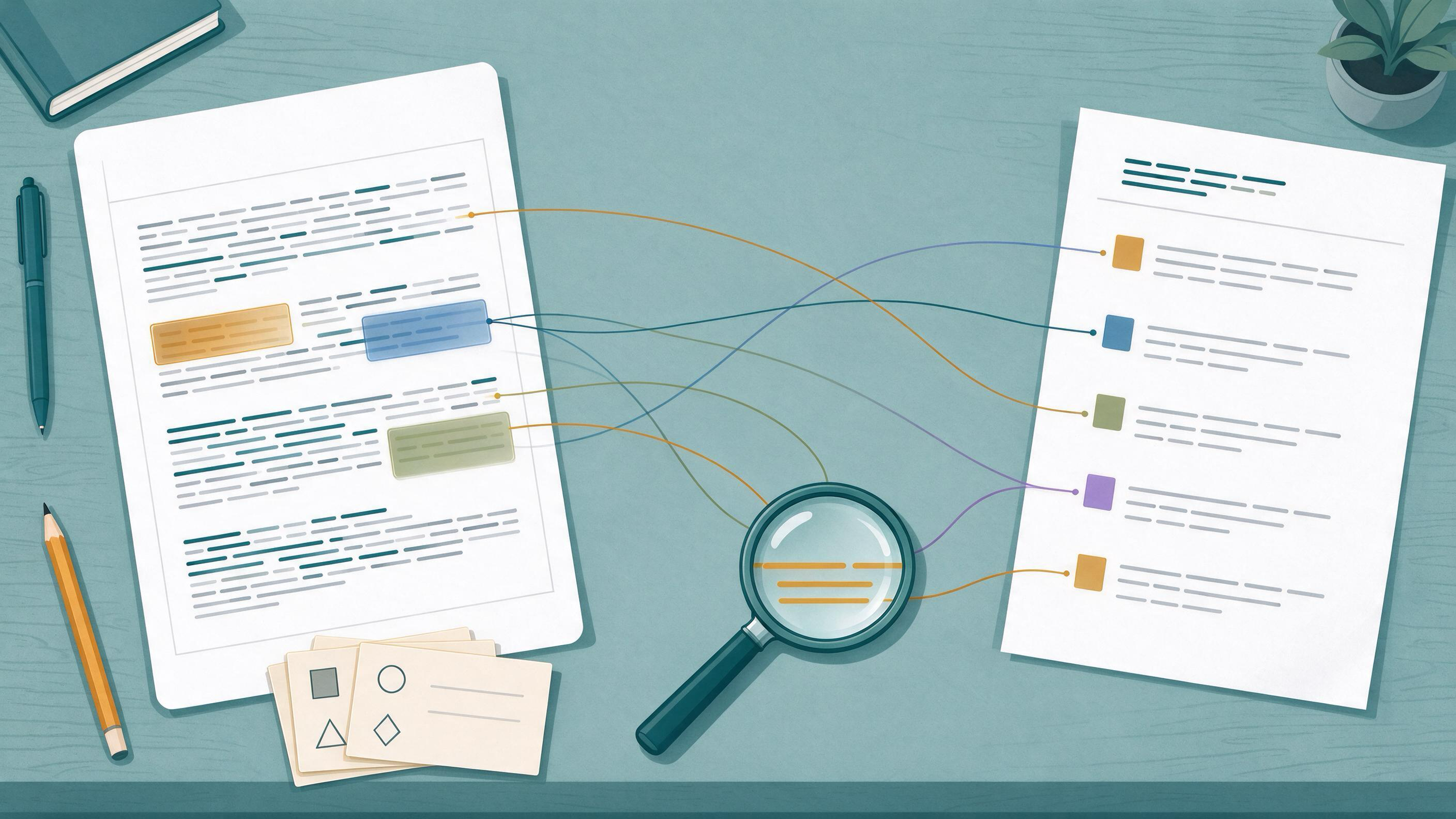
A citation-to-reference match is a one-to-one reconciliation: every in-text citation points to exactly one reference-list entry, and every reference-list entry is cited at least once. When that reconciliation is complete, a reader can move from any claim in the body to a specific, identifiable work and back again. The task is less about formatting than about identity: confirming that the work you cite is the work you list, and that the entry you list actually supports the sentence it sits beside.
This guide is written for clinicians and medical researchers assembling a focused evidence brief, a research update, or a team discussion document. It lays out a sequence with checkpoints, a worked example, a reusable checklist, and explicit completion criteria. It treats citation matching as a verification workflow rather than a proofreading pass.
Why does the match break in the first place?
Most mismatches are not typing errors. They come from three different failure modes that need different fixes.
Identity failures. Two papers share a similar title, or a preprint and its published version circulate under the same name. The in-text citation may be correct in isolation while the reference entry describes a different version of the work.
Coverage failures. A reference sits in the list but no sentence cites it, or a sentence cites a work that never made it into the list. These are structural gaps, not bibliographic errors.
Support failures. The citation and reference match perfectly, but the cited work does not actually support the claim in the sentence. This is the most consequential failure for an evidence brief, because it survives every formatting check.
Diagnosing which failure you face determines the order of work. Identity and coverage problems are mechanical and can be batched. Support problems require reading the cited work against the sentence, which is slower and should be reserved for claims that carry weight in your argument.
What should you have before you start matching?
Matching goes faster when three artifacts exist first. Building them is part of the task, not preparation for it.
- A frozen draft. Lock the body text before reconciliation. Every edit to a sentence can add or remove a citation, so matching against a moving draft wastes effort.
- A citation inventory. Extract every in-text citation in order of appearance, with the sentence it supports. A simple table with columns for location, citation, claim, and status is enough.
- A reference register. List every reference-list entry with its identifier and the bibliographic fields you will verify. Identifiers are the anchor for identity checks.
If your reference list was assembled from multiple sources or generated with assistance, the register should include a screening step. BibTeX citation screening is the specific job of TrueCite, which checks BibTeX against real academic databases to flag hallucinated references. Running that check before reconciliation means you are matching against entries that exist, rather than discovering phantom references midway through.
How do you verify that a reference identifies the right work?
Identity verification rests on identifiers and deposited metadata. A DOI can be resolved through doi.org to the current destination registered for that identifier. Resolution helps locate a work, but it does not by itself confirm that the bibliographic fields in your entry are correct, nor that the work supports your claim. Treat resolution as the first step, not the last.
Crossref exposes publisher-deposited scholarly metadata through its REST API, including titles, authors, venues, dates, identifiers, licenses, funding, ORCID and ROR identifiers, abstracts when deposited, and post-publication updates from trusted sources. That makes deposited metadata a strong reference point for checking titles, author lists, venues, and dates. Two cautions follow from how the data is described: abstracts appear only when deposited, and updates come from trusted sources, so a field may be absent or may have changed since you recorded it.
A practical identity check compares four fields against the deposited record: title, first author, venue, and year. If any of the four disagrees, resolve the discrepancy before moving on. Where a work has multiple versions, record which version you cite and make the reference entry reflect that choice consistently.
How do you find and confirm a work you only half-remember?
Partial references are common in early drafts: an author name, a rough title, a year. Google Scholar documents searching by author and title, date sorting and date limits, Cited by and Related articles, citation export, library access links, email alerts, and ways to locate alternative versions of a work. Those features support two distinct tasks: locating a candidate work, and then confirming you have the right one.
Use author-and-title search to generate candidates, then confirm identity through the identifier and deposited metadata as described above. Cited by and Related articles help when you are tracing a claim back to its origin, but they produce candidates rather than confirmations. Alternative-version lookup matters most when a conference paper and a journal article share a title.
For a focused search inside a scholarly interface, WisPaper search lets you find academic papers directly. Once you have candidates, save the ones you intend to cite into My Library so that your citation inventory and your source set stay aligned. Keeping the working set in one place prevents the common drift where a reference is edited in one document but not another.
What is the step-by-step reconciliation sequence?
Work in passes, and checkpoint after each one. Each pass catches a different class of failure.
Pass 1 — Forward map. Walk the body from the first sentence to the last. For each in-text citation, record the sentence, the claim type, and the reference entry it should point to. Mark any citation with no corresponding entry as a gap.
Pass 2 — Reverse map. Walk the reference list from top to bottom. For each entry, find at least one in-text citation. Mark any uncited entry as an orphan.
Pass 3 — Identity check. For every matched pair, verify title, first author, venue, and year against deposited metadata, and resolve the identifier. Record the verification date, since post-publication updates can change fields.
Pass 4 — Support check. For claims that carry weight in your brief, read the cited work and confirm it supports the sentence. Record the specific location in the source that supports the claim.
Pass 5 — Consistency check. Confirm that citation style, author-name forms, and version choices are uniform across the document.
Checkpoint after each pass: the count of gaps plus orphans should reach zero by the end of Pass 2, and every pair should carry an identity status by the end of Pass 3. Do not begin the support check while identity gaps remain, because you would be reading sources you may not end up citing.
Worked example: matching citations in a focused evidence brief
Consider a brief asking whether a specific care-delivery intervention improves a defined outcome in a defined population. The brief has a narrow scope: one population, one intervention, one outcome. That focus is what makes the matching tractable.
The draft. The body contains twelve in-text citations across six paragraphs. The reference list contains fourteen entries.
Pass 1 result. Eleven citations map cleanly to entries. One citation in the third paragraph has no matching entry — a gap. The author recalls the work but never added it to the list.
Pass 2 result. Two entries are never cited — orphans. One is a background paper the author read but did not use; the other is a duplicate of an entry already cited under a slightly different author form.
Pass 3 result. Of the twelve matched pairs, ten verify cleanly on title, first author, venue, and year. One has a year discrepancy, which turns out to be a preprint cited against a published version. One has a venue discrepancy, resolved by confirming the correct proceedings title.
Pass 4 result. The support check separates the claims by type. Background statements about the population are supported by the cited reviews. The central effectiveness claim is supported by a study in a different setting, which raises an applicability question the brief must address explicitly. A secondary claim about mechanism is supported only indirectly by the cited work.
Pass 5 result. Author-name forms are standardized, and the version choice for the preprint is recorded consistently in both the citation and the entry.
What the example teaches. The reconciliation produced four distinct outputs: a closed gap, two removed orphans, two corrected identity fields, and — most importantly — a set of judgments about how strongly each citation supports its sentence. The last output is what a reader of an evidence brief actually needs.
How do you judge whether a citation supports its claim?
Matching a citation to a reference is necessary but not sufficient. The support check asks a different question: does this work, in this population, with this design, support this sentence?
Keep four judgments separate, because collapsing them produces overclaiming.
Evidence level. What kind of study is this — and what does that design let you conclude? Record the design explicitly rather than ranking studies on a single ladder.
Applicability. Does the population, setting, and intervention in the cited work resemble those in your brief? A study in a different care setting may still be relevant, but the brief should say so.
Indirectness. Is the outcome in the cited work the same outcome your brief addresses, or a proxy for it? Indirectness is a property of the link between the evidence and your question, not a flaw in the study.
Limitations. What does the cited work itself acknowledge as a constraint on its findings? Limitations belong in the brief's characterization of the evidence, not buried in the reference list.
For a focused brief, the practical rule is to annotate each weight-bearing citation with these four judgments in your inventory. A citation that matches its reference but is indirect on outcome should be described as indirect in the sentence, not presented as direct support.
Where does a citation manager or assistant fit in the workflow?
Tools help most at the boundaries of the reconciliation: finding candidates, screening entries, and keeping the working set consistent. They help least in the middle, where the support judgment requires reading the source against your sentence.
When the brief grows into a longer research task — a literature review, an inspiration scan, or a reproduction effort — Scholar Agent supports those longer research tasks. For teams coordinating a shared reference set across a document, Research Projects provides a project area where the work can be organized. When you need to ask questions based on papers you have already uploaded to My Library or added from search results, Library QA supports that querying step.
A sensible division of labor: use search and screening tools to establish that each reference exists and identifies the right work; use your own reading to establish that each citation supports its sentence. The first is a database question. The second is an evidence question.
Reusable checklist for citation-to-reference matching
| Step | Action | Artifact produced | Pass condition |
|---|---|---|---|
| 1 | Freeze the draft | Locked body text | No edits during reconciliation |
| 2 | Build citation inventory | Table of location, citation, claim | Every in-text citation listed |
| 3 | Build reference register | Table of entries with identifiers | Every entry listed with identifier |
| 4 | Screen generated references | Screening result per entry | No phantom entries remain |
| 5 | Forward map | Gap list | Zero gaps |
| 6 | Reverse map | Orphan list | Zero orphans |
| 7 | Identity check | Verification status per pair | Title, author, venue, year confirmed |
| 8 | Support check | Evidence-level, applicability, indirectness, limitation notes | Every weight-bearing claim annotated |
| 9 | Consistency check | Style and version record | Uniform forms across document |
How do you know the match is complete?
The reconciliation is ready when all of the following hold:
- Every in-text citation resolves to exactly one reference-list entry, and every entry is cited at least once.
- Every matched pair has a confirmed identity on title, first author, venue, and year, with the identifier resolved and the verification date recorded.
- Every weight-bearing claim carries an annotation for evidence level, applicability, indirectness, and limitations.
- Version choices — preprint versus published, conference versus journal — are recorded once and applied consistently in both the citation and the entry.
- A second reader can move from any sentence to its source and from any entry back to its sentence without asking you a question.
That last criterion is the real test. Matching is complete when the document is navigable by someone who did not build it.
FAQs
Keep Reading

How to Narrow 100 Papers to the 20 You Actually Need
A hundred papers feels like progress until you have to defend a shortlist in front of a client, a decision committee, or the team picking up your work next quarter. The real task is not "read faster." It is deciding, in
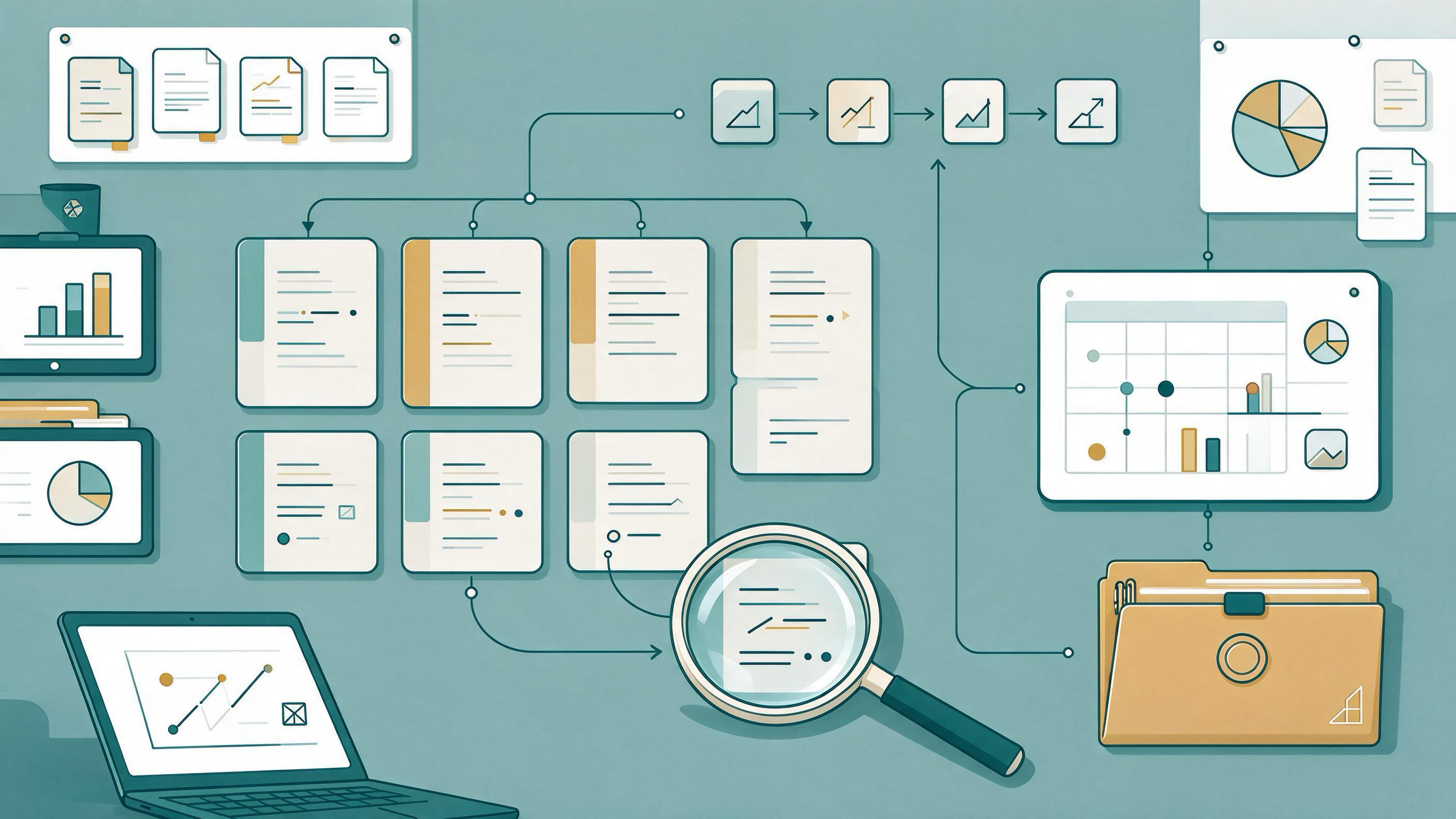
How to Organize PDFs for a Systematic Review
A systematic review's PDF folder is not a filing cabinet. It is the evidence base behind every number, table, and claim in the final report. If you cannot move from a sentence in your synthesis back to the exact PDF, pag
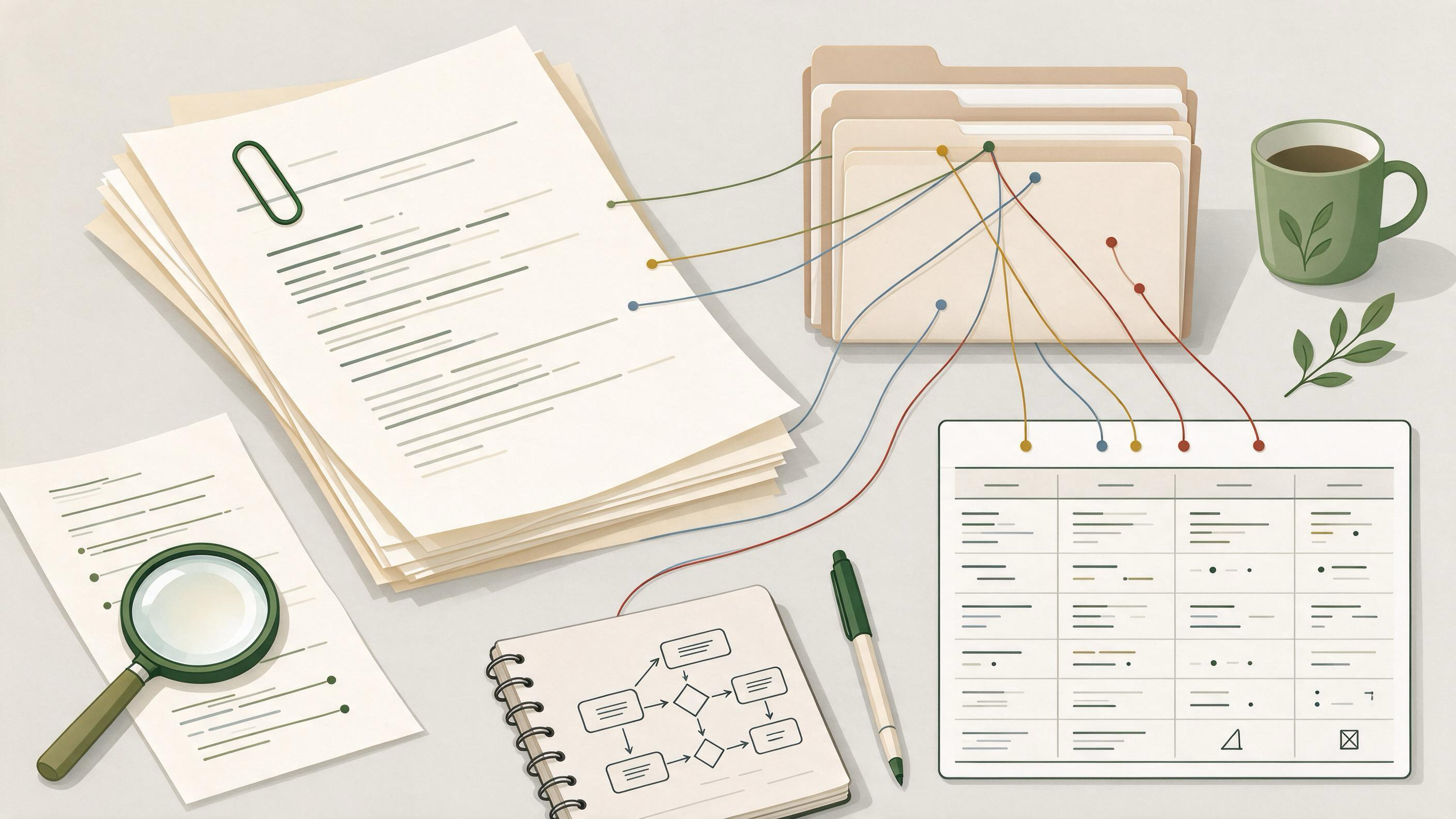
How to Prepare an Evidence Pack for Manuscript Submission
An evidence pack is the working dossier behind a manuscript's claims: the eligibility rules you set, the searches you ran, the records you screened, the studies you linked, the synthesis you built, and the limitations yo