
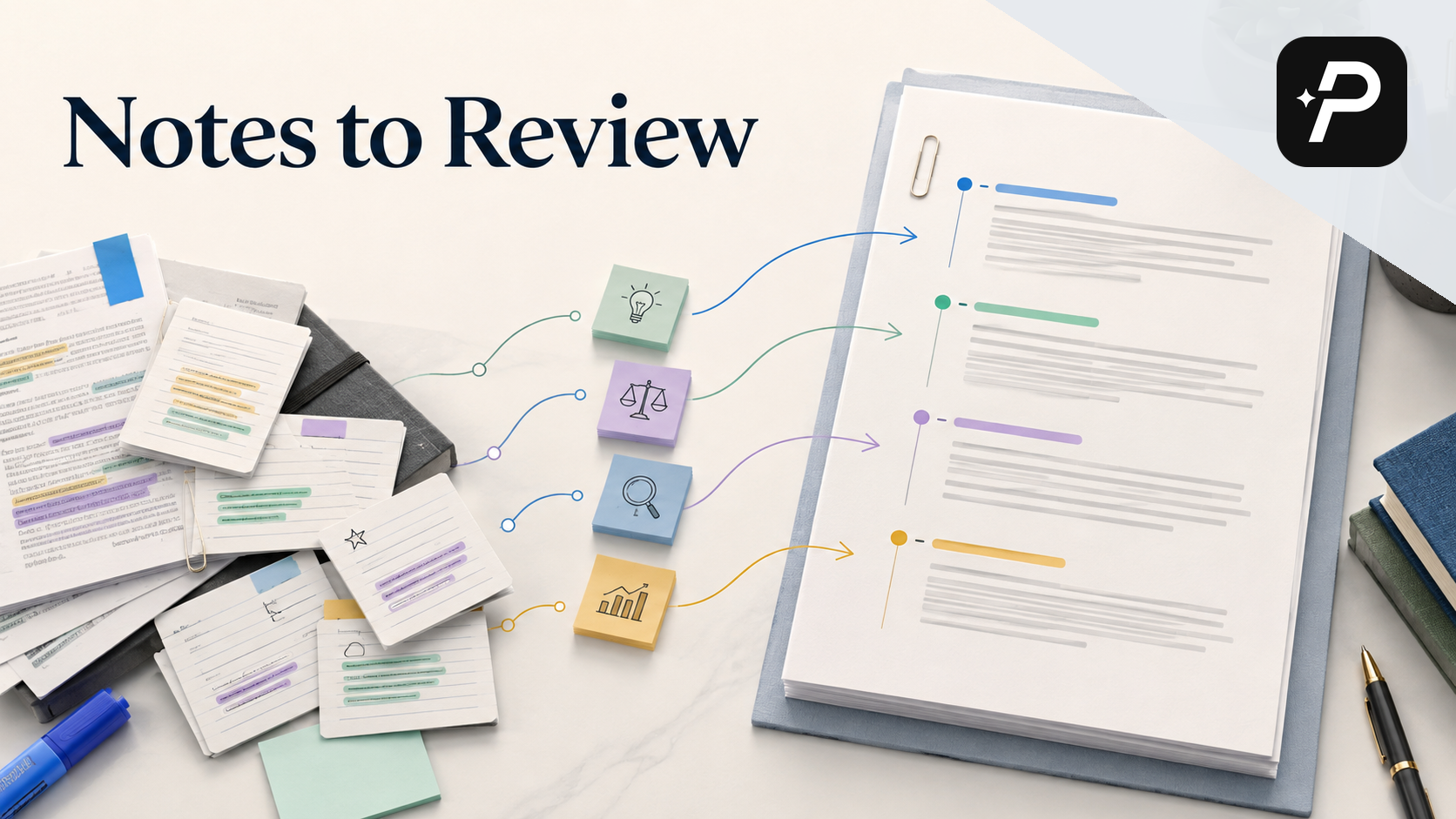
You have read twenty papers. You have highlighted key passages, jotted down definitions, and copied quotes into a document. Now you are staring at a blank page, wondering how to turn research notes into a literature review that actually flows.
This is the moment where most thesis writers stall. The notes exist, but they are organized by source, not by idea. The literature review, however, is organized by theme, debate, and research gap. Bridging that gap requires a deliberate sorting process.
This guide walks you through a practical workflow: sort your notes by claim, group them into thematic clusters, and then build paragraphs from the relationships between those claims. You will learn how to move from a pile of citations to a structured narrative that demonstrates your command of the field. If you need a separate bridge from note-taking to structure, use how to turn paper notes into an argument outline.
Why Your Current Notes Are Not Ready for Writing
If you took notes the traditional way—one document per paper, with summaries and quotes listed chronologically—you are facing a structural mismatch. Your notes are source-centric. A literature review is concept-centric.
When you try to write directly from source-centric notes, you end up with a "paper-by-paper" summary. Each paragraph starts with "Smith (2021) found..." and then "Jones (2019) argued..." This is an annotated bibliography in disguise, not a synthesis.
The problem is not your note-taking ability. The problem is that you have not yet reorganized the information around the questions your literature review must answer. Before you can turn research notes into a literature review, you need to break the source-based structure and rebuild it around themes.
Think of your notes as raw interview data. No researcher would write a findings chapter by listing each interviewee's answers one after another. They would code the data, group responses by theme, and then write about patterns. Your literature review deserves the same treatment.
Step 1: Define the Review's Guiding Question
Before sorting anything, you need a clear target. A literature review is not a summary of everything you read. It is an argument about the state of knowledge on a specific question.
Write your guiding question at the top of a fresh document. For example:
- "What do we know about the effectiveness of peer feedback in online writing courses?"
- "How has the concept of digital twin been operationalized in manufacturing research since 2015?"
This question becomes your sorting criterion. Every note you examine will be classified by how it helps answer this question. If a note does not relate to the question, set it aside. It might be useful for another section of your thesis, but it does not belong in this literature review.
If your research question feels too broad, use a tool like Inspiration Discovery to surface related angles and narrow your focus before you begin sorting. This prevents you from collecting notes that are tangential to your actual argument.
Step 2: Extract Claims, Not Only Facts
Go through your notes and identify the core claim of each source. A claim is not a topic ("social media and mental health"). It is a position ("passive scrolling correlates with lower well-being among adolescents, but active engagement does not show the same effect").
Write each claim on a separate index card, spreadsheet row, or note card in your reference manager. Include:
- The author and year
- The precise claim in your own words
- The evidence the author used to support it
- A page number or section marker if you plan to cite a specific passage
This step forces you to move from passive note-taking to active interpretation. You are no longer recording what the author said. You are extracting the argumentative core that will matter for your review.
If you have a large number of sources, you can use Library QA to ask questions about the papers you have saved in My Library. For example, you could ask, "Which of my saved papers discuss the difference between active and passive social media use?" This helps you locate the relevant claims without rereading every PDF.
Step 3: Sort Notes by Claim Similarity
Now you have a stack of claims. Your job is to group them by similarity. This is not about grouping by topic. It is about grouping by argumentative relationship.
You will find several common relationships:
- Agreement: Multiple authors make the same or very similar claims.
- Disagreement: Authors make contradictory claims about the same phenomenon.
- Extension: One author builds on another's work, adding a new variable or context.
- Methodological difference: Authors study the same question but use different methods, leading to different results.
- Chronological development: The claims show how thinking on the topic evolved over time.
Create clusters based on these relationships. You might end up with five to eight clusters for a typical thesis literature review. Each cluster will eventually become a section or a set of paragraphs in your review.
This is where the synthesis matrix method becomes useful. A synthesis matrix is a grid with sources on one axis and themes on the other. You fill in the cells with the specific claims each source makes about each theme. This visual layout helps you see which sources belong together and which themes are underdeveloped.
Step 4: Identify Gaps and Contradictions
As you sort, pay attention to what is missing. If you have a cluster where only one source makes a claim, that is a potential gap. If two sources directly contradict each other, that is a debate you must represent.
These gaps and contradictions are not problems. They are the raw material for your analytical voice. A literature review that only reports agreement is boring. A review that identifies a contradiction and explains why it exists demonstrates critical thinking.
For example, if Study A finds that gamification improves learning outcomes while Study B finds no effect, do more than report both results. Examine the differences in study design, participant populations, or outcome measures. Your review can argue that the contradiction stems from methodological variation, which then points to a need for more standardized research.
This step is also where you decide if you have enough sources. If a key theme has only one supporting source, you may need to search for more literature. Use Deep Search with a natural-language question like, "What evidence exists on the long-term effects of gamification in higher education?" to find additional peer-reviewed sources without constructing a complex Boolean query.
Step 5: Build a Working Outline from Your Clusters
Once your clusters are stable, arrange them into a logical order. There is no single correct order, but common patterns include:
- Broad to narrow: Start with general context, then move to specific debates.
- Chronological: Show how the field evolved over time.
- Methodological: Group studies by research approach.
- Problem-solution: Present the problem, then review solutions proposed in the literature.
For each cluster, write a one-sentence summary of the main argument that cluster will make. This sentence becomes your topic sentence for that section. For example:
- Cluster 1: "Early studies assumed a direct link between screen time and attention span, but this assumption was challenged by research that introduced moderating variables."
This outline is your roadmap. You now know exactly what each section of your literature review will argue before you write a single paragraph.
Step 6: Write Paragraphs from Evidence Relationships
Now you are ready to write. The key move is to structure each paragraph around the relationship between sources, not around a single source.
A strong literature review paragraph follows a pattern:
- Topic sentence: State the claim that this paragraph will establish.
- Evidence presentation: Present the sources that support, extend, or challenge this claim.
- Synthesis: Explain how the sources relate to each other.
- Critical commentary: Add your own assessment of the evidence.
- Transition: Link to the next paragraph or section.
Here is a condensed example:
The claim that formative feedback improves writing quality is well supported, but the mechanism remains contested. Hattie and Timperley (2007) argued that feedback effectiveness depends on the focus of the feedback, distinguishing between task-level and process-level comments. Subsequent studies extended this distinction to digital environments, where process-level feedback has been shown to reduce cognitive load during revision (Smith, 2019). However, a meta-analysis by Chen and Rossi (2022) found that the effect size of process-level feedback diminishes when students are novices, suggesting that prior knowledge moderates the relationship. This moderation effect has not been fully explored in peer feedback contexts, which is the gap this review addresses.
Notice that this paragraph is not about Hattie, or Smith, or Chen. It is about the relationship between their claims. The sources are the evidence, not the subject.
Step 7: Use Your Library to Verify and Expand
As you write, you will realize you need more detail from specific papers. This is where a well-organized library pays off.
If you have saved your sources in My Library, you can use Library QA to ask targeted questions about specific papers. For example, "What sample size did Chen and Rossi use in their meta-analysis?" or "What definition of process-level feedback did Hattie and Timperley use?" This saves you from scrolling through PDFs while you are in the middle of a writing flow.
You can also use this stage to verify that you have not misrepresented a source. A literature review is only as trustworthy as its citations. If you are unsure about a specific claim, go back to the original paper and check the exact wording before you finalize your paragraph.
Step 8: Review for Coherence and Flow
Once your draft is complete, read it as a continuous narrative. Do not read it as a series of isolated paragraphs. Ask yourself:
- Does each paragraph follow logically from the previous one?
- Have I repeated the same point in multiple sections?
- Is my own voice clear, or am I just reporting what others said?
- Does the review build toward a clear conclusion about the research gap?
This review stage is also where you should check for source overload. If you have too many citations crammed into a single paragraph, the reader loses track of the argument. Cut redundant citations and keep only the most representative sources for each claim.
If you are working with a supervisor, use the preparation strategies from a supervisor meeting workflow to get the most out of their feedback. Bring specific questions about structure and argument, rather than a request for general comments.
Common Mistakes to Avoid
Mistake 1: Writing a summary instead of a synthesis. If your paragraph would work just as well if you removed the citations, you are not synthesizing. You are summarizing.
Mistake 2: Letting the sources drive the structure. Your outline should be based on themes and claims, not on the order you read the papers.
Mistake 3: Ignoring contradictions. If two sources disagree, do not hide it. The disagreement is often the most interesting part of your review.
Mistake 4: Saving all your analysis for the conclusion. Your analytical voice should be present in every paragraph, not only at the end.
Mistake 5: Over-citing. A paragraph with eight citations is not better than a paragraph with three. Choose the most relevant sources and discuss them in depth.
How AI Tools Fit Into This Workflow
AI tools can accelerate parts of this process, but they cannot replace your judgment.
Use AI for the mechanical parts: finding sources, organizing notes, and drafting initial summaries. Use your own brain for the analytical parts: deciding which claims matter, identifying contradictions, and building the argument.
When you use AI, be transparent about how you used it. If you use AI to generate a draft paragraph, you are responsible for verifying the citations and checking for accuracy. AI can hallucinate sources or misrepresent findings, so every claim must be checked against the original paper.
For a safer workflow, use AI tools that are grounded in your own library. This reduces the risk of fabricated citations because the AI is working from papers you have already saved and verified.
From Notes to Review: A Recursive Process
Turning research notes into a literature review is not a linear process. You will likely move back and forth between sorting, outlining, writing, and searching for additional sources. This recursion is normal.
If you find that your clusters do not hold together when you start writing, go back to the sorting stage. If you discover a new theme while writing, search for additional sources to support it. The goal is not to follow the steps perfectly. The goal is to produce a review that demonstrates your understanding of the field.
The most important shift is mental: stop thinking of your literature review as a report on what you read, and start thinking of it as an argument you are building from evidence. Your notes are the raw material. The review is the structure you create from that material.
FAQ
How long does it take to turn research notes into a literature review?
The time depends on the number of sources and the complexity of your topic. A typical thesis literature review with 30–50 sources can take two to four weeks of focused work. The sorting and outlining stage often takes longer than the actual writing.
Can I use AI to write my literature review for me?
You can use AI to assist with drafting, but you should not rely on it to produce the final review. AI-generated text may contain inaccuracies, and the analytical voice must be your own. Use AI for organizing notes and drafting summaries, then revise heavily.
What is the difference between a synthesis matrix and an outline?
A synthesis matrix is a visual tool for sorting sources by theme. An outline is a structural plan for your written review. You use the matrix to build the outline.
How do I know if I have enough sources for a literature review?
You have enough sources when your clusters are saturated, meaning new sources no longer add new claims or perspectives. If you find that every new paper you read fits into an existing cluster without changing your argument, you are ready to write.
Should I include every paper I read in the literature review?
No. Your literature review should include only the sources that are directly relevant to your argument. If a paper is tangential, mention it in passing or leave it out entirely. A focused review is stronger than a comprehensive one.
How do I handle sources that disagree with each other?
Present the disagreement honestly. Explain the differences in methods, contexts, or assumptions that might account for the conflicting results. Then state which position you find more convincing and why. This demonstrates critical engagement with the literature.
FAQs
Keep Reading
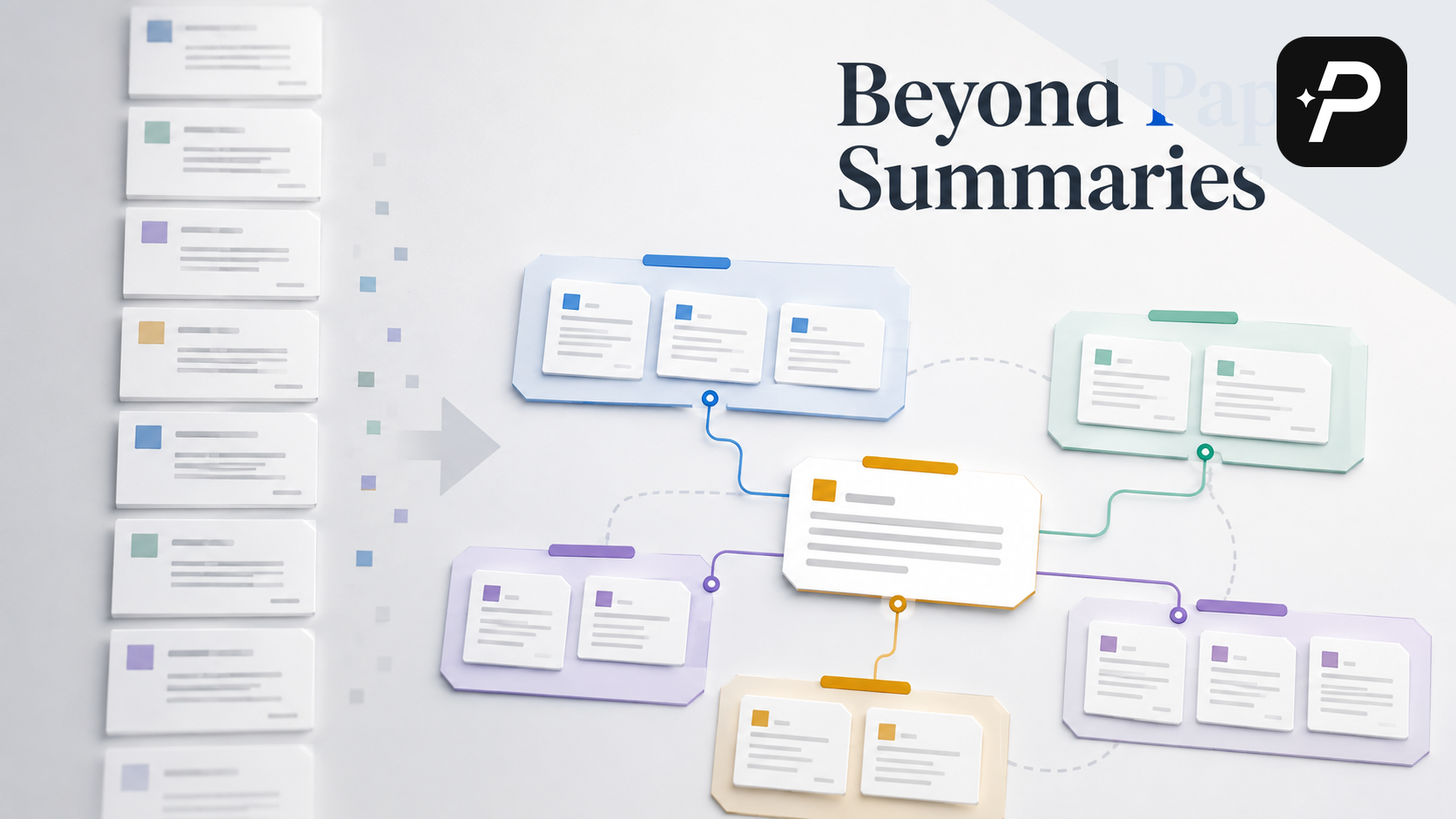
Why Your Literature Review Feels Like a List of Paper Summaries
You have read the papers. You have taken notes. And now your literature review draft reads like a sequence of book reports: "Smith (2021) found that... Jones (2022) argued that... Patel (2023) concluded that..." If this

What to Do When Research Papers Disagree With Each Other
You found twelve papers that seem perfect for your literature review. Then you read them closely and two report opposite findings. One says the intervention improves outcomes; the other says it makes no difference. A thi

How to Connect Multiple Academic Sources Into One Argument
You have read twenty papers, highlighted dozens of passages, and collected enough notes to fill a small notebook. Now comes the hard part: turning that pile into a single, coherent argument. The task is to connect multip