
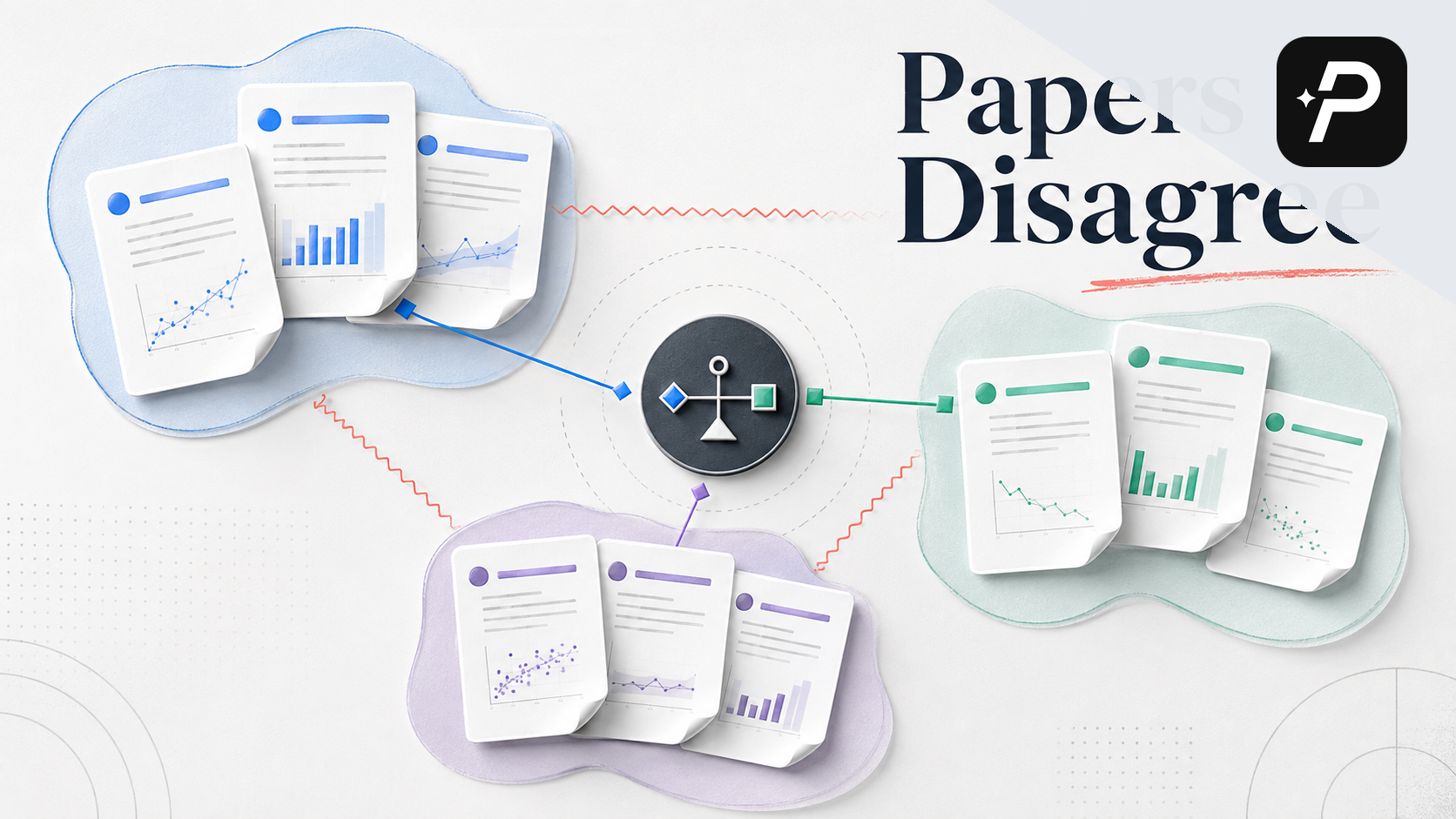
You found twelve papers that seem perfect for your literature review. Then you read them closely and two report opposite findings. One says the intervention improves outcomes; the other says it makes no difference. A third paper sits somewhere in the middle.
This is not a sign that you did something wrong. Disagreement is a normal part of science. But when you are a student or early-stage researcher, conflicting studies can feel like a roadblock. You might be tempted to ignore the papers that do not fit your argument, or to present only the side that supports your hypothesis.
There is a better path. When research papers disagree, you have a chance to demonstrate deeper thinking. You can turn a frustrating contradiction into the most interesting section of your literature review. This article walks through a practical workflow for diagnosing why papers conflict, writing about disagreement honestly, and using AI-assisted tools to manage the process without losing your own voice.
Why Research Papers Disagree
Disagreement is built into the scientific process. Studies are not failed copies of each other; they are individual experiments conducted under specific conditions. When research papers disagree, the cause is often mundane rather than mysterious.
The most common reasons:
- Different populations. A study on university students in Sweden may not replicate with working adults in Japan. Age, culture, socioeconomic status, and baseline health all shape outcomes.
- Different measurement tools. One paper measures anxiety with a self-report scale; another uses a physiological marker. These tools capture different aspects of the same concept.
- Different time frames. A two-week follow-up can show benefits that disappear at six months, or the reverse.
- Different statistical choices. Adjusting for different confounders, using different cutoffs, or choosing different analysis methods can flip a result.
- Publication bias. Journals favor positive results, so null findings are less likely to be published. This makes the literature look more conflicted than the underlying evidence actually is.
When you see conflicting studies, your first job is not to pick a winner. Your first job is to investigate why the results differ. That investigation is the heart of a strong synthesis.
Treat Disagreement as a Synthesis Opportunity, Not a Problem
The biggest mistake students make is treating conflicting evidence as a threat to their thesis. They worry that a contradictory paper will make their argument look weak. In reality, the opposite is true.
A literature review that presents only one side reads as naive. A review that acknowledges disagreement and explains it reads as sophisticated. When research papers disagree, you have the raw material for a nuanced discussion. You can show your reader that you understand the complexity of the field, that you can evaluate methodology, and that you can draw reasoned conclusions from imperfect evidence.
Think of your literature review as a conversation between studies. Your job is to be the moderator. You do not need to force all the speakers to agree. You need to help the reader understand where the conversation stands, why there are different voices, and what this means for future research.
This mindset shift matters. If you approach disagreement as a problem to hide, you will write a shallow review. If you approach it as an opportunity to synthesize, you will write a review that stands out.
Step 1: Map the Disagreement Before You Write
Do not start writing about the conflict until you understand its shape. Begin by laying out the papers side by side. For each paper, note the following:
- The research question or hypothesis
- The population studied
- The intervention or exposure
- The outcome measured
- The measurement tool
- The time frame
- The main finding
You can do this in a simple spreadsheet or a synthesis matrix for a literature review. A synthesis matrix helps you see patterns across studies. When you place conflicting papers in adjacent columns, the differences become obvious. You might notice that all the positive studies used one measurement tool, or that the negative studies all had shorter follow-up periods.
If you are working with a large set of papers, consider using a tool that can help you organize them. WisPaper lets you save papers to My Library and ask Library QA questions about the papers you have collected. You can ask something like, "What populations were studied in the papers that reported positive effects?" This can speed up your mapping process.
Step 2: Diagnose the Source of the Conflict
Once you have mapped the papers, ask yourself: Why do these studies disagree? Work through the possible explanations systematically.
Methodological differences are the most common source. Look at the study designs. Was one a randomized controlled trial and the other a cross-sectional survey? Were the sample sizes very different? A small study may have been underpowered to detect an effect, while a larger study found a small but real effect.
Conceptual differences matter too. Did the papers define the key variable differently? For example, "social media use" could mean total daily minutes, frequency of checking, or passive scrolling versus active posting. These are different constructs with different effects.
Contextual differences include the setting, the time period, and the cultural background. A study conducted during a pandemic may not generalize to normal times. A study in a high-income country may not apply to a low-income setting.
Statistical and analytical choices are often overlooked. Did one paper adjust for baseline differences while the other did not? Did one use a per-protocol analysis and the other an intention-to-treat analysis? These choices can change the result.
Write down your diagnosis for each pair or group of conflicting papers. This will become the backbone of your discussion section.
Step 3: Look for the Middle Ground
Sometimes research papers disagree because they are measuring different parts of the same phenomenon. The conflict is more apparent than real.
For example, one paper might find that a teaching method improves test scores, while another finds no effect on long-term retention. These findings do not actually contradict each other. The method may genuinely help students perform well on immediate tests without improving durable learning. The disagreement is a matter of outcome selection.
When you find this kind of apparent conflict, you can resolve it by identifying the conditions under which each finding holds. This is called boundary finding. You are not saying one paper is right and the other is wrong. You are saying that the effect depends on the context.
This is a powerful move in a literature review. It shows that you can think beyond individual studies and see the bigger picture. It also sets you up to identify research gaps, because you can point out that no single study has tested the effect across all the relevant conditions.
Step 4: Use AI Tools to Explore Conflicting Evidence
You do not have to do this alone. AI-assisted research tools can help you navigate disagreement, but you need to use them with care.
WisPaper's Deep Search can help you find more papers that address the same question. If your initial search returned conflicting results, you may not have found all the relevant studies. Use a natural-language research question to broaden your search. For example, instead of typing a long Boolean string, you can ask, "What factors influence the effectiveness of mindfulness-based stress reduction in university students?" Deep Search can surface studies you might have missed.
The Scholar Agent can help you explore research questions and paper directions inside the search workflow. If you are stuck on why two papers disagree, you can use it to brainstorm possible explanations or to find papers that cite both conflicting studies.
When you find a paper that seems to resolve a conflict, look at how it discusses the earlier literature. Authors often explain why their findings differ from previous work. These explanations are gold for your own review.
A word of caution: AI tools can help you find and organize evidence, but they cannot tell you which paper is "better." That judgment requires your own critical thinking. Use AI to expand your view, not to replace your analysis.
Step 5: Write About the Disagreement Honestly
Now you are ready to write. The way you present conflicting evidence will shape how your reader perceives your credibility.
Do not hide the conflict. If two papers disagree, mention both. If you only cite the paper that supports your argument, a knowledgeable reader will notice. They may also check your sources and find that you omitted relevant work. This damages your credibility.
Do not overstate the conflict. Some students go to the opposite extreme and describe the literature as "divided" or "contradictory" when the disagreement is actually minor. Be precise. If the studies mostly agree but differ in effect size, say that. If they agree on direction but not on magnitude, say that.
Use hedging language. Phrases like "may," "suggests," "appears to," and "under certain conditions" are not weak. They are accurate. They signal that you understand the provisional nature of scientific evidence.
Structure your discussion around the diagnosis. For example:
"Although Smith et al. found a significant effect of the intervention on anxiety, this result may be explained by the use of a self-report measure and a two-week follow-up. In contrast, Jones et al., who used a clinician-administered assessment and a six-month follow-up, found no sustained effect. These findings suggest that the intervention may produce short-term improvements in perceived anxiety without altering longer-term clinical outcomes."
This paragraph does three things: it presents both findings, it explains why they differ, and it offers a synthesis. That is exactly what a strong literature review does.
Step 6: Use the Disagreement to Define Research Gaps
Conflicting evidence is a gift for your research gap section. If the literature is genuinely divided, then there is a clear need for more research.
Ask yourself: What would it take to resolve this disagreement? The answer might be a study with a larger sample, a standardized measurement tool, a longer follow-up, or a more diverse population. Whatever it is, you have just identified a research gap.
This is a natural transition in your review. After you have discussed the conflicting studies and explained why they differ, you can say something like:
"The divergent findings reviewed above highlight the need for studies that use consistent outcome measures and longer follow-up periods to clarify the conditions under which the intervention is effective."
This sentence turns a problem into a contribution. You are interpreting the literature rather than only summarizing it.
If you want to develop this gap further, you can use tools designed to find research gaps with AI. These tools can help you articulate the gap in a way that is specific and researchable.
Step 7: Decide When a Paper Should Be Excluded
Not every paper deserves a place in your review. Sometimes research papers disagree because one of them is simply weak. You are allowed to exclude studies that are methodologically flawed, but you must do so transparently.
If you exclude a paper because of a small sample size, a lack of a control group, or a flawed measurement approach, say so in your methods section. This is different from ignoring a paper because it contradicts your hypothesis. The first is a legitimate screening decision; the second is bias.
When you are deciding whether to exclude a paper, consider its quality, relevance, and contribution. A paper can be methodologically sound but irrelevant to your specific question. A paper can be relevant but too weak to include. Document your reasoning.
If you are working with a large set of papers and are unsure where to draw the line, you may find it helpful to read about when to stop screening in an AI-assisted review. The same principles apply to deciding which papers to include in your synthesis.
Step 8: Build an Evidence Map to Visualize the Conflict
Sometimes the disagreement is not between two papers but across a whole body of literature. In that case, an evidence map can help you see the pattern.
An evidence map for a literature review is a visual representation of what is known, what is uncertain, and what is unknown. You can plot studies by population, outcome, or study design. When you see the map, the source of the disagreement often becomes clear.
For example, you might notice that all the studies with positive findings were conducted in clinical settings, while all the null findings came from community samples. This pattern would not be obvious from reading the papers one by one. The map reveals it.
You can create an evidence map by hand or use a tool that helps you organize papers into themes. The goal is to see the structure of the evidence, not only the individual studies.
Final Thoughts: Disagreement Is a Feature, Not a Bug
When research papers disagree, you have a choice. You can treat the conflict as an obstacle, or you can treat it as an invitation to think more deeply. The best literature reviews are not the ones where every study agrees. They are the ones where the author explains the complexity of the evidence with clarity and honesty.
As a student or early-stage researcher, you are not expected to resolve every scientific debate. You are expected to understand the debate, explain it, and contribute to it. When you write about conflicting studies with confidence and precision, you demonstrate that you are ready to join the scholarly conversation.
So the next time you find two papers that contradict each other, do not panic. Map the disagreement, diagnose its source, and write about it with care. That is what a mature researcher does. And with the right tools and mindset, you can do it too.
FAQs
Keep Reading

How to Connect Multiple Academic Sources Into One Argument
You have read twenty papers, highlighted dozens of passages, and collected enough notes to fill a small notebook. Now comes the hard part: turning that pile into a single, coherent argument. The task is to connect multip
How to Write a Literature Review Faster Without Cutting Corners
A literature review can consume weeks of your research timeline. You collect dozens of PDFs, read them, take notes, and then realize you cannot remember which paper said what. The writing itself becomes a second research

Can AI Find Academic Sources You Can Actually Cite?
You have a thesis due in eight weeks. You type a research question into ChatGPT or Perplexity, and within seconds the chatbot hands you a list of references with authors, journals, and years attached. It feels like a sup