
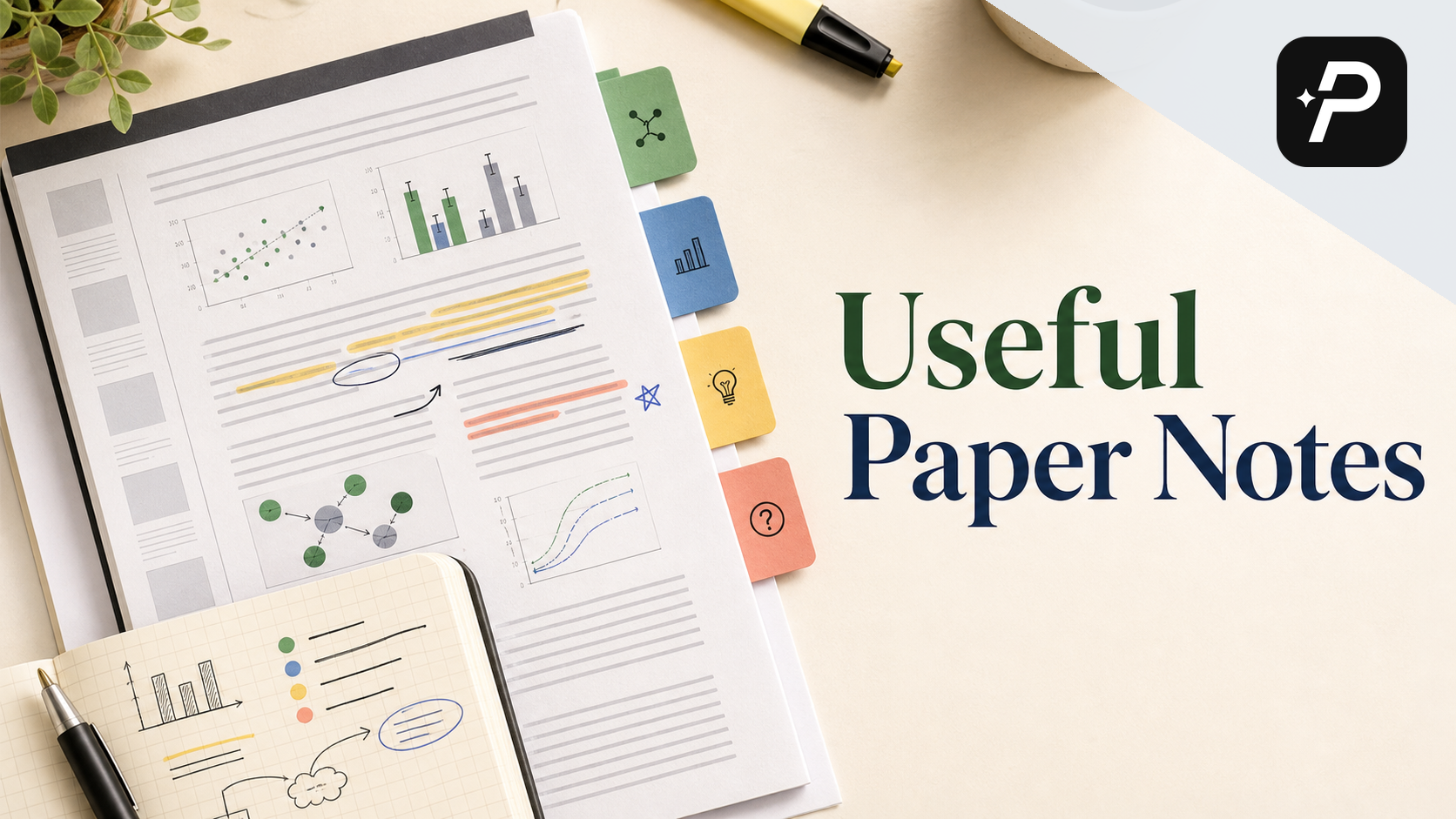
Most note-taking fails because it happens too late, captures the wrong details, or produces files you never open again. You read a paper, highlight a few sentences, and close the PDF. A week later, you cannot remember why the paper mattered or how it connects to your argument.
The goal is not to record everything. The goal is to build a personal map of each paper's logic so you can write faster and think more clearly. This guide walks through a practical workflow for taking notes from research papers—from the first read to the final draft of your literature review.
Why Most Research Paper Notes Fail
The most common mistake is treating note-taking as a transcription exercise. You copy abstracts, paste long quotes, and save the PDF. This creates what researchers sometimes call the illusion of understanding. You feel productive because you have highlighted text, but you have not processed the paper's argument.
Another failure pattern is note-taking without a destination. If you do not know how you will use the notes—for a thesis chapter, a seminar discussion, or a systematic review—you will capture everything and synthesize nothing. This leads to source overload, where you spend more time managing references than understanding them. If that is already happening, it helps to reset your intake process with a workflow for how to avoid source overload in a literature review before you keep adding papers.
Many students also take notes in isolation. They write summaries of Paper A, then Paper B, but never compare them. The notes become a pile of disconnected paragraphs instead of a conversation between sources. Useful notes always point forward to your own writing task.
What Makes Notes Useful for Your Research
Useful notes reduce your future workload. They let you answer three questions without reopening the PDF:
- What did this paper claim?
- How did the authors support that claim?
- What does this mean for my project?
If your notes cannot answer those questions, they are storage, not notes. Storage has a place—your reference manager holds the full text—but your active notes should be a compressed, structured version of the paper's logic.
For thesis writers, useful notes also include traceability. You need to know where a claim came from, which page or section supports it, and whether you are looking at the authors' words or your interpretation. This prevents accidental misattribution when you write.
Useful notes are also portable. They should work whether you are reading on a screen, in a library, or using an AI-assisted research tool. The format matters less than the consistency of your system.
The Core Principle: Notes Should Mirror the Paper's Logic
A research paper is not a block of text. It is an argument with identifiable parts. Your notes should mirror those parts so you can reconstruct the argument later.
Most empirical papers follow a predictable structure:
- Claim—what the authors argue
- Evidence—data, experiments, or sources they use
- Method—how they collected or analyzed the evidence
- Limitations—what they admit they cannot show
- Contribution—what they add to the field
Organize your notes around these five elements. This structure forces you to identify the paper's skeleton rather than its surface. It also creates a template you can apply to every paper, making comparison easier.
A note that says "This paper studies social media and anxiety" is weak. A note that says "Claims: passive scrolling increases anxiety. Evidence: longitudinal survey of 1,200 teens. Method: self-report scales. Limitation: no causal inference. Contribution: first study to separate active vs. passive use" is useful.
A Practical Note-Taking Template for Research Papers
You can use a simple template to take notes from research papers consistently. Write one template per paper, and keep all templates in the same place—a folder, a database, or a tool like WisPaper's My Library.
Here is a template that works for most disciplines:
Paper ID and Citation
Full citation, DOI or link, and the date you read it.
Claim (2–3 sentences)
What is the central argument? Write it in your own words.
Evidence (bullet points)
What data or sources support the claim? Include key numbers or findings.
Method (short paragraph)
How was the study conducted? What was the sample, setting, or analytical approach?
Limitations (bullet points)
What do the authors admit, or what do you suspect, they cannot address?
Use in My Paper (2–3 sentences)
Where might this fit in your argument? Which section, which counterargument, which gap?
Quotes to Keep (with page numbers)
Only include quotes you might actually use in writing.
This template is deliberately short. If you write more than one page per paper, you are probably copying rather than thinking. The act of compressing the paper into this structure is what creates understanding.
How to Read a Paper Before You Take Notes
Do not take notes on the first pass. Read the paper once to get the gist, then take notes on the second pass. This two-pass approach prevents you from writing down details that become irrelevant once you understand the whole argument.
First pass (5–10 minutes): Read the title, abstract, the introduction's last paragraph (where authors usually state their claim), and the conclusion. Skim the headings and look at any figures or tables. Write down, in one sentence, what you think the paper is about.
Second pass (30–60 minutes): Read the full paper with your template open. Now you know where the argument is going, so you can identify the claim, evidence, method, and limitations as you read. Fill in your template section by section.
Third pass (optional): Return to specific sections when you need precise details, such as a statistic for your literature review or a methodological detail for your methods chapter.
This workflow is especially helpful when you are building a reading queue for a new research topic. You can quickly screen papers in the first pass and only take full notes on the ones that survive your criteria. For a fuller version of that intake stage, use a guide on how to build a reading queue for a new research topic before you start taking detailed notes.
What to Capture: Claims, Evidence, Method, and Limitations
Each template element requires a different kind of attention.
Claims are the authors' answers to their research question. Capture them in your own words. If you cannot paraphrase a claim, you probably do not understand it. Avoid copying the abstract's first sentence. Instead, identify the specific assertion the paper defends.
Evidence is the support for the claim. For empirical papers, this includes sample sizes, effect sizes, or qualitative themes. For theoretical papers, evidence might be the key examples or logical steps. Record enough detail to evaluate the evidence's strength, but not so much that you recreate the results section.
Method matters because it tells you how much to trust the evidence. Note the research design—experiment, survey, case study, meta-analysis—the sample, and the main analytical technique. If you are writing a thesis with a methods chapter, these notes become a shortcut for comparing methodological approaches across sources.
Limitations are the most under-captured element. Authors usually state limitations in the discussion section, often in the final paragraphs. Write down what the authors admit they cannot claim. Also note any limitations you suspect that the authors did not mention. These are often the seeds of your own research questions.
How to Record Your Own Reactions and Connections
Your notes should include your voice as well as the paper's. After you capture the paper's logic, add a short section for your own reactions. This is where you note agreements, disagreements, confusions, and connections to other papers.
This step separates a summary from a research note. A summary tells you what the paper says. A research note tells you what you think about what the paper says. The latter is what you need when you sit down to write.
Useful prompts for your reactions:
- "This reminds me of [Paper X] because..."
- "The authors assume [something], but what if..."
- "This contradicts [a claim from another paper]."
- "I could use this evidence in my [specific section]."
- "I do not understand why they chose [method]."
These reactions become the raw material for your argument outline. When you later turn paper notes into an argument outline, you will not start from scratch. You will have already identified the connections and tensions between sources.
Managing Notes Across Many Papers
Individual paper notes are only half the system. The other half is how you manage notes across many papers. This is where most students struggle, especially when they have 20 or 30 papers to read for a literature review.
Use one system, not many. Pick a single place for your notes. This could be a folder of Markdown files, a note-taking app, or WisPaper's My Library, where you can save papers and keep notes attached to each source. Switching between systems creates friction, and friction kills consistency.
Create a master index. When you take notes from research papers, add tags or keywords for themes, methods, and findings. For example, tag a paper as "#qualitative," "#education," and "#intervention." Later, when you need to find all qualitative studies on education interventions, you can pull them up in seconds.
Write a synthesis note after every 5–7 papers. A synthesis note is a short document where you compare the papers you have just read. What do they agree on? Where do they conflict? What gaps remain? This prevents source overload and keeps your reading connected to your writing.
Review your notes before you write. Before drafting a section of your thesis or literature review, spend 10 minutes re-reading your notes and your synthesis notes. This refreshes your memory and helps you see the structure of your argument.
Using AI Tools Without Losing Your Own Thinking
AI research tools can help you take notes from research papers more efficiently, but they should not replace your own processing. WisPaper's Deep Search can find academic literature using a natural-language research question, and Scholar Agent can help you explore research directions. Paper cards show source labels, summaries, and publication details, which speeds up screening.
The template above is still your responsibility. An AI can summarize a paper's abstract, but it cannot tell you how that paper fits into your specific argument. Use AI to find and screen papers, then use your own template to capture the logic.
One practical workflow is to use AI to generate a first draft of your notes, then edit them critically. Ask the AI tool to identify the claim, evidence, method, and limitations. Then check the AI's output against the actual paper. This gives you a starting point while forcing you to engage with the source.
A word of caution: AI summaries can miss nuance, especially in theoretical or methodological papers. Always verify the AI's claims against the original text, especially for quotes you plan to use. And never outsource your reactions—those are the most valuable part of your notes.
Turning Notes Into Writing: The Next Step
The real test of your note-taking system is how easily you can write from it. If you have followed the template above, you already have the skeleton of a literature review or a related-work section.
When you sit down to write, group your notes by theme or argument. For each theme, look at the claims and evidence across papers. Where do they support each other? Where do they conflict? These patterns become your paragraphs.
Your notes' "Use in My Paper" section tells you where each source fits. Your reactions tell you what to say about each source. Your synthesis notes tell you how the sources relate to each other.
If you want a structured method for this step, see our guide on how to turn paper notes into an argument outline. That guide takes you from a pile of paper notes to a coherent outline you can draft from.
Common Note-Taking Mistakes to Avoid
Even with a good system, certain habits undermine your efforts.
Copying instead of paraphrasing. If your notes look like the paper, you have not processed it. Force yourself to write from memory, then check.
Saving everything. You do not need notes on every paper you read. For papers that are only tangentially related, a one-line note with the citation is enough.
Ignoring limitations. Limitations are where you find research gaps. Skipping them means missing opportunities for your own contribution.
No connection to your writing task. If your notes do not say how the paper helps you, you will struggle to use them later. Always write the "Use in My Paper" section.
Forgetting to review. Notes you never re-read are as useless as papers you never read. Schedule a review before major writing sessions.
FAQs
Keep Reading

How to Find the Main Finding of a Research Paper Quickly
You have a stack of papers for your literature review, a seminar discussion tomorrow, and no time to read every word of every study. The main finding of a research paper is usually buried under methodology, jargon, and b

Is This Paper Relevant to Your Topic? How to Decide
You have a PDF open, a highlighter ready, and a creeping doubt. The paper is well-written and the title looks promising, but you cannot tell if it actually belongs in your literature review or annotated bibliography. The

How to Read 20 Research Papers Without Losing Track
You have fifteen PDFs open, another five waiting in a folder, and a vague memory that one of them contained a definition you needed. The problem is not that you read slowly. It is that nothing outside your head is keepin