
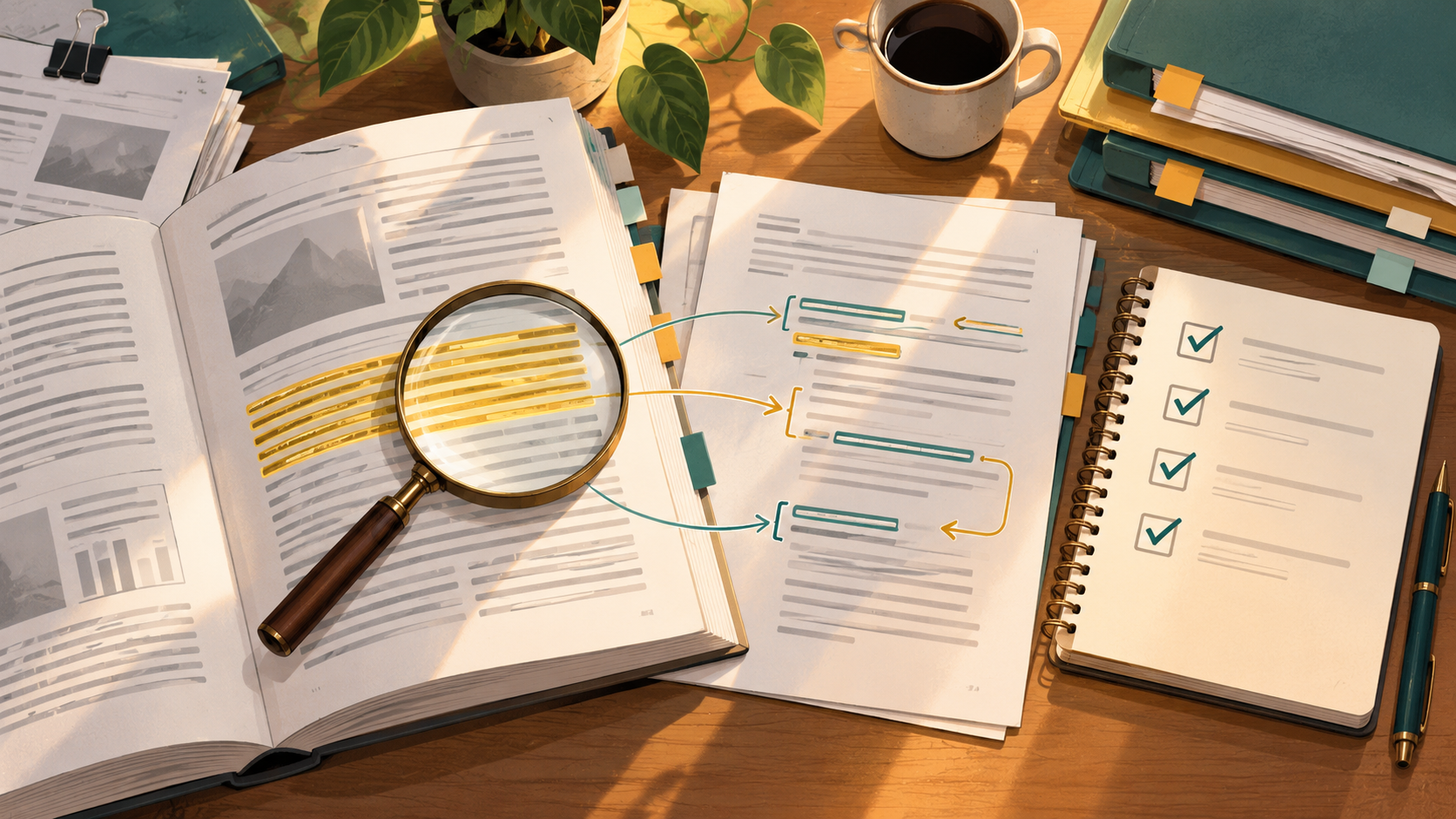
A quotation or paraphrase is verified when you have located the source passage in the original work, read it in its surrounding context, recorded where it sits (page or section), and confirmed that the words you plan to reuse carry the same meaning and qualifiers as the source. Verification is a sequence, not a single glance: each step produces a checkpoint you can record, so a co-author or reviewer can retrace your path.
This guide gives that sequence for manuscript drafting, peer review, revision, and grant evidence summaries. It assumes you already have a candidate source and a sentence that depends on it. The goal is an auditable trail: identifier, location, passage, and a short note on what changed, if anything.
Step 1: Pin the source identity before reading for meaning
Start with the identifier, not the sentence. A DOI resolves through doi.org to the current destination registered for that identifier, which helps you locate the work. Resolution alone is not verification: bibliographic fields and the source text still need to be checked for identity and claim support.
Record the DOI, title, authors, venue, and date as they appear at the resolved destination. If you are working from a reference list rather than a resolved link, Crossref's REST API exposes publisher-deposited metadata including titles, authors, venues, dates, identifiers, licenses, funding, ORCID and ROR identifiers, abstracts when deposited, and post-publication updates from trusted sources. That metadata is useful for confirming you have the right record, but an abstract is not the passage you will quote.
Checkpoint 1: You can state the DOI and the exact title, and they match the reference you intend to cite. If the resolved destination shows a different title or a correction notice, stop and resolve the discrepancy before continuing.
If you do not yet have the paper in hand, use a scholarly search interface to locate it, then move the PDF into an organized library so the version you verified stays fixed. WisPaper's scholarly search is one entry point for finding papers, and My Library is where you can save or upload papers and organize them. Keeping the verified copy in one place prevents the common failure of re-verifying against a different version later.
Step 2: Locate the passage, not just the paper
Finding the paper is the easy half. The passage must be found in the body text, and you should note whether it appears in the abstract, introduction, results, discussion, methods, a figure caption, or supplementary material. Each location carries different weight for a claim.
Use the search function of your PDF reader for a distinctive phrase, then read at least the full paragraph before and after the hit. If the phrase appears in a section heading or a cited secondary source inside the paper, you have not yet found the original claim.
Checkpoint 2: You can point to the paragraph and name its section. If the only match is in the reference list or in a quotation of another work, the passage is not yet located in this paper's own argument.
When you are working across many papers and need to ask questions of the ones you have already collected, Library QA supports asking questions based on papers uploaded to My Library or added from search results. Treat its answers as pointers back to the passage: open the cited paper and read the paragraph yourself before you rely on the wording.
Step 3: Preserve context and qualifiers
Meaning drift usually enters here. A sentence lifted from a discussion section may be hedged by the preceding sentence, limited by a stated population, or conditioned on an assumption stated two paragraphs earlier. Before you copy or paraphrase, write down four things:
- Scope: what population, dataset, material, or setting the statement applies to.
- Qualifiers: modal words such as may, suggests, in this sample, or under these conditions.
- Direction: whether the finding is an increase, a decrease, a null result, or a proposal.
- Status: whether the authors present it as their own finding, a hypothesis, or a summary of prior work.
Checkpoint 3: Your draft sentence, read alone, would lead a reader to the same scope, direction, and strength as the source paragraph. If your sentence is stronger, broader, or more certain than the source, revise it now rather than at proof stage.
Step 4: Check page or section information
Page and section details make a citation auditable and help the next reader find the passage quickly. Record the page number from the version you actually read, and note the section name. If you read a preprint and cite the published version, or the reverse, the pagination will differ; record which version your page number refers to.
For a paraphrase, a section reference is often enough; for a direct quotation, a page number is the practical minimum. Where the paper uses numbered sections or stable headings, include those as well so the location survives a change of PDF viewer.
Checkpoint 4: Your note contains the version identifier, the page, and the section. A colleague with the same version could reach the passage in under a minute.
Step 5: Repair meaning drift
Meaning drift is any gap between what the source says and what your sentence implies. It shows up in four recognizable forms:
| Drift type | What it looks like | Repair |
|---|---|---|
| Overstatement | "shows" where the source says "suggests" | Restore the modal verb |
| Scope creep | A finding about one sample stated as general | Reinsert the population or setting |
| Direction shift | A null or mixed result summarized as positive | State the result as reported |
| Attribution slip | The paper's summary of prior work presented as its own finding | Attribute to the original work or reframe |
Repair by returning to the passage and rewriting your sentence against it, not by softening the citation. If the source does not support the sentence even after repair, the sentence needs a different source or a narrower claim.
Checkpoint 5: You can read your final sentence and the source paragraph side by side and mark every element of the sentence as supported, qualified, or removed.
A worked example from a manuscript revision
Suppose a reviewer asks you to support this sentence in your discussion: Remote collaboration improves reproducibility of analysis pipelines.
- Identity. You locate the cited paper by DOI and confirm the title and authors match your reference. The resolved page shows a correction notice dated after your original download, so you retrieve the corrected version and note it.
- Passage. Searching a distinctive phrase leads you to a paragraph in the results section, not the abstract. The paragraph reports outcomes for three participating teams using a shared pipeline.
- Context and qualifiers. The preceding sentence states that all teams worked within one institution's infrastructure. The finding is phrased as an association observed in that setting, not a general causal claim.
- Location. You record the section name and the page in the corrected version.
- Repair. Your original sentence overstates both scope and strength. You revise to: In one institutional setting, teams sharing a pipeline reported more consistent analysis steps. The citation now points to a passage that supports the narrower claim.
Record the trail in your project notes: DOI, version, page, section, the source sentence, your revised sentence, and a one-line reason for the change. If your team keeps shared project files, Research Projects is the WisPaper area for creating and organizing a project, which gives the verification trail a home alongside the manuscript work.
A reusable verification checklist
Use this checklist per claim. It is deliberately short so it survives a busy revision cycle.
- DOI recorded and resolved; title and authors match the reference
- Version noted (preprint, published, corrected)
- Passage located in body text; section named
- Page number recorded for the version read
- Scope, qualifiers, direction, and status written down
- Draft sentence compared side by side with the source paragraph
- Drift type identified and repaired, or claim narrowed
- Trail stored where co-authors can reach it
For a research team, assign one person to hold the trail and one to spot-check a sample of claims before submission. The spot-check is not a re-verification of everything; it confirms that the recorded locations actually lead to supporting passages.
Reproducible search: keeping the trail auditable
A verification trail is only reproducible if the search that produced the source can be repeated. Google Scholar's help documentation describes searching by author and title, sorting and limiting by date, using Cited by and Related articles, exporting citations, following library access links, setting email alerts, and locating alternative versions of a work. Those features help you find and re-find a paper, but the trail should record what you actually did: the query, the filters, the date of the search, and the identifier you settled on.
When a claim depends on a body of literature rather than one paper, a longer literature task may fit Scholar Agent, the WisPaper area for literature review, inspiration, or reproduction use cases. Whatever tool produces the candidate set, the verification steps above still apply to each individual claim: locate the passage, preserve context, check location, repair drift.
If your reference list itself is in question, TrueCite checks BibTeX against real academic databases to flag hallucinated references. That addresses whether a reference exists; it does not tell you whether the cited passage supports your sentence, so run the passage check separately.
Stop and escalation rules
Stop the verification and escalate when any of the following occurs:
- The resolved DOI leads to a different work than your reference. Do not cite until the identity is resolved.
- The passage cannot be found in the body text. It may be in supplementary material, a figure caption, or a secondary citation; locate it or drop the claim.
- The source is a preprint and the published version differs in the relevant passage. Verify against the version you intend to cite and note the difference.
- The claim requires a passage the paper does not contain. Escalate to the author who owns the section; the sentence needs a new source or a narrower scope.
- Two team members read the same passage differently. Escalate to a third reader before submission rather than resolving it by preference.
Escalation means handing the trail — DOI, version, page, section, source sentence, draft sentence — to a colleague with a specific question. A trail with locations makes that handoff fast.
FAQs
Keep Reading

Keyword Search vs. Citation Chaining for Finding Missing Papers
When a manuscript's related-work section has a hole, or a reviewer names a body of literature you have not cited, you face a choice: run more keyword queries, or walk the citation graph outward from a paper you already t

Literature Review Evidence Management: From Search Results to Synthesis
A literature review is not a pile of PDFs. It is a chain of decisions: what to search, what to keep, what to read first, what to extract, how to compare studies, and how to turn those comparisons into an argument. When t

Manual Screening vs. AI Prioritization: How Should You Divide the Work?
Divide the work by what each side can actually be held to. Judgment, eligibility decisions, and the final record belong to the reviewer; speed, first-pass ordering, and recall support are where AI prioritization earns it