
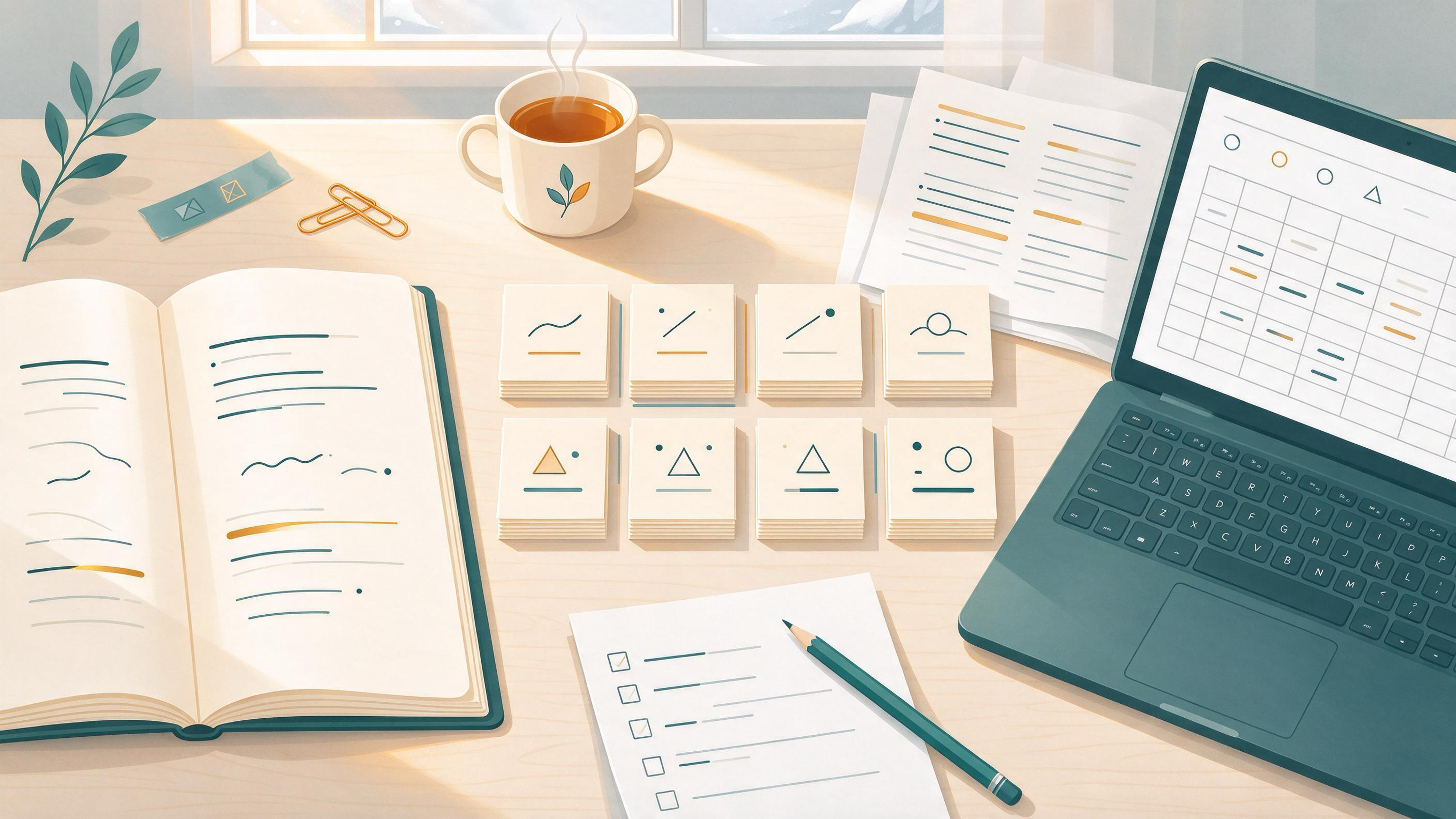
You already have the notes. The PDFs are downloaded, the quotes are highlighted, and somewhere in a folder there is a document of bullet points you made at 1 a.m. The problem is that notes are not a literature review. A review is an argument about what the field knows, how it knows it, and where the gaps sit — and it has to be traceable back to real sources.
This guide turns a pile of research notes into a finished, defensible literature review. It is written for students and early-career researchers finishing a course paper, a thesis chapter, or a first manuscript, and for anyone starting a new project in January with last term's notes still open. The sequence below moves from diagnosing your starting state, through decisions and artifacts, to a readiness check and clear stop rules.
Diagnose your starting state before you write a sentence
Most stalled reviews are stalled for one of four reasons, and each needs a different fix. Spend ten minutes deciding which one is yours.
- Notes exist but are unlabeled. You have quotes and summaries but cannot tell which paper each came from, or whether a note is a finding, a method, or your own reaction. Fix: rebuild provenance before drafting.
- Notes are organized by paper, not by idea. You have one block per article, so every paragraph you try to write becomes a mini-summary. Fix: re-sort notes into thematic columns.
- Coverage is unclear. You are not sure whether your search was systematic enough, or whether you have missed a cluster of work. Fix: document and, if needed, rerun the search.
- The argument is missing. You have good notes but no claim about what they add up to. Fix: write the through-line before the prose.
A quick diagnostic: open your notes and try to write one sentence that begins "Across these studies, the evidence suggests…". If you can finish it with a specific, source-backed claim, you are further along than you think. If you cannot, your notes are still raw material.
Decide what kind of review you are actually writing
The same notes can support very different documents, and the format determines how much search documentation you need.
| Review type | Core question | What your notes must support |
|---|---|---|
| Course paper / essay | What is the state of debate on X? | Representative sources, clear themes, a defensible position |
| Thesis chapter | What has been established, and what remains open? | Broad coverage, explicit gap statement, method transparency |
| First manuscript (narrative review) | How should this literature be interpreted? | Thematic synthesis, acknowledged limits of the search |
| Systematic review | What does the full eligible evidence say? | Predefined eligibility criteria, documented multi-source search, staged screening, deduplication, linked reports |
If you are writing a systematic review, the bar is different. The Cochrane Handbook recommends planning searches from eligibility criteria, using multiple sources, combining free-text terms with subject headings, documenting the process, deduplicating records, screening in stages, linking multiple reports of one study, and rerunning searches before publication. PRISMA 2020 supplies a reporting checklist, expanded explanations, an abstract checklist, and flow-diagram templates for original and updated systematic reviews, covering transparent reporting of search, selection, and synthesis methods.
For a course paper or thesis chapter, you do not need the full systematic apparatus, but the same instincts apply at smaller scale: know your inclusion logic, keep a record of where you searched, and be able to say why each cited study is there.
Checkpoint 1: Write one sentence naming your review type and one sentence naming the question it answers. If those two sentences disagree, resolve that before continuing.
Turn scattered notes into a source register
Before synthesis, every note needs a home. Build a source register — a simple table, one row per source — with these columns:
- Citation key (author, year)
- Full reference
- Why it is included (relevance to your question)
- Method or design
- Key finding(s), in your own words
- Direct quotes with page numbers
- Limitations the authors acknowledge
- Themes it speaks to
- Status (core / supporting / background / excluded)
This register does two jobs. It gives you a single place to check facts while drafting, and it exposes duplicates and weak entries early. If you use a reference manager, Zotero collections can place one item in multiple project groupings without duplicating it, and tags can describe topic, method, status, or workflow — which maps neatly onto the status and theme columns above. Saved searches update automatically, and the Duplicate Items collection supports review and merging, so a winter-break cleanup of an inherited library is a realistic task rather than a fantasy.
If your notes are spread across PDFs and search results, you can save or upload papers and organize them in My Library so the register and the files live in the same place.
Checkpoint 2: Every note in your document traces to a row in the register, and every row has a status. Anything unlabeled gets labeled or deleted now, not later.
Rebuild coverage: search with a purpose, not a vibe
If your starting state was "coverage unclear," this is the step that unblocks you. Define your eligibility logic in plain language first: which populations, methods, time windows, or publication types count, and which do not. Then search from those criteria rather than from whatever keywords you happened to use.
Use more than one route. Combine free-text terms with subject headings where the database supports them, and record the date, database, and query string for each search. This record is what lets you say, honestly, how you found your evidence.
When you need to find additional academic papers, WisPaper search provides a scholarly search interface, and WisPaper Scholar Search offers a public entry point for finding academic papers. Use them the way you would use any database: run a query derived from your criteria, log it, and screen the results against your inclusion logic rather than saving everything that looks relevant.
Screening in stages saves time. Title and abstract first, full text second, with a reason recorded for each exclusion. If several reports describe one study, link them in the register so you count the study once.
Checkpoint 3: You can state, in three sentences, where you searched, what your criteria were, and how many sources survived screening. If you cannot, your coverage is still a guess.
Sort notes into themes, not papers
This is the step that converts a reading log into a review. Take your register and look down the "themes" column. You are looking for clusters — three or more sources that speak to the same question, tension, or method.
For each cluster, write a theme card with four fields:
- Claim: what the cluster collectively shows.
- Supporting sources: which register rows back the claim.
- Disagreement: where sources within the cluster diverge, and why.
- So what: what this cluster implies for your question.
Theme cards are the actual building blocks of the review. A paragraph is then a claim plus its supporting and dissenting sources — not a tour of one paper after another.
A worked example. Suppose your notes contain twelve studies on remote work and productivity. Sorted by paper, you have twelve summaries. Sorted into themes, you might find: (a) studies measuring output, which mostly report gains; (b) studies measuring collaboration quality, which report mixed results; and (c) studies of early-career workers, which are few and mostly qualitative. That third cluster is your gap statement, and it emerged from sorting, not from staring at a blank page.
If you want help interrogating a set of papers you have already collected, Library QA lets you ask questions based on papers uploaded to My Library or added from search results — useful for checking what a cluster actually says before you commit a claim to the page.
Checkpoint 4: You have between three and six theme cards, each with a claim, sources, a disagreement, and an implication. More than six usually means your themes are too fine-grained.
Write the through-line before the prose
Draft a one-paragraph argument skeleton: the question, the three to five themes in a logical order, the tension that runs across them, and the gap your review identifies. This paragraph is not the introduction — it is the spine you will hang sections on.
Order themes by logic, not by chronology of your reading. A common and effective order is: what is established, where findings conflict, what methods explain the conflict, and what remains unstudied.
Then write section by section, using theme cards as your outline. Each section should open with its claim, bring in supporting sources, acknowledge dissent, and close by connecting to the next theme. Keep quotes short and reserve them for phrasing you genuinely need; paraphrase everything else into your own words while drafting, so the final text is yours.
Checkpoint 5: Read only your section-opening sentences in sequence. They should form a coherent argument on their own. If they read as a list of topics, rewrite them until they argue.
Verify citations before the review hardens
A review built from notes inherits every citation error in those notes. Before you polish prose, check that each reference exists and matches what you claim it says.
Two passes work well. First, a reference pass: confirm author, year, title, venue, and DOI for every register row. Second, a claim pass: for each sentence that attributes a finding, reopen the source and confirm the attribution. Notes taken months ago are the most likely to have drifted.
For BibTeX-based workflows, TrueCite screens BibTeX citations against real academic databases to flag hallucinated references — a targeted check on the reference pass rather than a substitute for reading the sources.
Checkpoint 6: Zero unresolved references, and every attributed claim checked against its source at least once.
Know when the review is ready
Readiness is not a feeling; it is a set of conditions you can check. Use this list:
- The review type and question are stated in the opening.
- The search logic and sources are described well enough that a reader could understand how evidence was found.
- Every theme has a claim, supporting sources, and acknowledged disagreement.
- The gap statement follows from the themes rather than being asserted.
- Every citation resolves to a real source, and every attributed claim has been checked.
- The section-opening sentences form a coherent argument when read alone.
- Limitations of the evidence base are described where they affect your conclusions.
- A reader outside your subfield could follow the argument without your notes.
If you are writing a systematic review, add the PRISMA 2020 reporting items and flow diagram to this list, and rerun your searches before submission as the Cochrane Handbook recommends.
Stop rules: when to pause, narrow, or escalate
Clear stop rules prevent the two classic failure modes — endless searching and premature drafting.
- Stop searching when new queries return only sources already in your register across two consecutive search rounds. Record that you reached this point.
- Narrow the question when your themes exceed six and no two can be merged, or when your register exceeds what you can verify before your deadline.
- Escalate to your supervisor when your gap statement depends on absence of evidence you have not confirmed, when two core sources directly contradict each other on a point central to your argument, or when your review type may need to change (for example, a chapter drifting toward systematic review).
- Pause drafting when a theme card has a claim but fewer than two supporting sources; go back to search or merge the theme.
- Do not submit with any unchecked citation or any claim you cannot trace to a register row.
A January project-start example
Consider a master's student returning in January to a thesis chapter on remote work. Her notes from the previous term are a folder of highlights and a half-finished spreadsheet.
Week 1 — diagnose and register. She identifies her starting state as "organized by paper." She builds a source register from her existing notes, assigning each source a status and theme. During cleanup she merges duplicates in her reference manager and tags items by method and status.
Week 2 — coverage. She writes her eligibility logic, runs two logged searches, and screens results in stages. She finds four new sources, two of which join an existing theme.
Week 3 — themes and through-line. She consolidates twelve sources into four theme cards, each with a claim, support, disagreement, and implication. She drafts the argument skeleton and shows it to her supervisor, who flags that her gap statement is too broad.
Week 4 — draft and verify. She writes section by section from theme cards, then runs the reference pass and claim pass. She checks her BibTeX with TrueCite, fixes two malformed entries, and works through the readiness checklist.
Week 5 — final check. She reads only her section-opening sentences, confirms the argument holds, and submits the chapter with her search log attached as an appendix.
If your project involves generating new directions from the literature rather than only synthesizing it, Idea Discovery takes research topics, background, references, and experimental constraints to generate research ideas — a natural next step once the review has exposed a gap. For longer research tasks that fit a literature review workflow, Scholar Agent supports literature review, inspiration, and reproduction use cases, and Research Projects gives you a place to create and organize a new project.
Your next action
Open your notes and build the source register — one row per source, with status and theme columns filled in. Do it today, before you write another sentence of prose. Everything else in this guide depends on that table existing, and once it does, the review stops being a pile of notes and becomes an argument you can finish.
FAQs
Keep Reading

How to Write a Synthesis Paragraph from Multiple Studies
A synthesis paragraph does more than list what several papers found. It organizes those findings around a claim, shows where studies agree or diverge, and makes the relationship between them explicit. If you are finishin
Keyword Alerts vs. Citation Alerts for Tracking a Topic
If you are deciding between keyword alerts and citation alerts, the short answer is that they answer different questions. A keyword alert asks, "What new work mentions my topic?" A citation alert asks, "What new work cit
Landmark Papers vs. Recent Papers: Which Should You Read First?
Read the landmark paper first when you need the field's founding question, its core method, or the vocabulary that later work assumes. Read recent papers first when you need the current state of a fast-moving subfield, t