
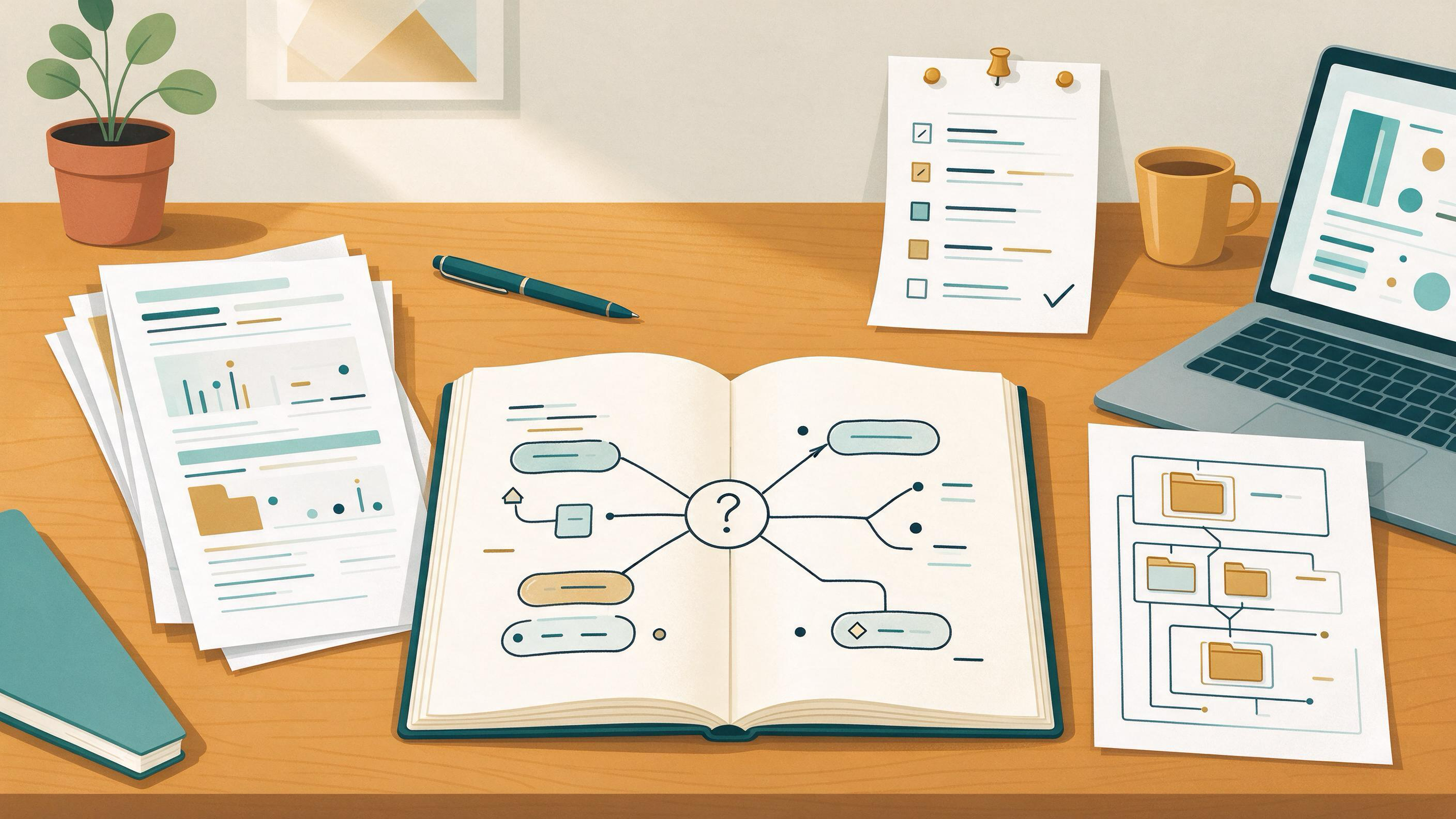
A new research project rarely fails at the writing stage. It fails earlier, when the topic is still a phrase, the reading list is a pile of PDFs, and no one can say which papers were screened, why they were kept, or what the first week of reading is supposed to produce. The practical fix is to treat setup as a short sequence of decisions and artifacts: a scoped question, explicit eligibility criteria, a documented search, a deduplicated record set, and a first reading plan that a coauthor or successor could pick up cold.
This guide is a pillar for that sequence. It opens with a diagnostic so you can see where you actually are, then walks through the decisions and artifacts that finish the job, with routes for readers entering at different stages. Throughout, the test is the same: could someone else reconstruct your method from what you saved?
Diagnose your starting state before you search
Most people arrive at "new project setup" in one of four states. Naming yours prevents the common error of searching before you know what you are selecting for.
| Starting state | What you have | What is missing | First move |
|---|---|---|---|
| Vague topic | A phrase or a hunch | A question and eligibility criteria | Write the question and criteria first |
| Scoped question | A question, maybe a hypothesis | A documented search and record set | Plan sources and terms from the criteria |
| Partial reading | Some papers, no structure | Deduplication, screening stages, a reading plan | Consolidate records and screen in stages |
| Handoff or revision | A draft, a coauthor, or a successor | An auditable trail and a rerun point | Reconstruct the method trail and rerun searches |
Cochrane's search guidance is explicit that searches should be planned from eligibility criteria rather than assembled ad hoc. That single principle reorders the whole setup: criteria first, then sources and terms, then records. If you cannot yet state what would make a paper eligible, you are in the vague-topic state, and no amount of searching will substitute for that decision.
NIH's rigor and reproducibility guidance reinforces the same posture from the funder side: careful assessment of prior knowledge, including strengths, weaknesses, and knowledge gaps, is treated as a core part of rigorous practice. Your setup artifacts are how that assessment becomes visible.
Turn the topic into a question and eligibility criteria
The first artifact is a one-page scope note. It does not need to be long, but it needs to be specific enough that two people would select the same papers from the same results list.
Write down:
- The question, in one or two sentences, including the population, intervention or exposure, and outcome you care about.
- Inclusion criteria: what a paper must contain to enter the reading set.
- Exclusion criteria: the near-misses you expect and why they are out.
- Source types: which databases, registries, or indexes you will search, and which you are deliberately leaving out.
- Date and language limits, stated as decisions rather than defaults.
Cochrane recommends using multiple sources rather than a single database, and combining free-text terms with subject headings. Both choices belong in the scope note, because they determine what your search can and cannot find. If your topic sits between fields, note that in the scope note too; it will shape your term list.
If the topic is still too open to yield criteria, a structured idea-generation step can help you surface candidate framings before you commit. WisPaper's Idea Discovery workflow takes research topics, background, references, and experimental constraints as inputs to generate research ideas, which is useful when you need options to choose between rather than a search to run.
Plan the search from the criteria, not from habit
Once criteria exist, the search plan becomes a translation exercise. For each concept in your question, list free-text synonyms and the subject headings your chosen sources use. Cochrane's guidance supports documenting this process as you go, not reconstructing it later.
A workable search plan has four parts:
- Concept blocks. One block per concept in your question, each with synonyms and variant spellings.
- Source list. The databases and registries you will run each block against, with the interface noted.
- Draft strings. The actual queries, saved verbatim, including limits.
- Run log. Date, source, string version, and number of records returned.
The run log is the artifact most often skipped and most often needed. When a coauthor asks why a paper is missing, the run log answers whether it was never retrieved or retrieved and excluded. Those are different problems with different fixes.
For the retrieval step itself, WisPaper's scholarly search interface is where you find academic papers; run your concept blocks there and keep the strings in your run log so the search is repeatable. Readers who want a public entry point before committing to a workflow can start from the Scholar Search page.
Build a deduplicated record set you can defend
Raw results are not a reading list. Cochrane's process includes deduplicating records and screening in stages, and it also flags a subtlety that trips up new projects: multiple reports of one study should be linked rather than counted as separate studies. Your record set needs to reflect both moves.
Set up the record set with these fields:
| Field | Purpose |
|---|---|
| Record ID | Stable identifier for each retrieved record |
| Source and date | Where and when it was retrieved |
| Duplicate flag | Marks records merged across sources |
| Study link | Groups multiple reports of the same study |
| Screening stage | Title/abstract, then full text |
| Decision and reason | Include, exclude, or pending, with the criterion applied |
Staged screening is not bureaucracy; it is how you avoid reading full texts you will discard. Title and abstract screening applies the criteria cheaply, and full-text screening resolves the genuinely ambiguous cases. Record the reason for each exclusion against a named criterion so the trail stays legible.
If your project will produce a systematic review, PRISMA 2020 supplies the reporting frame: a checklist, expanded explanations, an abstract checklist, and flow-diagram templates for original and updated reviews. Building your record set with PRISMA's search, selection, and synthesis reporting in mind means the flow diagram later becomes a summary of decisions you already made rather than a reconstruction.
Organize papers so the structure carries meaning
A folder called "read later" is not an organization scheme. Zotero's collections and tags offer a more useful split: collections can place one item in multiple project groupings without duplicating it, while tags can describe topic, method, status, or workflow. That distinction maps cleanly onto research setup.
Use collections for project groupings — the core reading set, the methods set, the comparison set — and tags for attributes that cut across them: topic, method, status such as screened or cited, and workflow stage. Because an item can sit in several collections without duplication, a paper that informs both your background section and your methods section does not need to be filed twice.
Two Zotero features are worth wiring in at setup. Saved searches update automatically, so a saved search for unscreened records or for a specific tag becomes a live work queue. The Duplicate Items collection supports review and merging, which complements the deduplication step in your record set.
If you prefer to keep the reading set inside a single research workspace, WisPaper's My Library lets you save or upload papers and organize them there. The principle is the same either way: the organization should encode your screening decisions, not just your downloads.
Produce the first reading plan as a real artifact
The first reading plan is the deliverable of setup. It should be a document, not a mental list, and it should answer four questions: what to read first, why, in what order, and what each reading is meant to produce.
A practical structure:
- Anchor papers. The two to five works that define the question or the method. Read these fully and first.
- Methods and measurement papers. The works that tell you how comparable studies handled design, measurement, or analysis.
- Gap and critique papers. The works that articulate what is unresolved, which you will use to justify the project.
- Per-paper output. For each item, the note you owe: a summary, a methods note, a limitation, and a link to the criterion it satisfies.
Order the plan by dependency rather than by date. Anchor papers first, because they recalibrate your criteria; methods papers next, because they may change what counts as comparable; gap papers last, because they are easiest to over-read before you know the field's shape.
For longer projects, a literature-review workflow can carry the reading plan into drafting. WisPaper's Scholar Agent is built for longer research tasks in its literature review, inspiration, and reproduction use cases, which fits the stretch between a first reading plan and a first synthesis.
Keep an auditable method trail from day one
The method trail is the difference between a project you can hand off and a project only you can navigate. Cochrane's documentation guidance and NIH's emphasis on transparent methods point the same direction: the record of what you did is part of the research, not an afterthought.
Keep the trail in one place with five components:
- Scope note — question, criteria, limits, and the date they were set.
- Search plan and run log — strings, sources, dates, and counts.
- Record set — deduplicated, staged, with decisions and reasons.
- Reading plan — ordered items with per-paper outputs.
- Change log — every revision to criteria or strings, with the reason and date.
The change log matters most in revision. When a coauthor or reviewer asks why a criterion shifted, the change log shows the decision and its date rather than a recollection. If you are working inside a shared workspace, WisPaper's Research Projects area is where you can create a new project and keep the work grouped.
Route by entry point: revision, coauthorship, peer review, handoff
Not everyone starts at the topic. The same artifacts serve different entry points, but the order of repair changes.
| Entry point | What usually exists | What to repair first |
|---|---|---|
| Manuscript revision | A draft and a partial reading set | Reconstruct the search and selection trail behind the draft |
| Coauthor joining | A shared project with uneven notes | Consolidate the record set and reading plan into one artifact |
| Peer-review response | Reviewer comments and a citation list | Verify references and rerun searches before resubmission |
| Lab handoff | Files, maybe a folder structure | Write the scope note and change log so the method is legible |
| New review | A question, no records | Start from criteria, then search plan, then record set |
Cochrane recommends rerunning searches before publication, which makes the revision and peer-review routes more than administrative. A rerun against your saved strings and run log tells you what changed since the original search, and the change log records why you did or did not incorporate it.
For the peer-review route, reference verification is a distinct task from literature search. WisPaper's TrueCite checks BibTeX against real academic databases to flag hallucinated references, which is the right step when a citation list has grown faster than its verification.
Know when setup is finished
Setup is done when the artifacts can answer questions you did not anticipate. Use this readiness check:
- Criteria test. Could a colleague apply your inclusion and exclusion criteria to a results list and reach your decisions?
- Search test. Could they rerun your searches from the saved strings and source list?
- Record test. Does every record have a source, a date, a screening stage, and a decision with a reason?
- Deduplication test. Are duplicates merged and multiple reports of one study linked rather than counted separately?
- Reading test. Does the reading plan state an order, a rationale, and a per-paper output?
- Trail test. Does the change log explain every revision to criteria or strings?
If any test fails, the fix is usually a single artifact rather than a restart. A failed criteria test means the scope note is too vague; a failed record test means the screening fields were not filled in; a failed reading test means the plan is a list rather than a sequence.
Use the workspace to ask questions of your own reading set
Once papers are saved, a common next need is to interrogate the set rather than search the wider literature again. WisPaper's Library QA supports asking questions based on papers uploaded to My Library or added from search results, which fits the stage where your reading plan is set and you need to compare what the saved papers say.
Keep the answers inside the trail. When a Library QA exchange changes your reading of a paper, note it against that paper's per-paper output and, if it affects criteria, log the change. The question-and-answer step is part of the method, not a detour from it.
For projects that involve reproducing a published method, WisPaper's PaperClaw supports research-paper reproduction planning from an uploaded PDF and reproduction instructions, which is the natural next artifact when a methods paper becomes a build task rather than a reading task.
A worked example: the reproducible-search route
Consider a lab starting a review on a question that sits between two fields. The team begins in the vague-topic state and writes a scope note with a question, inclusion and exclusion criteria, a source list, and date and language limits. They translate each concept into free-text terms and subject headings, run the blocks against multiple sources, and log every string with its date and record count.
The record set is deduplicated, and multiple reports of the same study are linked rather than counted separately. Title and abstract screening applies the criteria; full-text screening resolves the ambiguous cases, each with a recorded reason. Papers are organized so that collections mark project groupings and tags mark topic, method, and status, with a saved search acting as the unscreened queue.
The reading plan orders anchor papers first, then methods papers, then gap papers, each with a required note. The change log records two revisions: a widened date limit and an added synonym. Before submission, the team reruns the searches against the saved strings and records what changed.
At handoff, a new member can reconstruct the entire method from five artifacts and rerun the search without asking anyone. That is the readiness standard this guide has been building toward: not a perfect reading list, but a setup that explains itself.
FAQs
Keep Reading

Notes by Paper vs. Notes by Claim: Which Scales Better?
Notes by claim scale better for writing, while notes by paper scale better for building a reading record. If you are finishing a course paper, thesis chapter, or first manuscript and already have a pile of PDFs, the prac
One Master Library vs. Separate Libraries for Every Project
You are finishing a paper, a thesis chapter, or a first manuscript, and the next project is already visible on the horizon. The question is not abstract: should every paper you have ever found live in one master library,
Paper Summaries vs. Evidence Extraction: What Should You Save?
Save both, but for different jobs. A paper summary is a fast orientation layer: it tells you what a study claims and whether it belongs in your reading pile. Evidence extraction is the audit layer: it records the specifi