

Notes by claim scale better for writing, while notes by paper scale better for building a reading record. If you are finishing a course paper, thesis chapter, or first manuscript and already have a pile of PDFs, the practical answer is to keep a paper-level archive but organize your working notes around the claims you intend to make. The claim is the unit you will actually write, defend, and revise; the paper is the container you will cite.
This article compares both approaches on the same task, shows where each one breaks down, and gives you a decision table plus a combined workflow you can run during a winter-break cleanup or a January project start.
Why the question matters at the end of a writing cycle
When you are deep in a draft, your notes have to do two different jobs. They have to help you find a source again, and they have to help you write a sentence that the source supports. Notes by paper are good at the first job. Notes by claim are good at the second.
The trouble usually appears late. You have a folder of annotated PDFs, a few summary paragraphs per paper, and a chapter that still needs to be assembled. The summaries tell you what each paper is about, but they do not tell you which sentence in your draft each paper is supposed to support. That is the gap this comparison addresses.
Diagnose your starting state before choosing a method
Before you pick a system, look at what you already have. Most students and early-career researchers are in one of three states.
The paper pile. You have PDFs and maybe a citation manager, but your notes are organized by source. You can answer "what is this paper about?" but not "which of my claims does this paper support?"
The claim list. You have an outline or a set of topic sentences, but the sources behind them are thin or loosely attached. You know what you want to argue but not yet which work backs each point.
The mixed middle. You have some paper summaries and some draft claims, but they are not connected. This is the most common state after a supervisor-feedback round, when comments like "support this" or "where is this from?" arrive faster than you can re-read every PDF.
A quick diagnostic: open your draft and pick three sentences that make a factual or interpretive point. For each one, can you name the specific source and the specific part of that source that supports it? If you can do this for all three, your notes are already claim-oriented. If you can only name the paper, you are working by paper.
What notes by paper are good for
Notes by paper treat the source as the organizing unit. Each entry captures the citation, the research question, the method, the main findings, and your reactions. This is the natural format for a literature review table or an annotated bibliography.
Its strengths are real:
- Completeness. You build a durable record of what you read, which helps when you return to a project months later.
- Context. A paper-level note preserves the study design and scope, so you are less likely to lift a finding out of its conditions.
- Retrieval. When you need to cite a work again, the note is where you expect it to be.
Notes by paper fail at the moment of writing. A summary of a study does not tell you which of your sentences it supports, and it does not stop you from overstating what the study found. If your draft has fifteen claims and twelve paper summaries, the mapping between them is still missing.
What notes by claim are good for
Notes by claim treat the assertion as the organizing unit. Each entry is a sentence or short proposition you intend to make, paired with the evidence that supports it, the conditions under which it holds, and the source location.
This format matches how a draft is actually built. A paragraph is a sequence of claims, and each claim needs support. When your notes are organized by claim, revision becomes a lookup rather than a re-reading exercise. Supervisor comments about support are easier to answer because the support is already attached to the sentence.
Notes by claim have their own failure mode. If you only record claims, you lose the surrounding context of each study. You may end up with a set of true-sounding statements that are detached from the design and scope that made them valid. Claim notes also multiply quickly, and without a paper-level anchor they can become hard to trace back to a source.
Comparing both methods on the same task
Imagine a January project start. You are turning a coursework paper into a thesis chapter, and your supervisor has asked you to strengthen the evidence base. You have twenty papers and a rough outline of six sections.
With notes by paper, you would summarize each of the twenty sources, then try to match them to the six sections. The summaries are useful, but the matching step is manual and error-prone. You may find that three papers cluster around one section and none address another.
With notes by claim, you would start from the outline and write the claims each section needs. Then you would search for evidence per claim. This surfaces gaps early, because a claim with no source is visible immediately. The risk is that you read narrowly and miss context.
The comparison comes down to criteria:
| Criterion | Notes by paper | Notes by claim |
|---|---|---|
| Organizing unit | The source | The assertion |
| Best at | Building a reading record | Drafting and revising |
| Surfaces evidence gaps | Late | Early |
| Preserves study context | Strong | Weak unless anchored |
| Supports supervisor feedback | Indirectly | Directly |
| Scales to a long draft | Poorly | Well |
| Scales to a large reading list | Well | Poorly without a paper index |
Neither column wins outright. The table shows why the combined approach is usually the right answer: paper-level records for context and retrieval, claim-level notes for writing.
Where each method fails
Notes by paper fail when the reading list grows faster than the writing. You accumulate summaries, feel productive, and still cannot answer a specific support question. The failure is not laziness; it is a mismatch between the unit of storage and the unit of use.
Notes by claim fail when they float free of their sources. A claim note that says "study X shows Y" without the study design, sample, or scope is fragile. It may be accurate in isolation but misleading in your paragraph. Claim notes also fail when you have many claims and no index back to the papers, because tracing a claim to its source becomes a search problem.
The practical lesson is that each method covers the other's weakness. Paper notes give claim notes a home; claim notes give paper notes a purpose.
A combined workflow you can run this week
Here is a workflow that uses both methods without doubling your work. It is designed for a winter-break cleanup or a January project start, when you have existing material and a clear next writing task.
Step 1: Build a paper index, not paper essays
For each source, record the citation, the identifiers, the research question, the method, and one line on scope. Keep it short. The goal is a lookup table, not a set of essays. If you are starting from a search, use WisPaper search to find academic papers and save the ones you keep to My Library so your index and your PDFs live in the same place.
Step 2: Write your claims as sentences
Take your outline and turn each bullet into a full sentence you intend to defend. These sentences become the headings of your claim notes. A claim note should include the sentence, the source that supports it, the specific location in the source, and any condition that limits it.
Step 3: Attach evidence to claims, not the reverse
Work through your claim list and match each sentence to a source from your paper index. When a claim has no match, mark it as a gap. When a source supports several claims, that is fine; link it to each one. This is where claim notes earn their keep, because gaps become visible before you write the paragraph.
Step 4: Verify identifiers before you cite
A DOI resolves to the current destination registered for that identifier, but the bibliographic fields and the source text still need to be checked for identity and claim support. Use that as a checkpoint: confirm the DOI resolves, confirm the title and authors match, and confirm the passage you are citing actually supports your sentence. If you are assembling a BibTeX file, TrueCite checks BibTeX against real academic databases to flag hallucinated references, which is a useful screen before submission.
Step 5: Ask questions against your own library
Once your sources are in one place, you can query them directly. Library QA lets you ask questions based on papers uploaded to My Library or added from search results. Use it to check what a set of papers says about a specific claim, then confirm the answer against the source text before it enters your draft.
Step 6: Keep the two layers linked
Every claim note should point to a paper index entry, and every paper index entry should list the claims it supports. This bidirectional link is what makes the combined system scale. When a supervisor asks for support, you follow the link from claim to source. When you re-read a paper, you see which of your claims depend on it.
Turning the workflow into a project
If you are starting fresh in January, set up the project before you read. Research Projects is the WisPaper area for creating a new project, which gives your paper index and claim notes a shared home. For a longer task such as a literature review or a first draft of a chapter, Scholar Agent fits WisPaper's literature review, inspiration, or reproduction use cases. If your next step is generating research ideas from your topic, background, references, and experimental constraints, Idea Discovery is built for that step.
These tools support the workflow; they do not change its logic. The paper index still holds context, and the claim notes still hold your assertions. The tools reduce the friction of finding, organizing, and querying sources so you can spend your time on the mapping step.
How to know your notes are ready
Your notes are ready when you can answer three questions without opening a PDF.
First, can you name the source and location for every factual sentence in your draft? If yes, your claim notes are complete enough to write from.
Second, can you describe the scope and method of each source you cite? If yes, your paper index is doing its job.
Third, can you list the claims that still lack support? If yes, you have a working gap list, which is the most useful artifact at this stage.
A fourth check is useful before submission: confirm that every identifier in your reference list resolves and that the bibliographic fields match the work you intend to cite. A DOI helps locate a work, but identity and claim support still need to be checked against the source.
A concrete next action
Pick one section of your current draft and extract its claims as sentences. For each sentence, write the source and location that supports it, or mark it as a gap. Do this for one section only, today. Then decide whether your existing paper notes are enough to fill the gaps or whether you need to search for more sources. That single section will tell you whether your notes scale, and it gives you a template for the rest of the chapter.
FAQs
Keep Reading

One Master Library vs. Separate Libraries for Every Project
You are finishing a paper, a thesis chapter, or a first manuscript, and the next project is already visible on the horizon. The question is not abstract: should every paper you have ever found live in one master library,

Paper Summaries vs. Evidence Extraction: What Should You Save?
Save both, but for different jobs. A paper summary is a fast orientation layer: it tells you what a study claims and whether it belongs in your reading pile. Evidence extraction is the audit layer: it records the specifi
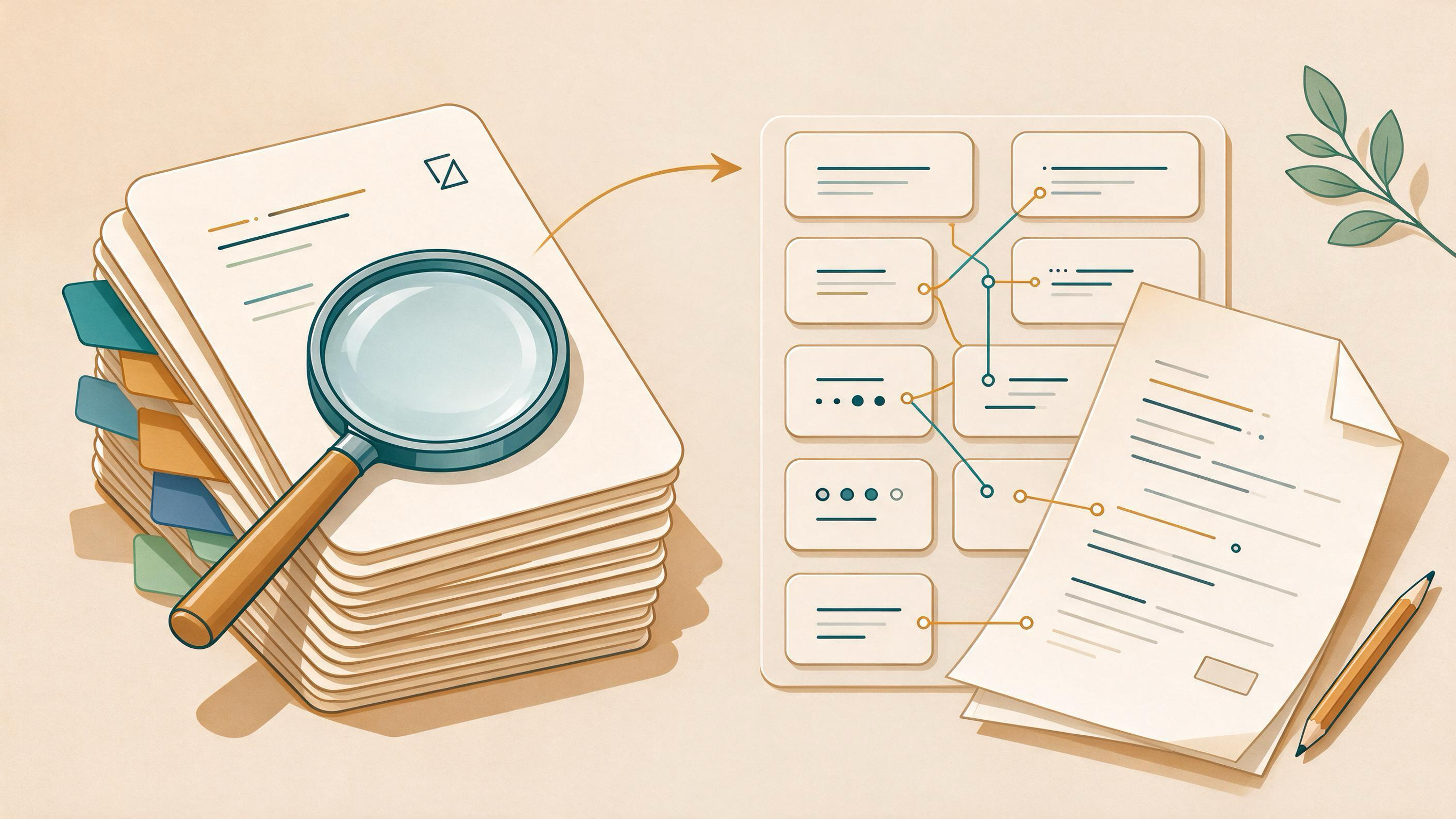
Reading List vs. Evidence Matrix: What Does Each One Miss?
A reading list answers "what should I read?" An evidence matrix answers "what does each source actually let me claim?" If you are finishing a course paper, a thesis chapter, or a first manuscript, you probably already ha