
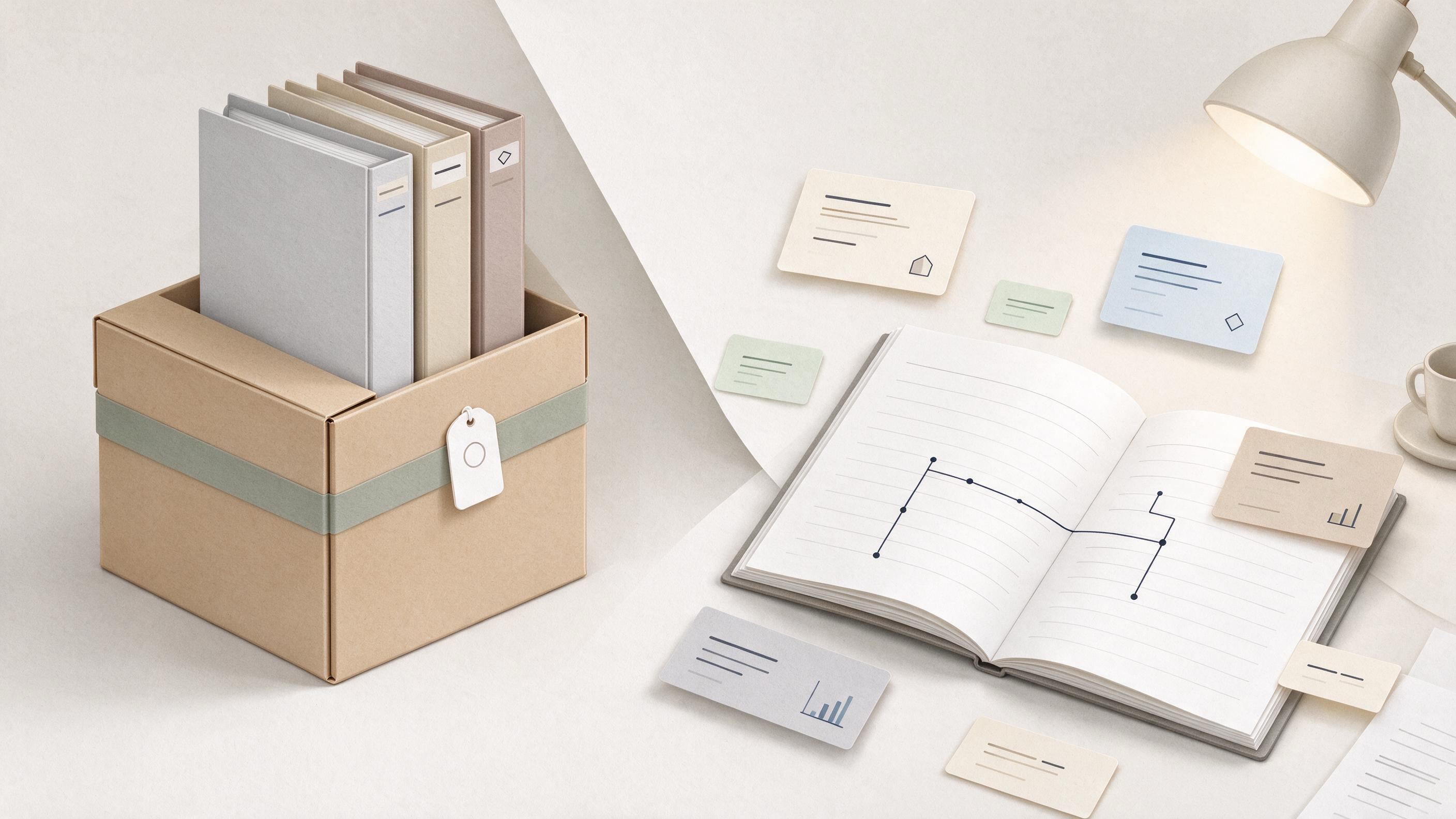
The end of a thesis chapter, course paper, or first manuscript tends to leave two things behind: a folder that feels finished and a pile of sources you might still need. Most researchers handle both the same way. They keep one master folder called "references," drag everything into it, and then spend the next project searching through a mix of half-read PDFs, renamed downloads, and screenshots of database results.
The real question is not whether you should keep a collection. It is whether your collection is acting as an archive that documents a completed project or as a library that supports the next one. The answer changes what you store, how you name it, and when you can safely move forward.
This guide walks through the difference, shows how to diagnose your current state, and gives you a decision table for deciding what belongs in each space. If you are between a submission and a January project start, this is the reset work that saves the most time.
What Is a Project Archive?
A project archive is the stable record of a completed piece of research. It captures what you searched, what you found, and what you decided to include or exclude. Its job is reproducibility and accountability, not convenience for future browsing.
The clearest model comes from systematic review practice. Cochrane recommends planning searches from eligibility criteria, using multiple sources, documenting the process, deduplicating records, screening in stages, linking reports of the same study, and updating searches before publication. That sequence describes an archive as much as it describes a method. The search history, the screening log, the duplicate decisions, and the linked reports all remain useful after submission because they show why a data point exists.
For a thesis or course paper, an archive usually contains the exact search strings, the date each database was queried, the records you screened, the PDFs tied to included studies, and any notes that explain a decision. The timestamp matters more than the polish. When a supervisor asks why a 2017 paper is missing from your discussion, the archive lets you show that your search ended at a specific cutoff and that the paper appeared afterward.
What Is an Active Research Library?
An active library is a working collection tuned for the next decision. It contains records organized around a question you can name now, such as "submission readiness for the winter thesis deadline" or "gaps in the discussion section I need to fix before the second review round."
A library does not need a full search trail for every item. It needs enough structure that you can retrieve a source at the point where you are writing or revising. One practical way to build that structure is to save sources in My Library as you work, keeping the items you expect to cite again in one place rather than reopening old database tabs.
A DOI is part of what makes a library stable. A DOI is a persistent identifier that resolves through the DOI system and can remain stable when the location or descriptive metadata of an object changes. When your library record keeps the DOI, a source stays retrievable even if a publisher changes its site or you move the PDF later.
How Do I Know Which One I Have Right Now?
Start with a simple inventory test. Open the folder or tool you call your reference collection and ask three questions:
- Would someone else understand which project each item belonged to?
- Could you list the save date and the search source for an item without opening the file?
- Is there an unanswered question that tells you which items are still live?
If the first two answers are no and the third is yes, you have an archive stored in library clothing. If all three are yes, you have a working library. Most messy collections are a mix: an archive that never got closed and a library that never got opened.
The failure mode is not lack of material. It is lack of a boundary. Archived items look identical to active ones, so you open the wrong layer during revision and lose the thread.
The Submission-Readiness Use Case: Closing the Archive
Take a student who finished a thesis chapter for a supervisor review. The chapter is drafted. The citations are placed. The search trail, however, lives in the same folder as the PDFs. This creates a specific risk: when the supervisor returns comments, the student may not be able to show how any single source entered the work.
Before submission, run a closure pass. Your archive is submission-ready when it can answer, for each used source, where the record came from and whether duplicate versions of the same report were resolved. Crossref exposes registered scholarly metadata through its REST API, including DOI, title, author, publication, funder, license, and relation fields when deposited. That is the kind of detail you can use to tie a record to a registered version, but the archive only becomes trustworthy if you store the source of that check too.
Do not wait until the supervisor asks. Close the archive before you send the chapter. The artifact you produce is a short record sheet: search date, database, query, number of records, screening outcome, and final DOI for each included item.
The January Project-Start Use Case: Opening the Library
Now take the same student in January, a few weeks before the next project starts. The thesis feedback has arrived. The library still contains every paper from the previous chapter. The new question is not "what did I search" but "which sources live in my next argument."
This is when an active library earns its name. Open Research Projects to create a clean space for the new question and move only the sources that will matter for it. The archive stays untouched. The library becomes a short, linked set of records, not a historical map.
A fresh project also resets the search mind. You can plan the January search through WisPaper search, where you find papers for the new question and add the keepers directly to the working library. The old archive does not contaminate the new screening decision because it is not open next to the search screen.
If the seed set should be questioned before the next search, you can ask Library QA about the papers already saved in the library to check which claims the sources actually support before expanding the set.
Where Do Search Records Belong?
Search records belong in the archive. They are evidence of method. A library can hold a few saved references, but it should not pretend to be a search log.
The Cochrane guidance is useful here because it describes the strongest version of what a search record does. The process runs from eligibility planning through multiple sources, documented searching, deduplication, staged screening, linking reports, and pre-publication updates. A library that holds a saved PDF and a keyword tag cannot stand in for any of that. Keep the full trail in the archive, and let the library carry only the decision it needs to support: the source you intend to cite.
If you uploaded the same PDF to more than one place, the archive should note the duplicate resolution. The library only needs the returnable, citable version.
What Are the Tradeoffs and Failure Modes?
The same research task performed in each mode produces different risks. Compare a final citation check on a thesis chapter:
| Mode | What works | What breaks |
|---|---|---|
| Archive-first | You can reproduce every inclusion decision and show the search trail. | Slow retrieval during writing. You are looking at method records instead of citable text. |
| Library-first | You can reach a source in seconds and keep writing. | The method becomes invisible. If a citation is questioned, you cannot show how the source entered the work. |
For a winter-break cleanup, archive-first creates confidence at submission but feels heavy. Library-first feels fast in January but can silently drop provenance. Most researchers need both layers because they have two jobs that happen close together: prove the old work, then build the new one.
The failure mode to watch for is a half-migrated archive. You create a new project folder but leave ten PDFs in Downloads and three search results in the old library. The boundary exists on paper but not in practice. When the next revision round arrives, you still do not know which layer you are standing on.
What Does a Combined Workflow Look Like?
A combined workflow works in two passes, and the order matters.
Pass one: archive freeze. Before you submit, move the finished project's search records, screening notes, and final source list into a labeled completion area. The archive is done when you could hand the folder to another researcher and they could follow your method.
Pass two: library seed. After submission, open the new project and create a small seed set: the papers that tell the new question where to start. Save the new search adds in My Library as you go, and attach a one-line reason to each keep.
When a source relates to both layers, a DOI lets one record point to the stable registered version. Crossref exposes metadata such as title, author, publication, funder, license, and relation fields when deposited, so you can resolve the registered record without storing three copies. The archive holds the method note; the library holds the citation.
How Do I Know Either Layer Is Ready?
The archive is ready when you can answer three questions without opening a PDF: where each record came from, how duplicates were resolved, and which records link to which included reports. The library is ready when you can answer a different three: what question each saved source supports, where the stable identifier points, and what you would add next if the supervisor returns one more comment.
Readiness is not the number of items. It is the speed at which the collection answers the question you actually have. If the archive answers "why is this source here" and the library answers "what do I do with this source next," both are working. One quick way to test whether a saved source still belongs in the active layer is to open it in My Library and name the next writing decision it would support. If you cannot name one, it is ready to move to the archive.
Decision Table: Archive or Library for Every Common Source
| Source type | Archive | Library | Why |
|---|---|---|---|
| Final search string and date | Yes | No | Method evidence from performing searches |
| Screening log with included and excluded decisions | Yes | Optional note | Cochrane-style staged screening belongs to reproducibility |
| Included study PDF | Yes | Yes | Proof of method and citable working copy |
| Saved search result never screened | Yes | No | Shows the candidate pool, not a citing decision |
| Session notes discussing duplicates | Yes | No | Linking reports is an archive concern |
| Citation-ready record with DOI | Yes | Yes | Persistent identifier supports both layers |
| Supervisor-requested add during revision | Yes | Yes | Enters method record and active draft |
| Background paper from a new project idea | No | Yes | Not part of completed method |
What Should You Do This Week?
Pick one concrete next action based on where you are:
If you are pre-submission, run the archive freeze pass. Write down the final search date, database, query, screening count, duplicate decisions, and DOI for each included source. Store that one file in the completed project folder.
If you are between projects, open a new Research Projects space, create a seed set of the papers that will drive the new question, and leave the archive untouched.
Then either way, ask one question of the layer you just built: if next week's task is a supervisor reply or a first search, does this collection answer the first question you would ask? If yes, stop building. The boundary is set.
FAQs
Keep Reading
Proofreading on Screen vs. Proofreading on Paper
A supervisor has just returned your thesis chapter with a note that still stings: the argument is nearly there, but the writing lets it down. You have two PDFs open, a printed stack on the desk, and no clear plan for the
Reading Backlog vs. Research Pipeline: Which One Is Blocking Your Submission?
Researchers rarely fail for lack of PDFs. Most of us have a reading stack that never shrinks and a manuscript that needs decisions, not another open tab. The question underneath “Reading Backlog vs. Research Pipeline” is
Research Limitation vs. Future Research Direction: Submit With a Credible Handoff
Editors and reviewers read the final section of a manuscript looking for one thing: can this author tell the difference between a boundary the study could not cross and a direction the field should now pursue? When those