
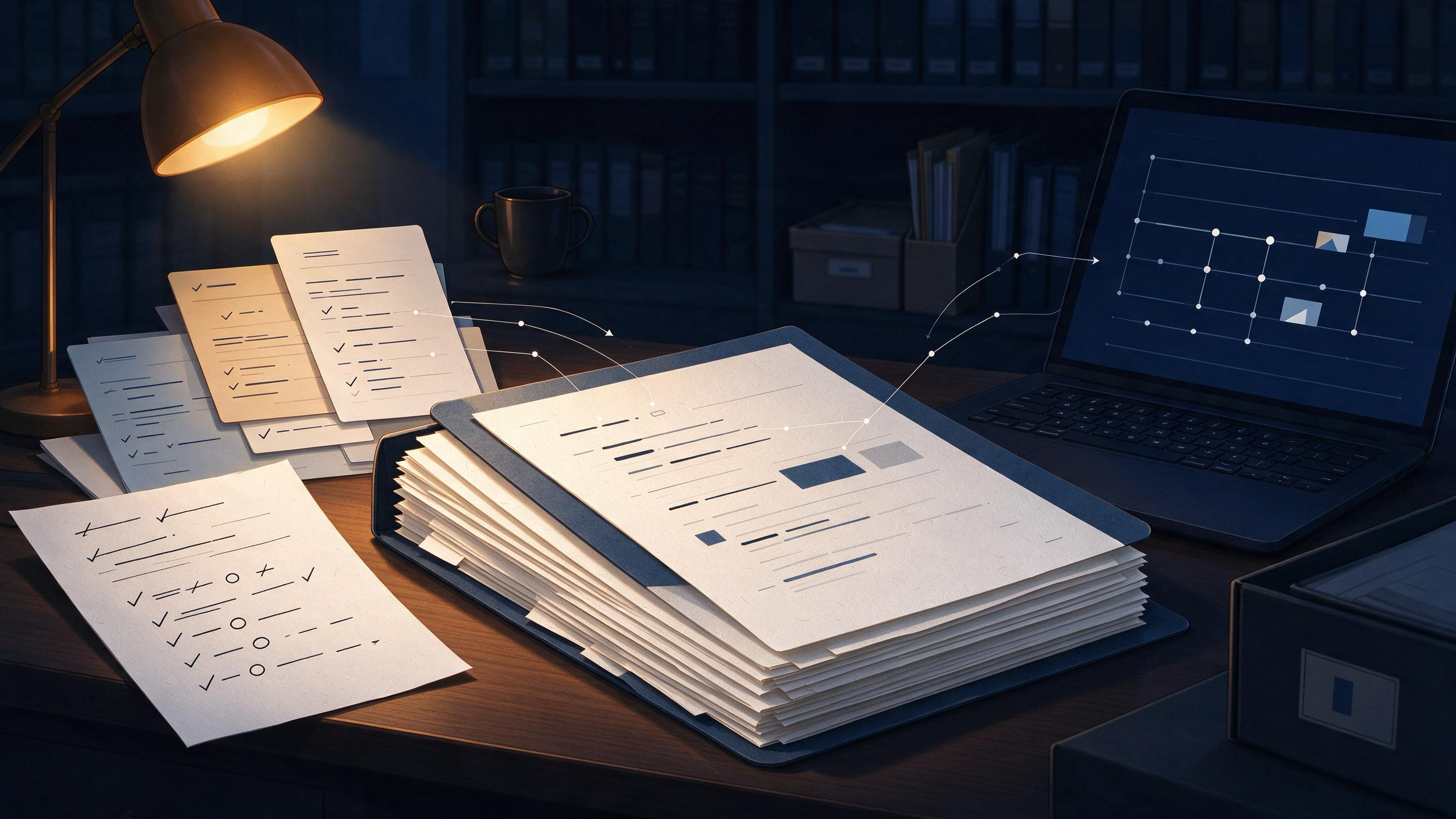
Your manuscript is accepted, the DOI is live, and the citation count is starting to move. Then a reviewer for the next project asks how you built the search string from two years ago, and you realize you cannot produce it. The records are divided across three reference managers, an old spreadsheet, a coauthor's institutional drive, and a notebook you stopped updating after round two of revisions. The paper exists. The trail that produced it does not.
This is a common point in a research career: the publication survives while the search decisions, screening records, deduplication steps, and version history quietly disappear. The immediate cost is friction when a grant proposal, reproducibility request, or follow-up review asks for the method. The longer cost is that you cannot reuse a method that took weeks to build. The practical fix is not to preserve everything from the start of every project. It is to diagnose what is missing, rebuild the part that matters for submission readiness, and store it in a form that survives the next round of revisions.
What actually disappears when a research trail breaks
A research trail is the chain of decisions behind a published result: the databases searched, the eligibility criteria applied, the records deduplicated, the studies linked, and the updates made before submission. Cochrane's handbook describes this as a process of planning searches from eligibility criteria, using multiple sources, documenting the process, deduplicating records, screening in stages, and linking reports of the same study. Each of those steps produces an artifact, and each artifact can be lost in a different way.
The search string lives in a database interface that has since changed its syntax. The screening log lives in a shared spreadsheet that someone exported, edited locally, and never merged back. The citation records exist only in the polished manuscript, with no BibTeX file that matches the final reference list. The version trail of the manuscript exists only in email attachments with names like final_v7_REALLY_final.docx. The paper is still citable because its DOI resolves, but the way you arrived at the paper is no longer visible to anyone, including you.
Which state are you in: closed project, active revision, or handoff
Before rebuilding, identify which failure mode you are actually facing. The repair differs for each.
A closed project is a published paper where you may need the trail for future work, a reproducibility request, or a systematic review update. The priority is reconstructing enough of the search and screening record to answer a specific question, not recreating every intermediate draft.
An active revision is a manuscript still in review or under preparation where coauthors are still editing. The priority is agreeing on a single source of truth for the reference list and the method section so that round three does not produce a fourth version of the truth.
A lab handoff is the case where you are leaving a project and someone else will carry the review or the next paper forward. The priority is making the trail legible to a person who did not live through the original decisions.
Most researchers oscillate between these states. The artifact you build should reduce the cost of moving from one to the next. If you start from a published paper, you are effectively doing a retrospective audit of your own process. If you are mid-revision, you are building a live trail that updates as the manuscript changes.
What the reader can and cannot reconstruct from a published paper
The DOI is a persistent identifier, but it is not a research trail. Both the Crossref REST API documentation and the DOI Foundation note that archives can expose descriptive metadata such as title, author, publication, funder, license, and relation fields when deposited. A DOI resolves reliably and supports citation linking, but resolution alone does not show the search strategy, the screening decisions, or the reasons for excluding studies before the final reference list. The published paper shows the result of the method trail. Reconstructing the trail from the paper alone is like reconstructing a kitchen from a photograph of the meal.
The first reconstructable layer is the reference list of your own paper. Each entry in that list corresponds to a record you screened at some point. The second reconstructable layer is the method section, which should name the sources and criteria but often compresses them to fit the journal's word limit. The third layer, the search log and screening log, is usually not in the paper at all. To rebuild it, you need to return to the tools you used and recreate the queries and decisions from the reported method, then reconciling them against the papers you actually cited.
Rebuild the bibliography as a verifiable BibTeX file
Start with the published or final manuscript and extract the complete reference list into one BibTeX file. This gives you a concrete artifact: every reference the paper depends on, in a machine-readable form. If coauthors used different managers, collect the files and reconcile them. The goal is a single file whose entries match the published list one-to-one.
A BibTeX file that accumulated automatically from several managers can contain references that look plausible but do not exist. A common failure is a hallucinated or malformed reference that was inserted during a quick citation-formatting pass. Before you treat any BibTeX file as evidence, verify the entries against the scholarly record. WisPaper's TrueCite screen checks BibTeX references against academic databases to flag entries that do not correspond to real records. Using this as a verification step during revision or reconstruction turns the reference list from an assumption into an auditable output. Once the file is verified, store that exact version alongside the manuscript version it belongs to, so the link between the reference list and the paper is explicit.
Reconstruct the search record, not just the search phrase
The search record has two parts: the query strings and the decision log around them. Cochrane's guidance is explicit that searches should be planned from the eligibility criteria. If your published method section names the criteria, use them to regenerate the search. Start with the population, intervention or exposure, comparator, and outcome, then rebuild the query for each database you reported. Do not assume the old database interface still accepts the old syntax; rerun the query and record exactly what the interface now interprets.
For the decision log, create a dated record of which sources you searched, which records each source returned, how you deduplicated them, and which records advanced past each screening stage. This is the core method trail for any later update or reproducibility check. Cochrane recommends documenting the process and screening in stages, and the practical form of that recommendation is a spreadsheet or project record where each record has a source, a screen result, and a reason for exclusion. If you already have a paper-management workflow, start the reconstruction inside it so the log does not become a second orphaned file. WisPaper's search interface supports finding academic papers through scholarly search, and the results can feed directly into the next stage of your record. You can save relevant papers to My Library to keep the set visible and organized as the screen proceeds.
Ask the trail what it says, instead of trusting your memory of it
Once the bibliography and the screening set are in one place, interrogate them. Retired projects often die because no one can answer a targeted question about the method. The moment you can ask specific questions of your saved set, the project stops being an archive and becomes a working asset.
For a saved set of papers, WisPaper's Library QA lets you ask questions based on papers uploaded to My Library or added from search results. Use it to compare what your saved set actually contains with what your method section claims it contains. If the method says the search prioritizes a given population and your question-based check cannot find that population in the retained set, you have found a divergence to fix before the next submission, not after a reviewer finds it.
Set up the live trail for the revision or new review
If you are mid-revision or starting a new systematic review, do not wait until publication to build the trail. Create a project that holds the articulated search, the screening records, and the versioned reference list together. The project is the container that makes a handoff possible. When a coauthor needs the current query, they go to the project, not to a forwarded email from last quarter. When the review is updated before publication, the update is logged in the same place as the original search.
For reviews and literature-driven projects, WisPaper's Research Projects area is the appropriate place to hold the moving pieces. It is not a fossil of publication; it is the living state of the work as you and your coauthors revise it. For longer research tasks that involve literature review, inspiration, or reproduction work, the Scholar Agent area supports tasks that span the whole project rather than a single query. One is the workspace, the other the working agent. Both matter when the goal is a trail that survives revision.
Rebuild a lab handoff that survives the person leaving
Handoff failures are often described as communication problems, but they are usually artifact problems. The person leaving has the knowledge, and the person staying cannot import it because the trail was never externalized. The fix is to produce a handoff artifact that a new person can execute without a long onboarding conversation.
The minimum handoff package should contain: the BibTeX file verified against the scholarly record, the search query per source as currently accepted, the screening log with exclusion reasons, and a short note on what the query is intended to find. If long search or screening work is required after the handoff, the project area is where the remaining decisions are documented so the new person sees both the history and the open items. Where a specific paper must be reproduced, WisPaper's PaperClaw can help create a reproduction plan from an uploaded PDF and reproduction instructions, which gives the incoming researcher an operationally useful starting point instead of a vague assignment. The measure of success for a handoff is not whether the outgoing person explains clearly; it is whether the incoming person can reproduce the next step alone.
How do you know the trail is ready for the next submission
Readiness is a checklist with a single organizing principle: an independent scrutinizer can follow the chain from your criteria to your cited papers without asking you for missing context. Test that by walking the chain cold.
One, every reference in the final manuscript maps to a verified BibTeX entry. There are zero entries in the file that do not appear in the manuscript, and zero manuscript references missing from the file. Two, each reported eligibility criterion maps to at least one query term that operationalizes it. If a criterion has no query representation, either the query is wrong or the criterion was never actually applied. Three, the deduplication and screening counts are recorded in one dated log, not in separate team memories. Four, the final updated search is logged with a date and a result count. Five, the project container ties the search, the screened set, and the reference list into the same accessible location.
When all five are true, the trail is ready. The test is behavioral: a coauthor or a reviewer's assistant can open the project, find the current search, and reconstruct the decision for a cited paper without a video call. If they still need you to interpret, the trail is not yet a trail; it is a memory that happens to be written down.
FAQs
Keep Reading
The Reviewer Requests an Analysis You Cannot Run
A reviewer returns your manuscript with a single sentence that stops the revision cold: "Please add a mediation analysis, a multilevel model, a sensitivity analysis, or a subgroup comparison." The request sounds reasonab
The Revised Manuscript and Response Letter Do Not Match
You open the reviewer comments one more time, then open the revised manuscript, and start checking off what you changed. By the third comment, something is wrong: the response letter says you replaced the old analysis wi
Tracked Changes vs. Clean Copy During Revision: Which Gets Your Paper Ready Faster?
You have just finished a full chapter or manuscript draft, and the same file now has to serve two audiences at once: a supervisor who needs to see what changed, and a future version of you who needs clean, readable text