
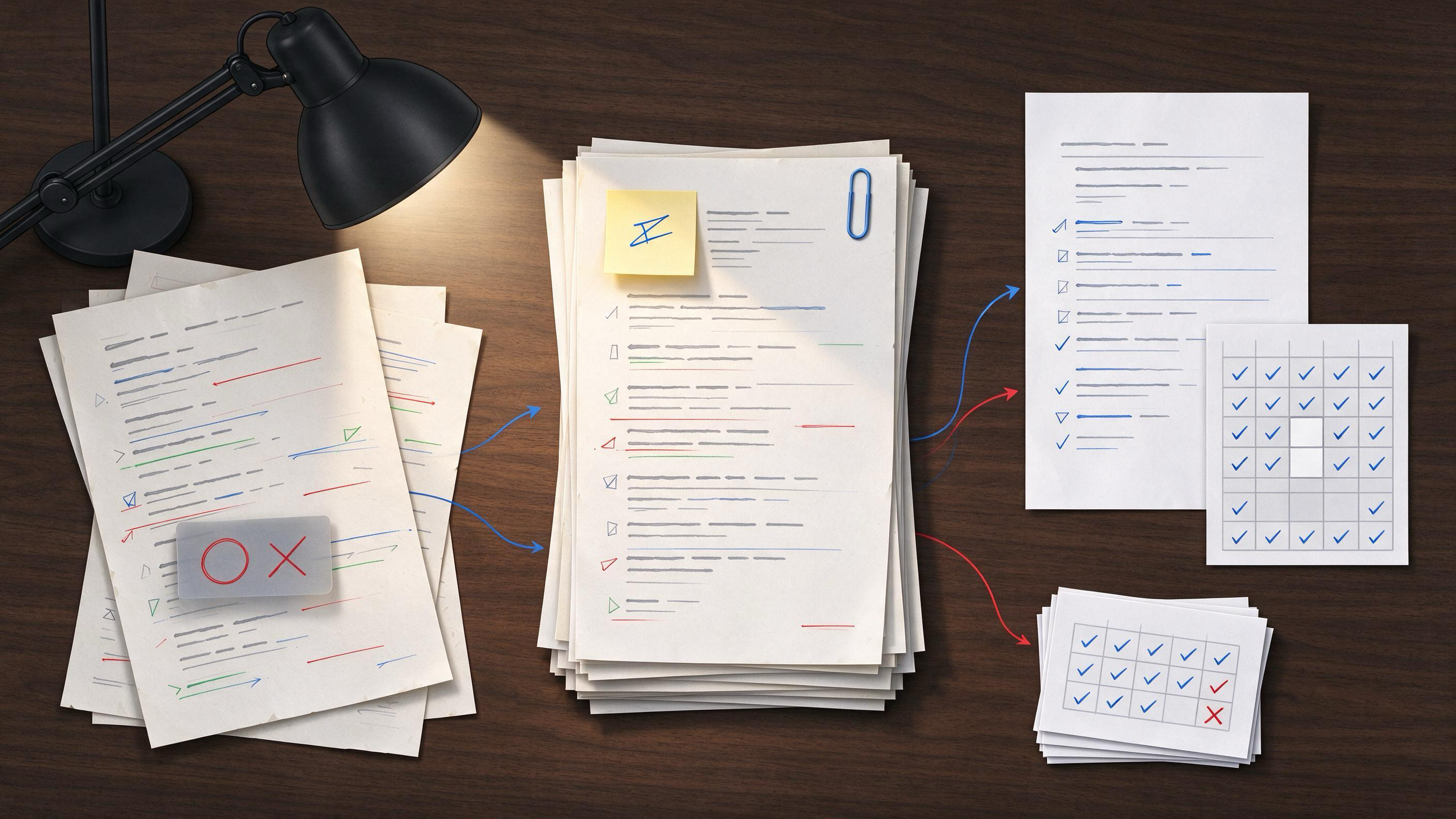
A reviewer returns your manuscript with a single sentence that stops the revision cold: "Please add a mediation analysis, a multilevel model, a sensitivity analysis, or a subgroup comparison." The request sounds reasonable, but the data cannot support it. The exposure was measured once, the clusters are too few, the follow-up is too short, or the sample is too small. You now face the core revision problem: you cannot run the requested analysis, yet a bare refusal will look defensive and may sink the manuscript.
This article is a practical protocol for diagnosing why an analysis is impossible, deciding what to do instead, revising the manuscript in a way editors and reviewers can verify, and preserving every decision in an auditable trail. It is written for researchers who are holding a marked-up manuscript and need to move from a blocked state to a resubmissible one.
Which Revision State Are You In?
Before choosing a response, identify what kind of blocked analysis you are facing. The three states require different repairs.
The analysis is impossible with the current data. A reviewer asks for a longitudinal test, but the study is cross-sectional. A reviewer asks for causal mediation, but the mediator was not measured before the outcome. In this state, the correct move is not to approximate the analysis anyway; it is to state the design boundary and offer the closest defensible alternative.
The analysis is possible in principle but underpowered or unplanned. The model could be specified, but the design has too few clusters for reliable variance components, or the subgroup is too small to produce a stable estimate. Here the revision can include a clearly labeled exploratory or sensitivity analysis with narrow claims.
The analysis appears to be possible only because the method section is unclear. The reviewer believes the data contain a variable they do not, or assumes a design feature that was not reported. In this state, the failure is not analytic but documentary. The repair is a revised method section that shows the study's actual structure.
Name your state in writing before you touch the manuscript. One sentence in a revision note is enough, and it becomes the first entry in your decision log.
What Exactly Makes the Requested Analysis Unavailable?
Convert the reviewer's request into a list of data requirements. A mediation analysis requires temporal ordering, a measured mediator, and no unmeasured confounding of the mediator-outcome path. A multilevel model requires a defensible number of higher-level units, adequate within-cluster variation, and a correctly specified covariance structure. A subgroup analysis requires the grouping variable to be measured and the smallest cell to contain enough events for a meaningful estimate.
Write each requirement next to a yes, no, or uncertain for your dataset. NIH frames the relevant standard as the strict application of the scientific method across design, methods, analysis, interpretation, and reporting. That framing matters here: the decision about the requested analysis is itself an analytic step, and it should meet the same transparency standard as the analysis you did run.
The most useful artifact from this step is a short requirement table. It usually shows that the request fails on one or two concrete conditions, not on a general lack of effort. That table becomes the backbone of the response letter.
Where Is the Evidence for "Cannot Run"?
A claim that an analysis is impossible is a scientific claim, and it needs support. The support is stronger when it comes from your own data rather than from a general methodology statement. Compute the missing requirement: the number of clusters, the timing of measurements, the smallest subgroup size, the distribution of the potential mediator. Put the number in the table. A statement such as "the mediator was not assessed" is adequate for documentation, but "the mediator was not assessed; the exposure was measured at baseline and the outcome at 12 months, with no interim measure" is what a reviewer can verify.
Where the boundary is a design convention rather than a computed number, keep the claim narrow. The decision should rest on your reported design, not on appeals to what other journals require or what is generally accepted.
What Is the Closest Analysis You Can Defend?
Once the unavailable analysis is specified, choose the next best defensible option. The replacement should share as much of the original intent as possible while staying within the data.
For a requested mediation analysis, the closest alternatives often include a partial-adjustment sequence, a moderation test, or a cross-sectional path model that is explicitly labeled as not supporting causal mediation. For a requested multilevel model, a cluster-robust or fixed-effects specification may address part of the clustering concern. For a requested subgroup analysis, an interaction term in the main model is usually the better-powered alternative to separate subgroup models.
Whatever you choose, do not silently substitute it for the requested analysis. The revision note should say: the requested analysis requires X, our data provide Y, therefore we conducted Z, and the interpretation is limited to W. This sentence structure prevents the two most common revision errors: pretending the substitute is the same thing, or abandoning the reviewer's underlying concern entirely.
How Do You Rewrite the Methods So the Boundary Is Visible?
A reviewer's impossible request is often a symptom of an underspecified method section. ICMJE guidance directs authors to follow the selected journal's instructions for manuscript structure, required statements, and submission materials, but the deeper requirement is that a methods section make the design visible. If the reviewer asked for an analysis that cannot be run, part of the repair is to make the structural reason legible.
Revise three places. First, describe the measurement schedule precisely, including what was measured and when. Second, state the analytic decisions that follow from the design, such as why a fixed-effects specification was chosen over random effects. Third, include the requirement table in the supplement if the missing feature is not obvious in prose.
The goal is not to preempt every future request. It is to make the paper's design boundaries the reader's discovery rather than the author's surprise. That shift is the difference between a reviewer who understands the study and a reviewer who asks for something the study cannot provide.
What Belongs in the Response Letter?
The response letter is where the decision becomes an argument. For each impossible request, include four elements: a direct acknowledgment of the request, the specific requirement that cannot be met, the replacement analysis you performed, and the manuscript change where the reader can verify both.
Keep the tone matter-of-fact. A reviewer is not wrong to ask for a stronger analysis; the response demonstrates that the strongest analysis available under the constraints is now in the manuscript. COPE's description of peer review as depending on trust and constructive assessment applies in both directions: the reviewer offers a constructive assessment, and the author responds with a verifiable account. The cleanest response letter treats the correspondence as a shared search for the correct inference under the actual design.
How Do You Keep the Decision Trail Auditable Across the Revision?
Revision decisions made in email threads and margin comments disappear. The protocol that works under deadline is to keep a single decision log with three columns: reviewer request, requirement gap, and chosen repair. Each row links to the manuscript location where the repair appears.
For researchers who want the supporting evidence organized as they work, My Library is a direct place to keep the core papers used in the revision. Save the papers that define the requested method, the papers that support your replacement analysis, and the papers you cite in the response letter. The library structure lets you return to the same evidence when a second reviewer raises a related question.
When the calibration or reference burden grows, My Library also becomes the place to store papers returned by a targeted scholarly search. Run a search for the requested method's minimal conditions, add the relevant papers to the library, and attach the strongest one or two to the requirement table in the supplement. You can run that kind of targeted search in WisPaper's scholarly search interface, which is built for finding academic papers. The revision note then carries the support with it.
For a longer repair that spans several methods and manuscripts, the Research Projects area gives you a container for the revision as a unit rather than as loose files. Create a project for the resubmission, attach the requirement table, the response letter draft, and the method papers that define the requested analysis. When a coauthor asks why the interaction term replaced the subgroup models, the project holds the answer.
How Do You Run a Recheck Before Resubmission?
The final check is not a style pass. It is a verification that every change survives scrutiny outside your own reading. Two checks matter most.
First, the numerical claims must match the analysis output. A table that says the smallest subgroup has 14 events, a prose sentence that says 15, and a response letter that says "fewer than 20" are three different claims. Pick one phrasing and use it everywhere. Second, the replacement analysis must be presented as what it is. If the manuscript suggests the substitute answers the original question, the reviewer will find it, and the correction will reopen the whole revision.
For teams needing a neutral document-level check, WisPaper's Library QA supports questions asked against papers saved in a library. After you have added the manuscript's cited method papers to your working library, query the collection for the minimum condition you relied on. The returned passages from the saved papers give you a fast way to confirm that the cited source actually says what your requirement table attributes to it, before the table goes to the reviewer. If the citation is only in BibTeX and has not been read at source, a separate screening step may be warranted.
A BibTeX file with references inherited from previous drafts is a common source of downstream trouble. TrueCite is designed to check BibTeX entries against academic databases to flag references that cannot be verified. Running this check on the reference list for the revised methods section closes a common gap: a method paper cited for a minimum sample rule that does not exist in the source, or a citation that migrated through drafts with the wrong year.
How Do You Know the Revision Is Ready?
The revision is ready when four conditions hold. The requested analysis is named precisely and the unmet requirement is stated as a fact about your data. The replacement analysis is present in the manuscript with its limitations stated in the same paragraph. The response letter traces each request to a manuscript change. The method section lets a new reader discover the same design boundary without seeing the review correspondence.
If you can send the manuscript and response letter to a colleague who has not read the reviews, and that colleague can answer "Why wasn't the mediation analysis run?" with the same reason you gave, the revision is ready. If they cannot, the boundary is still living only in your head and in the email thread.
FAQs
Keep Reading

The Revised Manuscript and Response Letter Do Not Match
You open the reviewer comments one more time, then open the revised manuscript, and start checking off what you changed. By the third comment, something is wrong: the response letter says you replaced the old analysis wi
Tracked Changes vs. Clean Copy During Revision: Which Gets Your Paper Ready Faster?
You have just finished a full chapter or manuscript draft, and the same file now has to serve two audiences at once: a supervisor who needs to see what changed, and a future version of you who needs clean, readable text

Two Reviewers Give Conflicting Revision Advice: How to Decide What to Change
You open the decision letter expecting a clear to-do list. Instead, Reviewer 1 wants you to add a control condition and reconsider your main claim. Reviewer 2 says the argument is strong but asks you to cut a section and