
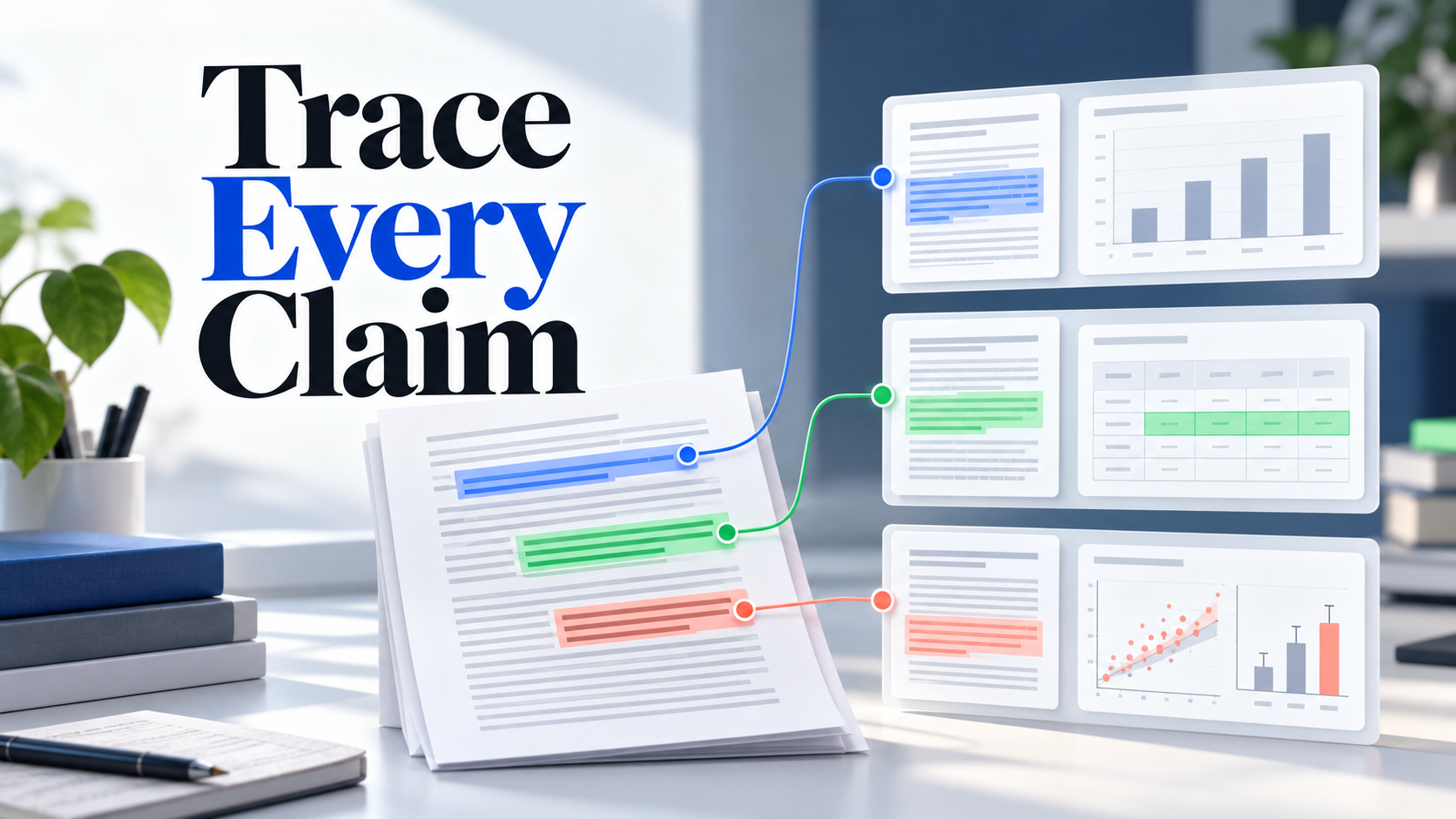
You can trace every factual claim, but only if the review is written with traceability in mind. A polished paragraph generated first and checked later is much harder to audit than a paragraph built from a claim ledger.
I tested this on a short synthesis of three online sleep-intervention studies. The first draft contained eight checkable claims. Five mapped cleanly to one source. Two combined details from multiple papers without showing the boundary. One turned a possible explanation into a general conclusion.
The paragraph sounded reasonable. The ledger showed where it had become too smooth.
What counts as a traceable claim?
A traceable claim has four parts:
- the exact sentence or clause
- the source that supports it
- the location inside that source
- the strength of the relationship: direct, inferred, or background
For example, “completion fell from 49 participants at module one to 21 at module five” can point directly to a table. “Low engagement may have reduced the observed effect” is an interpretation and should be labeled as such, even if the authors discuss it.
Why do citations drift in AI-written reviews?
AI tends to compress several studies into one fluent sentence. The citation may sit at the end, making it unclear which source supports which clause. It may also turn “was associated with,” “may explain,” and “did not outperform” into stronger causal language.
Another common problem is citation inheritance. One sentence cites a paper, and the next sentence looks like an elaboration but introduces a new uncited fact.
Build a claim ledger before the final prose
Use a table with these columns:
- claim ID
- draft claim
- source ID
- page, section, or table
- direct quote or faithful note
- relationship: direct / synthesis / interpretation
- verification status
Ask AI to write from verified rows only. If a sentence needs two sources, attach both at clause level. If no row supports a claim, revise or remove it.
A useful audit prompt is:
Split this paragraph into the smallest factual claims. For each claim, identify the supplied source and exact location that supports it. Do not use a citation merely because it is topically related. Mark unsupported, overgeneralized, or causalized claims separately.
Use WisPaper as the evidence workspace
Save the source set in My Library, then ask Library QA narrow questions for each claim. For a generated bibliography, run the BibTeX through TrueCite to flag references that do not validate. Existence checking and claim checking are separate steps; do both.
The final review should let a skeptical reader travel from sentence to paper without guessing which source you meant.
FAQs
Keep Reading
How to Turn One Good Paper into a Reading List
Expand one relevant paper into a focused reading list through references, citations, authors, keywords, and disciplined screening.
What to Do When Two AI Tools Give Different Answers About the Same Paper
Learn why two AI tools can read the same paper differently and how to resolve conflicts by checking prompts, evidence, and scope.

What Does “Deep Research” Actually Mean for Academic Research?
Understand what AI deep research does, how it differs from academic research, and where source and method checks still matter.