
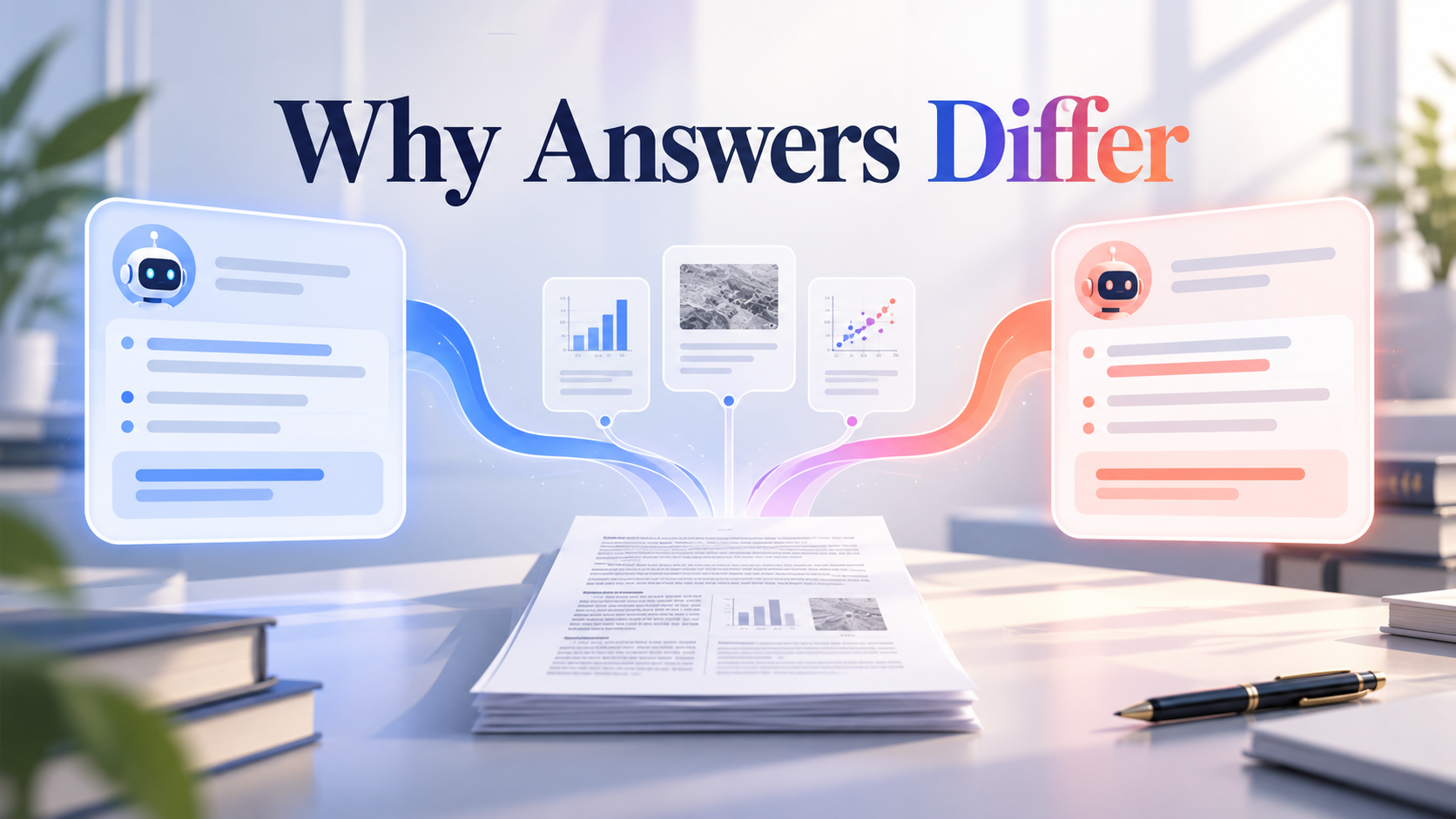
You upload the same paper to two AI tools. One says the intervention worked. The other says the result was inconclusive. Both provide confident explanations and both appear to cite the paper.
Do not settle the disagreement by asking a third tool which answer is right. First find out whether the tools were answering the same question from the same part of the paper.
Freeze the conditions before comparing answers
Small setup differences create large output differences. Check that both tools received:
- the same version of the paper
- the full text rather than an abstract or landing page
- the same prompt
- the same source restrictions
- a fresh conversation without earlier assumptions
One tool may have searched the web while the other used only the PDF. One may have read a preprint while the other saw the final article. A conversation may also carry a previous instruction such as “focus on positive findings.” Fix these differences before treating the outputs as a real disagreement.
Turn each answer into claims you can inspect
Copy the two answers into a simple table with four columns:
- claim
- source location
- paper’s actual wording or result
- your judgment
“The intervention worked” is still too broad. Break it into smaller claims:
- Which outcome improved?
- Compared with which group or baseline?
- At what time point?
- Was the result statistically and practically meaningful?
- Was it the primary outcome?
Now ask each tool to identify the table, figure, page, or paragraph behind its answer. If a tool cannot locate its claim, you have learned more than another long explanation would tell you.
Look for the place where both answers can be true
Many apparent contradictions come from scope. The intervention may improve a secondary outcome but not the primary one. It may work immediately after treatment but not at follow-up. The full sample may show no clear effect while one subgroup does.
Also compare the language used by the authors. “No statistically significant difference” does not prove that two treatments are equivalent. “Associated with” does not mean “caused by.” A confidence interval that includes both benefit and harm supports a different conclusion from a precise estimate near zero.
The two tools may have selected different legitimate details and then summarized them too aggressively.
Ask a reconciliation question, not a vote
Once you have located the disagreement, give both tools the competing interpretations:
Answer A says the intervention worked; Answer B says the result was inconclusive. Using only this paper, identify which outcome, comparison, time point, and numerical result each interpretation relies on. Explain whether the interpretations are incompatible or refer to different parts of the study. Cite the relevant table or passage.
This prompt does not ask the model to choose the answer you prefer. It asks it to explain the source of the difference.
What if the paper itself is ambiguous?
Sometimes the abstract, results, and discussion pull in different directions. The abstract may emphasize a positive secondary result; the main table may show uncertainty; the discussion may use broader language than the data.
In that case, write the ambiguity rather than forcing one verdict:
The study found an immediate improvement in self-reported stress, but the primary outcome and three-month follow-up did not show a clear difference.
That sentence is more useful than choosing either “worked” or “did not work.”
How can WisPaper help with repeated disagreements?
If you are checking several papers, save them in WisPaper My Library and ask Library QA for the same evidence fields across the set: primary outcome, comparison, time point, numerical result, and author conclusion. A consistent extraction makes it easier to see when two tools selected different fields.
If the disagreement reveals that your paper set mixes populations or study designs, use WisPaper Search to rebuild a more comparable set. Better source control often resolves more confusion than another round of prompting.
FAQs
Keep Reading

What Does “Deep Research” Actually Mean for Academic Research?
Understand what AI deep research does, how it differs from academic research, and where source and method checks still matter.

What Is an AI Scientist—and What Can It Actually Do for a PhD Student?
Learn what today's AI scientist systems can actually do for PhD work, where they help, and which research decisions remain yours.
What Should You Give an AI Research Agent Before It Starts Searching?
Give an AI research agent a usable brief with population, concepts, dates, exclusions, evidence rules, and the output you need.