
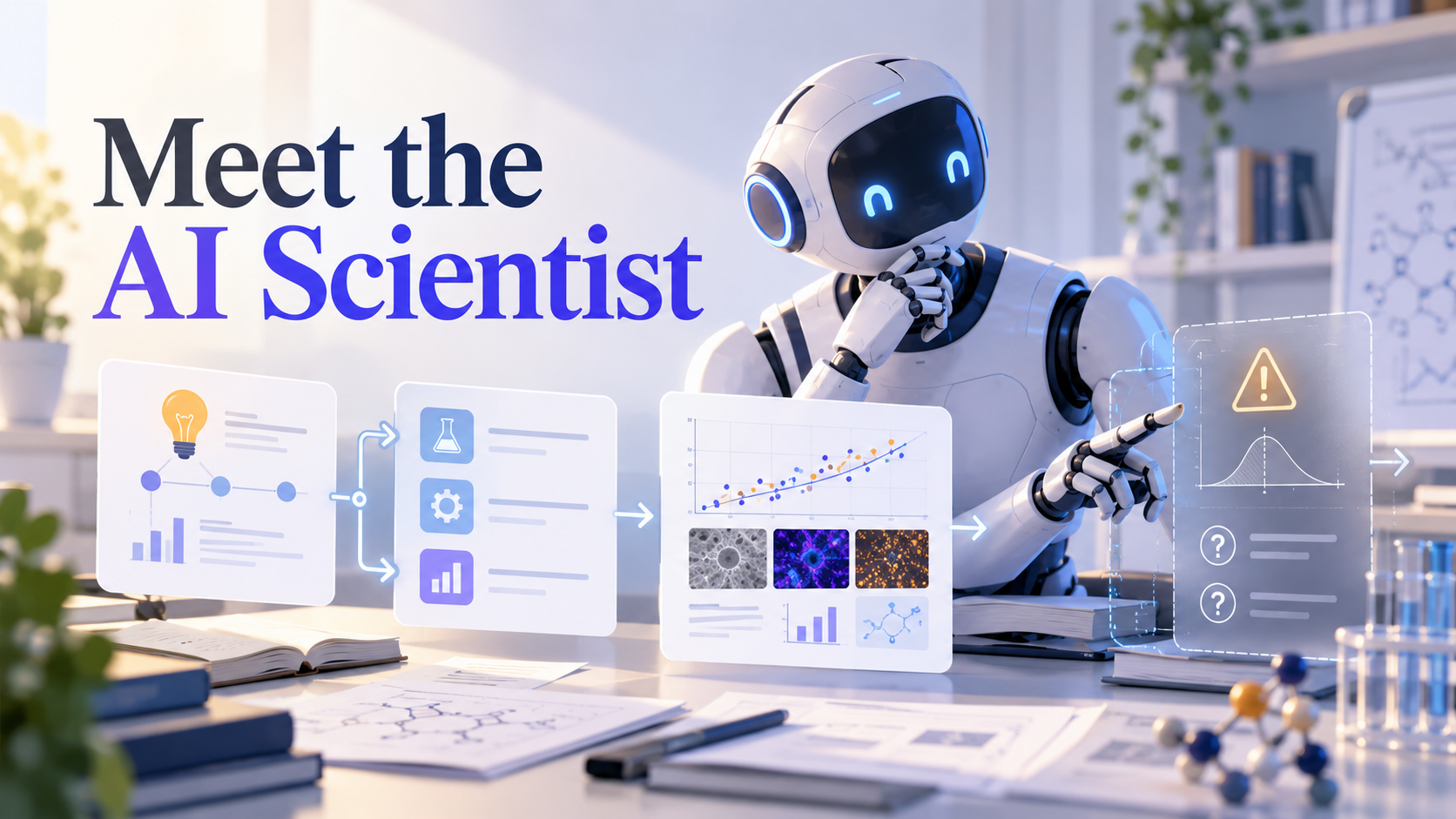
“AI scientist” sounds like a system you can hand a research question to on Monday and collect a discovery from on Friday. Current systems are more useful—and much narrower—than that image.
An AI scientist is an agentic system that attempts several parts of the research cycle rather than answering one prompt. It may search literature, propose hypotheses, write or run code, evaluate results, critique ideas, and produce a report. The important word is attempts. The workflow can be automated without making every scientific judgment reliable.
How is an AI scientist different from a chatbot?
A chatbot usually responds one turn at a time. A research agent can plan and execute a multi-step information task. An AI scientist goes further by connecting ideation, experimentation, analysis, and evaluation inside one loop.
For example, the original AI Scientist system was demonstrated in machine-learning research: it generated ideas, modified code, ran experiments, created figures, wrote papers, and used an automated reviewer. Google DeepMind's AI Co-Scientist uses specialized agents to generate, debate, rank, and refine hypotheses.
These are significant research systems. They are not evidence that a general-purpose tool can independently conduct any PhD project. A computational benchmark with executable code is very different from fieldwork, wet-lab biology, archival interpretation, or a study involving human participants.
What can it do for a PhD student today?
The most useful tasks are bounded and inspectable:
- turn a broad problem into several testable hypotheses
- search for literature that supports or challenges each hypothesis
- propose competing explanations
- draft analysis code or an experiment plan
- run computational experiments in a controlled environment
- list assumptions and failure conditions
- critique a proposal from several disciplinary perspectives
Think of it as a fast research workshop. It can produce more candidate directions than you would explore in one sitting. Your job is to decide which candidate is meaningful, feasible, ethical, and genuinely connected to the field.
What should you not delegate?
Do not hand over the final judgment that an idea is novel. Independent evaluations of autonomous research systems have found weak novelty assessments and established ideas labeled as new. Novelty depends on search coverage, current literature, field vocabulary, and expert context.
Also keep human responsibility for:
- choosing the research problem
- approving experimental or participant risk
- deciding whether methods answer the question
- interpreting unexpected results
- checking data provenance and analysis
- making authorship and disclosure decisions
An agent can simulate criticism. It cannot assume accountability for a flawed study.
Give the agent a work package, not “do my PhD”
A useful request has five parts:
- Question: the exact problem to investigate
- Evidence boundary: sources, dates, fields, and exclusions
- Deliverable: hypothesis table, search log, code, or critique
- Checks: citations, counterevidence, assumptions, and stopping rules
- Human gates: decisions the agent must leave for you
For example:
Generate three explanations for why a model fails on low-resource languages. For each, find supporting and contradictory studies since 2022, propose one computational test using our existing dataset, list required assumptions, and stop before running code.
That request creates something you can review. “Find me a novel thesis” does not.
Where can WisPaper support the workflow?
Use WisPaper Search to build the evidence set behind a proposed direction, and save the relevant papers in My Library. For longer exploratory tasks, Scholar Agent can help examine research directions; return any promising claim to the paper set and verify it with Library QA.
The useful handoff is from agent-generated possibility to researcher-checked evidence. If that handoff is missing, more autonomy simply produces a longer chain of unchecked decisions.
FAQs
Keep Reading
What Should You Give an AI Research Agent Before It Starts Searching?
Give an AI research agent a usable brief with population, concepts, dates, exclusions, evidence rules, and the output you need.

Why Your AI Paper Summary Misses the Important Details—and What to Ask Next
AI paper summaries often miss sample details, measurements, and uncertainty. Learn what to ask next and how to trace each answer back to the paper.

Why AI Research Agents Keep Finding the Same Papers
Find out why AI research agents keep returning the same papers and how new vocabulary, seeds, and search routes improve coverage.