
Research agents often fail before the first search. The user gives them a topic—“AI and student learning”—and expects the agent to infer the population, evidence standard, date range, exclusions, and final output. The result is long because the task was vague, not because the search was good.
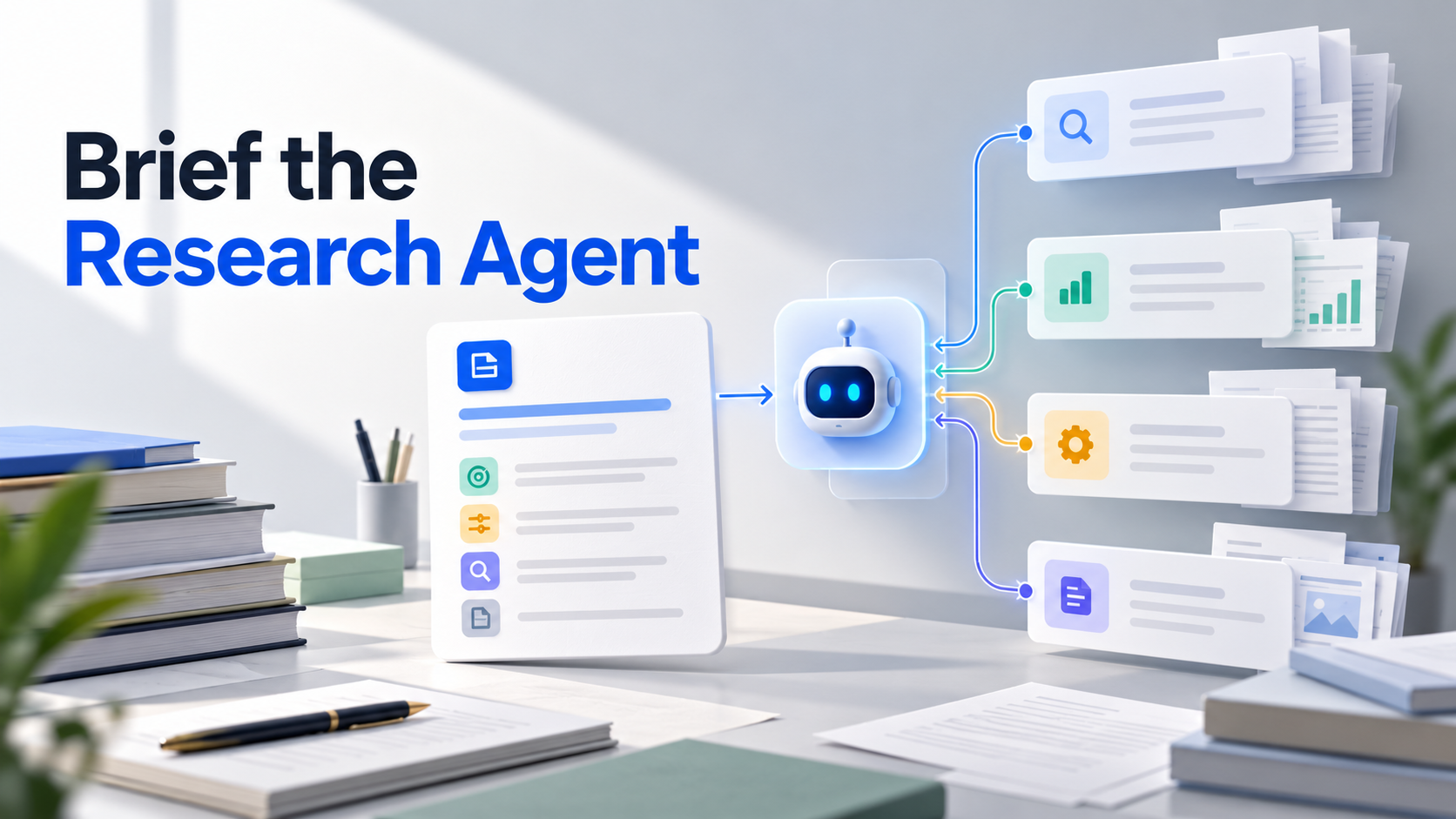
A useful agent brief should make seven decisions visible.
1. The question and the decision it will support
Write a question, then say what you will do with the answer. “How does AI affect learning?” is broad. “Should our writing center pilot AI feedback for first-year students?” gives the research a decision.
2. The population, context, and concepts
Name who, where, and what counts. Specify whether “students” means undergraduates, medical trainees, or K–12 learners. Define whether “AI feedback” includes grammar checkers, chatbots, automated scoring, or only generative feedback.
3. Seed papers and vocabulary
Give the agent one to three papers that are clearly relevant, plus known authors, acronyms, and alternative terms. Seed papers show what “relevant” looks like and provide references to follow. Tell the agent not to treat them as automatically correct or complete.
4. Evidence boundaries
State dates, languages, publication types, fields, and exclusions. If preprints are allowed, ask the agent to label them. If you need empirical studies, exclude commentaries and product pages.
5. The required deliverable
Ask for an artifact you can inspect: a paper table, evidence map, annotated reading list, or claim-to-source report. Define the fields. “Write a literature review” hides too many decisions inside prose.
6. Verification and counterevidence
Require stable links, DOI or publication records, source locations for important claims, and a search for studies that disagree. Tell the agent to write “not found” or “not reported” rather than filling gaps.
7. Stopping rules and human gates
Say when the agent should stop: after a time limit, after a set of diverse relevant papers, or when new searches stop changing the evidence map. Name decisions it cannot make, such as final inclusion, ethical approval, or running code.
A brief you can adapt
Investigate whether generative AI feedback improves revision quality for first-year university writers. Include empirical studies from 2022 onward in English and Chinese. Exclude K–12 studies, opinion pieces, and studies measuring only user satisfaction. Begin with the two attached papers and follow their terminology and citations. Return a table with publication record, population, design, comparison, outcome, numerical result, limitation, and inclusion reason. Search for conflicting and null findings. Keep a search log, label preprints, and stop after producing 15 clearly relevant candidates for my review. Do not make final inclusion decisions.
This brief will not guarantee a perfect search. It makes failures easier to see and correct.
Where WisPaper fits
You can run the question in WisPaper Search or give a longer version to Scholar Agent. Save the approved candidates to My Library, then use Library QA for questions based on that stable set.
The brief should travel with the project. When the search changes direction, update the brief rather than relying on the agent to remember an implicit decision from twenty messages ago.
FAQs
Keep Reading

Why Your AI Paper Summary Misses the Important Details—and What to Ask Next
AI paper summaries often miss sample details, measurements, and uncertainty. Learn what to ask next and how to trace each answer back to the paper.

Why AI Research Agents Keep Finding the Same Papers
Find out why AI research agents keep returning the same papers and how new vocabulary, seeds, and search routes improve coverage.

What Is an AI Scientist—and What Can It Actually Do for a PhD Student?
Learn what today's AI scientist systems can actually do for PhD work, where they help, and which research decisions remain yours.