
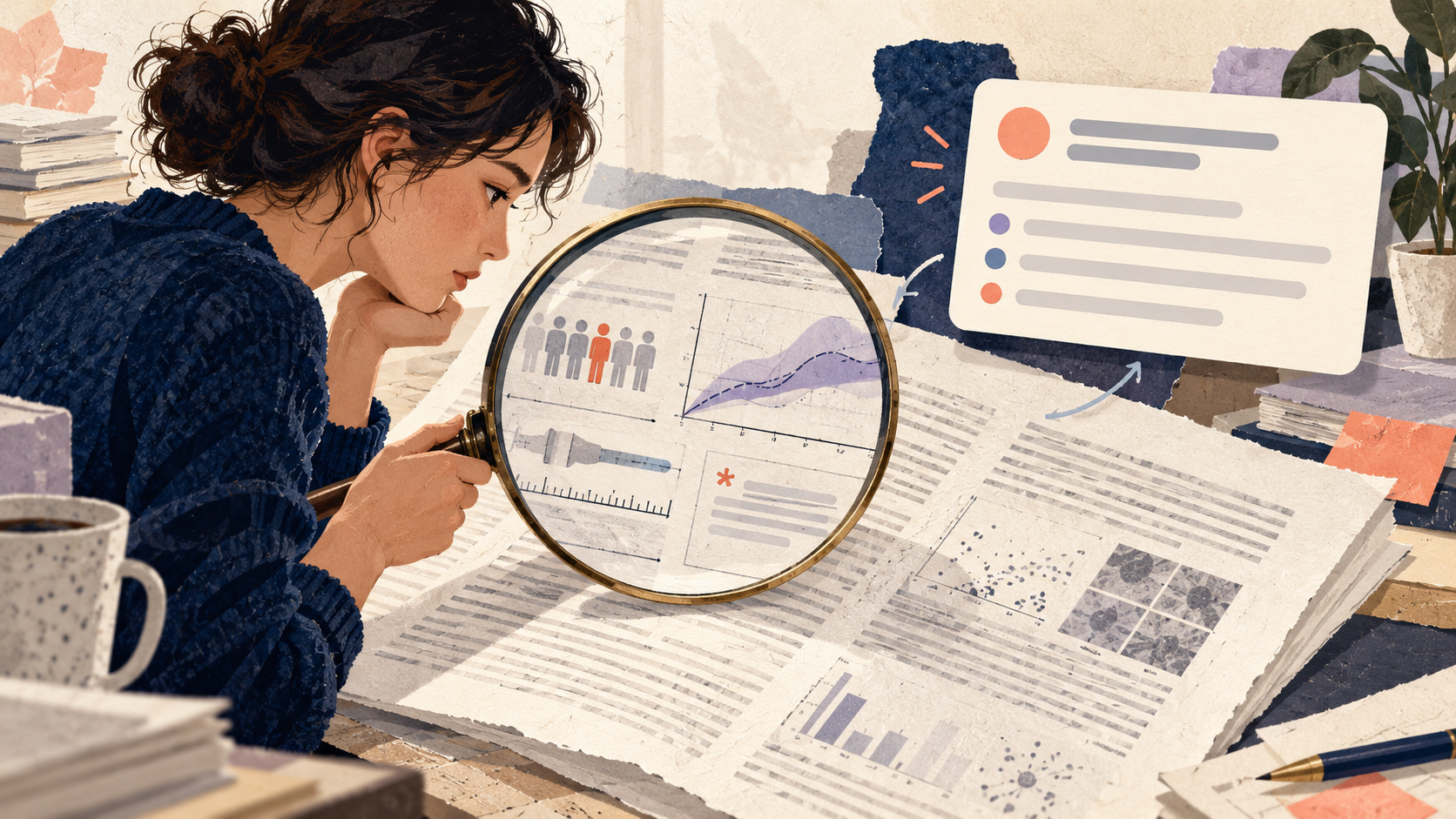
You upload a 24-page paper and ask for a summary. The answer sounds sensible: the question, the method, the conclusion. Then you open the paper and discover the detail that changes everything—the study only included 31 people, the main result was not statistically significant, or the outcome was measured with a questionnaire you would never use for your own project.
The summary did not necessarily fail. It answered a question that was too open. “Summarize this paper” gives an AI tool permission to decide what matters. Its choice may be reasonable for a quick overview and still be wrong for the decision you are trying to make.
The fix is to stop asking for a shorter paper and start asking for the pieces you need to judge it.
Why does a fluent summary leave out the detail I needed?
A research paper contains several stories at once. The abstract tells the publication's headline story. The methods explain what the researchers actually did. Tables may contain qualifications that never appear in the conclusion. Limitations tell you where the authors think the result may stop applying.
A general summary compresses all of that into one narrative. Compression favors the research question and headline finding because they are easy to state. Sample exclusions, measurement choices, subgroup results, and uncertainty are harder to fit into a smooth paragraph.
This problem becomes more obvious when you only give the tool an abstract. Abstracts are useful for deciding whether to read a paper, but they do not carry every detail needed to evaluate it. Research comparing abstracts with full reports has found missing or inconsistent information around outcomes, sample counts, and result reporting in some clinical studies. That does not mean every abstract is misleading. It means an abstract-sized answer should be treated as a map, not the terrain.
What should I ask instead of “summarize this paper”?
Ask questions that match the decision in front of you. Suppose you are reading a paper about a mindfulness app for university students. Before deciding whether it belongs in your review, ask:
What was the research question? Describe the study design, participant eligibility, sample size, intervention, comparator, outcome measures, follow-up period, numerical results, and author-reported limitations. Write “not reported” when the paper does not provide a detail. Point me to the relevant page, section, or table for each answer.
That prompt does three useful things. It names the fields you care about, makes missing information visible, and asks for a route back to the source.
You do not have to ask everything at once. A better reading sequence is often:
- What question did the study try to answer?
- Who was actually studied, and who was excluded?
- What did the researchers do or measure?
- What were the main numerical results, including uncertainty?
- What would make this result hard to apply elsewhere?
Gemini Notebook's source guide also recommends asking specific questions rather than relying on a generic request to summarize a source. If several papers are selected, name the paper you mean or narrow the source selection before asking.
How do I make the answer show evidence instead of confidence?
Ask for the claim and its location together. “The intervention improved well-being” is easy to repeat. “The well-being score changed by how much, compared with what, at which time point?” forces the answer toward the result you can inspect.
Try these follow-ups:
Show the exact result that supports the authors' main conclusion. Include the comparison group, effect size or reported difference, uncertainty measure, and table or page number.
Which sentence in the discussion goes beyond what the results directly show?
List any outcome the authors measured but did not emphasize in the abstract.
What information would I need before applying this finding to a different population?
The goal is not to catch the tool making a mistake. It is to make your own standard of evidence visible. A polished paragraph can hide ambiguity; a field such as “follow-up period: not reported” cannot.
What if I need to compare the same detail across several papers?
Do not ask for five independent summaries and compare them from memory. Use the same questions for every paper.
For the mindfulness example, you might compare:
- student population and setting
- intervention length and frequency
- control condition
- measure used for stress or well-being
- follow-up period
- main numerical result
- attrition
- author-reported limitation
Once you know those fields, the job changes from “understand these papers” to “extract the same evidence from each paper.” That is much easier to check and much more useful for a literature review.
This is also a natural point to move the papers you have chosen into WisPaper My Library. With the relevant PDFs in one collection, Library QA can answer the same field-level question across the set: “For each study, who participated, how long was the intervention, how was stress measured, and what limitation did the authors report?” If the comparison exposes a gap—perhaps every study is short-term—you can take that gap back to WisPaper Search and look for longer follow-up studies.
The product is useful here because the question remains attached to your paper set. You are not starting a fresh chat and hoping it remembers which evidence matters.
When should I stop asking the AI and open the paper?
Open the paper whenever a detail could change your conclusion. That usually includes eligibility criteria, outcome definitions, subgroup labels, numerical results, tables, figures, and limitations.
For a quick relevance check, an AI answer may be enough to tell you that a paper studies the wrong population. For a sentence you plan to cite, read the surrounding passage. For a number you plan to report, check the table, denominator, unit, and time point.
This division of labor is practical: let the tool tell you where to look, then let the paper settle what the evidence says.
FAQs
Keep Reading
Why AI Research Agents Keep Finding the Same Papers
Find out why AI research agents keep returning the same papers and how new vocabulary, seeds, and search routes improve coverage.
What Should You Give an AI Research Agent Before It Starts Searching?
Give an AI research agent a usable brief with population, concepts, dates, exclusions, evidence rules, and the output you need.

What Is an AI Scientist—and What Can It Actually Do for a PhD Student?
Learn what today's AI scientist systems can actually do for PhD work, where they help, and which research decisions remain yours.