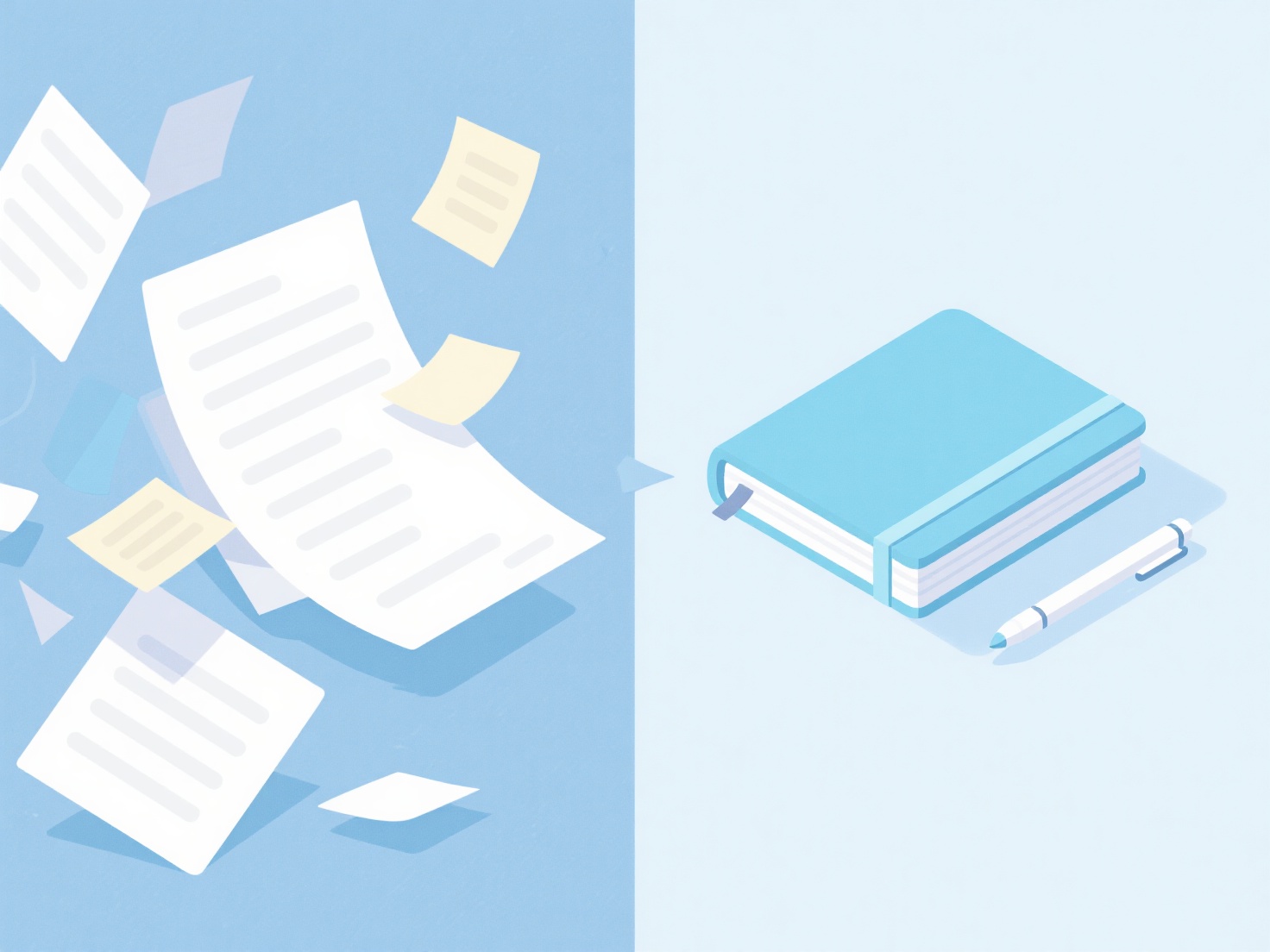
To minimize research notes, focus on synthesizing key concepts in your own words rather than copying large blocks of text, and use structured templates to capture only essential information.
Many early-career researchers fall into the trap of over-highlighting and transcribing everything out of fear they might forget a crucial detail. However, bloated literature review notes actually make it harder to synthesize research and write your final paper. By shifting your focus from extracting text to processing ideas, you can keep your notes concise and actionable.
Here are the most effective strategies to streamline your note-taking process:
1. Stop Copy-Pasting
The fastest way to bloat your notes is by copying and pasting paragraphs directly from a PDF. Instead, read a section, look away, and write down the main point in your own words. This active recall not only keeps your notes brief but also ensures you actually understand the material. Only write down exact quotes if the specific phrasing is critical to your future argument.
2. Use a Structured Note-Taking Template
Without a framework, it is easy to write down interesting but irrelevant facts. Restrict yourself to a specific template for each academic paper you read. A highly effective method is capturing just three elements: the core research question, the primary evidence or methodology, and the main conclusion. If a detail does not fit into your template, leave it out.
3. Write a One-Sentence Summary
Challenge yourself to summarize the entire paper's contribution to your specific project in a single sentence. Place this at the very top of your notes. When you revisit your reference management system months later, this brief summary will instantly tell you if the paper is worth re-reading, saving you from digging through pages of detailed bullet points.
4. Let Your Digital Library Do the Heavy Lifting
You do not need to extract every minor data point into your notes if you can easily find it later. Instead of exhaustive transcription, you can organize your PDFs in WisPaper's My Library, which allows you to manage references and chat directly with your uploaded papers via AI to instantly retrieve specific details when you actually need them. Treat your notes as a lightweight index of ideas, relying on your digital archive to hold the raw data.
5. Separate Source Notes from Your Own Ideas
Consider adopting a modular note-taking approach like the Zettelkasten method. Keep your literature notes (brief, objective summaries of what a paper says) completely separate from your permanent notes (your own synthesized thoughts, arguments, and research ideas). By isolating your original ideas from the source material, your notes become bite-sized and much easier to piece together when it is time to draft your manuscript.