
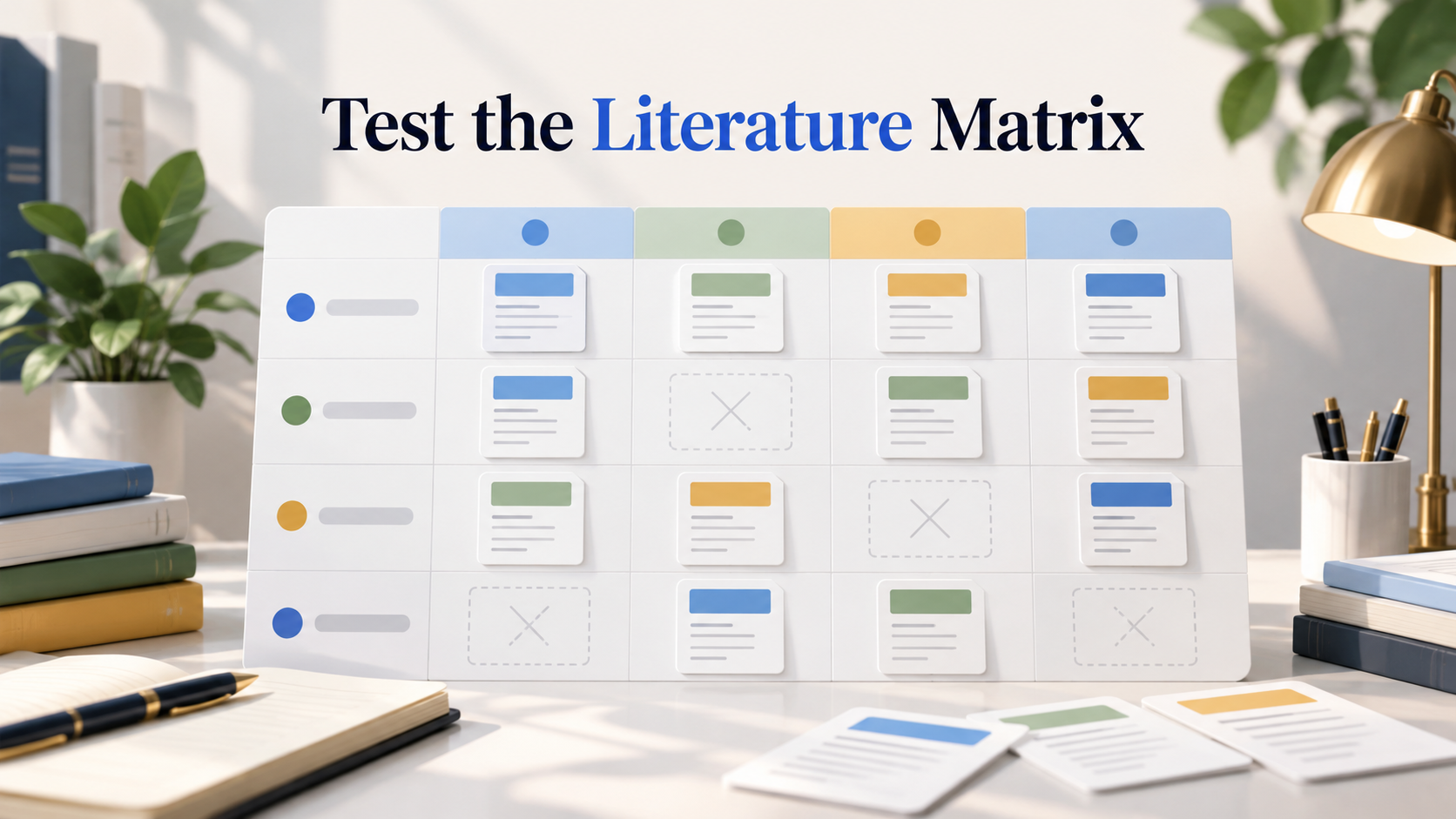
Yes, AI can build a useful first-pass literature matrix. The difficult part is not creating rows. It is keeping unlike papers from looking comparable.
I tested a matrix on the first ten papers returned for a query about digital CBT for insomnia in university students. Before extraction, I defined seven columns: citation, population, study design, intervention, comparator, sleep outcome, and decision note.
The matrix immediately did something a list of summaries had not: it exposed that several of the ten papers did not belong in the same comparison.
What worked well?
Titles, years, broad population, and document type were usually straightforward. The matrix also made obvious scope differences visible. A diabetes study, a heavy-drinking study, a systematic review, and a commentary could not quietly sit beside university trials as if they were equivalent observations.
The “decision note” column was the most valuable. Instead of forcing every paper into the synthesis, it recorded why a record was directly relevant, background only, or excluded.
That made the matrix useful for screening as well as note-taking.
Where did the matrix need correction?
Three problems appeared quickly:
- missing information became guesses: an abstract that did not name the comparator tempted the extraction to infer one
- outcomes were flattened: insomnia severity, sleep quality, daytime sleepiness, and intervention adherence are not interchangeable
- reviews and trials were mixed: a review summarizes a body of evidence; it should not be treated as another participant-level study
The safest extraction rule was: if a field is absent from the available text, write “not reported here.” Blank cells are useful. They tell you which full texts to open.
Which columns should you ask for?
Start with columns that support your actual decision. For an intervention review, that may be:
- population and setting
- design and sample size
- intervention dose
- comparator
- outcome measure and time point
- effect estimate or direction
- attrition or adherence
- relevance decision
- source location for each extracted value
Do not begin with twenty columns because a template online has twenty columns. Every field adds extraction work and another chance to invent consistency that the papers do not have.
A prompt that keeps the matrix honest
Build one row per paper. Use only the supplied text. Keep outcome names as the authors report them. Write “not reported” instead of inferring missing fields. Add a source-location column with section, table, or page. Flag reviews, commentaries, protocols, and nonmatching populations before comparing results.
Then verify the cells that will appear in your writing: sample size, comparator, primary outcome, time point, and effect estimate.
Build the evidence set in WisPaper
Save the selected papers in My Library and use Library QA to ask the same structured questions across the set. Use the answers to populate a draft matrix, then return to the papers for the cells that support your main claims.
AI makes the table fast. Your inclusion rules and cell-level checks make it trustworthy.
FAQs
Keep Reading
Can AI Read Tables in Research Papers Accurately?
Test AI table reading at the cell level and preserve headers, units, denominators, time points, confidence intervals, and footnotes.
Can AI Spot Contradictions Across Research Papers? A Small Test
Learn how AI can detect opposite-looking findings and how to separate true contradictions from differences in study design.
Can AI Summarize a Paper from Its Abstract Alone? A Full-Text Check
See what an abstract-only AI summary gets right, what full text changes, and how to run a source-grounded correction pass.