
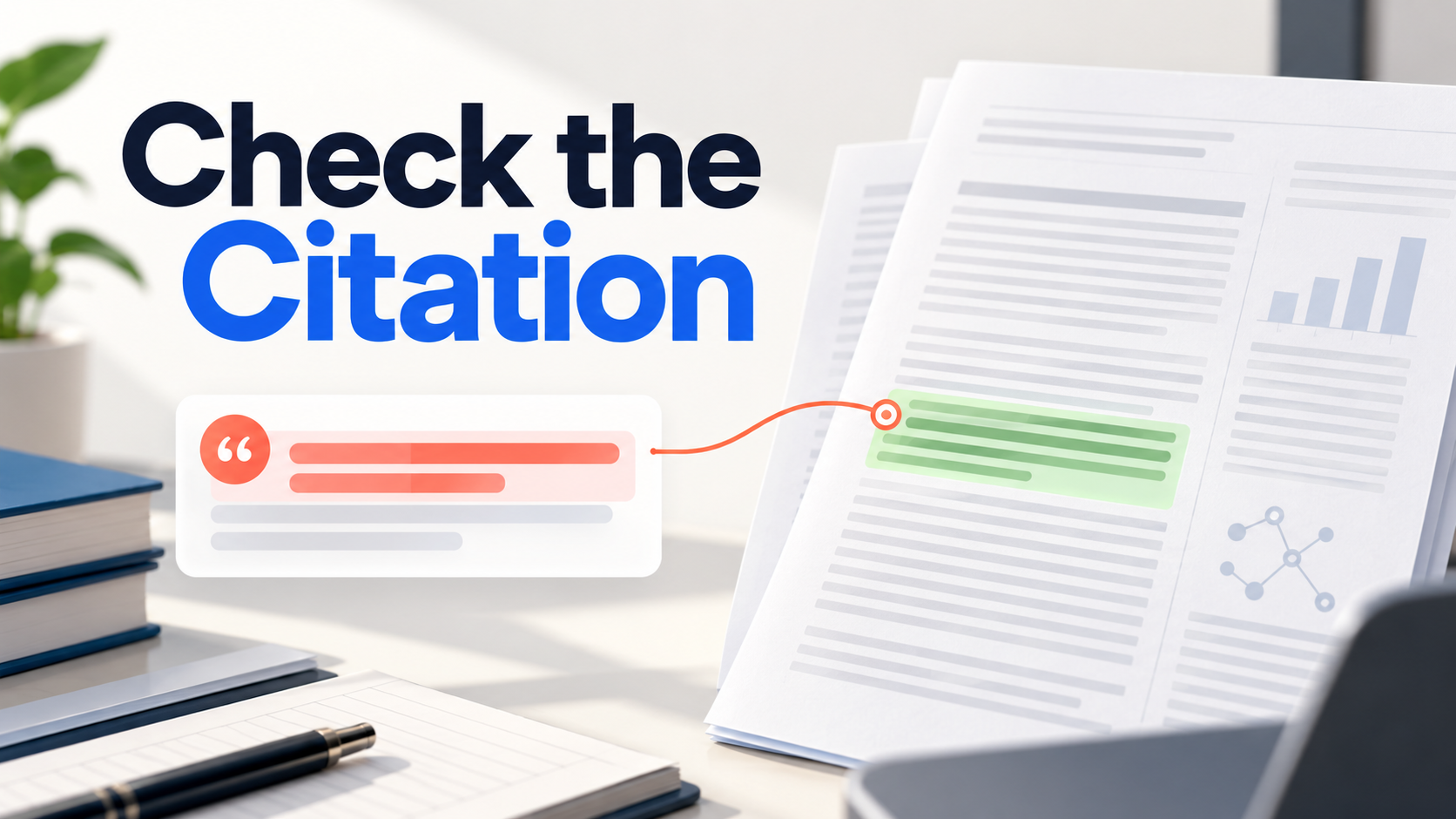
An AI answer can cite a real paper and still misrepresent it. The paper exists, the authors and DOI are correct, and the topic looks relevant—but the study examined a different population, found only an association, or reported a much smaller effect than the sentence suggests.
Citation checking has two separate questions: Does this source exist? and Does this source support this claim? The second question requires reading evidence, not just matching metadata.
Break the claim into parts before opening the paper
Take a sentence such as:
Regular use of AI writing assistants improves university students’ critical-thinking skills.
Underline what must be true for a paper to support it:
- Population: university students
- Exposure or intervention: regular use of AI writing assistants
- Outcome: critical-thinking skills
- Direction: improvement
- Causal strength: “improves,” not merely “is associated with”
Now the task is concrete. A survey showing that frequent users report more confidence would not support this sentence. A classroom trial measuring essay scores may still not support a claim about critical thinking.
Find the exact passage the AI relied on
Open the citation attached to the sentence. Search the paper for the outcome, key phrase, or reported number. Ask the tool:
Show the exact passage, table, or figure that supports each part of this claim: population, intervention or exposure, outcome, direction, and causal wording. If any part is not supported, identify it.
Then inspect the location yourself. Read enough surrounding text to see whether the sentence came from the results, the authors’ interpretation, background literature, or a limitation.
A sentence in the introduction saying “AI may improve critical thinking” is not a finding from that paper. A discussion sentence proposing a possible explanation is not the same as a measured result.
Check the four common ways a citation gets stretched
1. The population changed
Evidence from ten graduate engineering students becomes a claim about university students generally. Check eligibility, setting, and sample—not just the abstract’s broad nouns.
2. Association became causation
Cross-sectional data can show that two variables occur together. It usually cannot establish that one caused the other. Watch for verbs such as improves, reduces, leads to, and prevents.
3. The outcome changed
Self-reported confidence becomes “performance,” or engagement becomes “learning.” Find the instrument or operational definition used in the methods.
4. The size and certainty disappeared
A small, uncertain difference becomes a strong general conclusion. Check the actual estimate, comparison group, confidence interval, and whether the result was primary, secondary, or exploratory.
Rewrite the claim to match the evidence
If the paper partly supports the idea, do not discard it automatically. Narrow the sentence.
The original claim might become:
In a survey of students at one university, frequent use of AI writing assistants was associated with higher self-reported confidence in evaluating arguments.
That sentence is less dramatic, but readers can now see the design, population, outcome, and level of certainty. If the paper reports no causal test, the wording no longer implies one.
How can WisPaper help when you have many claims to check?
Save the cited papers to My Library and use Library QA to ask the same support question across them: “For each claim, identify the studied population, design, measured outcome, numerical result, and passage that supports it.” Open the cited passages before keeping the claim.
If a citation turns out to address the wrong population or outcome, search the corrected question in WisPaper Search. If the problem is that an entire .bib list may contain nonexistent records, TrueCite can flag entries for bibliographic investigation. That existence check is useful, but it does not decide whether a real paper supports your sentence.
A two-minute support test
Before using any AI-cited source, write five short answers:
- What exactly is my claim?
- What did the paper actually measure?
- Who or what was studied?
- What result supports the direction and size of my claim?
- What wording would remain true if a skeptical reader opened the source?
If one answer is missing, the citation is not ready for the draft.
FAQs
Keep Reading
Before You Trust an AI-Generated Literature Review, Check These 5 Things
Audit an AI literature review for real sources, claim support, missing evidence, false consensus, and scope before using the draft.
How to Check an AI Research Report Without Rereading Every Paper
Audit an AI research report efficiently with risk-based source sampling, claim checks, citation coverage, and stop rules.
AI Can Generate a Research Hypothesis. How Do You Check the Evidence?
Turn an AI-generated hypothesis into a testable claim, then check its mechanism, boundary conditions, and supporting evidence.