
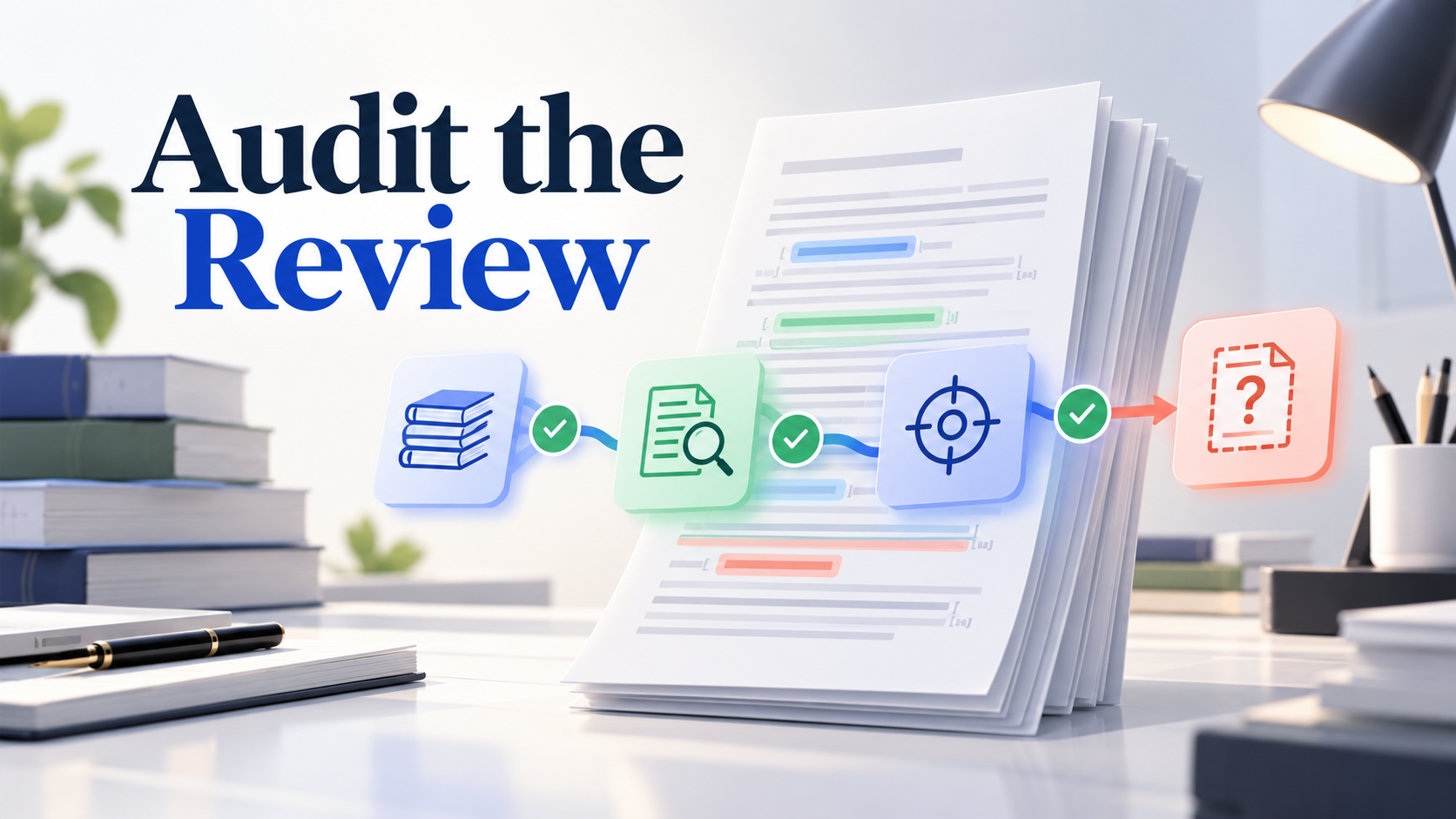
An AI-generated literature review can look finished before the research has really started. It has headings, smooth transitions, citations, and a confident conclusion. What you cannot see is whether the search missed an entire line of work or whether the citations support the sentences beside them.
You do not need to reread every source to decide whether the report is usable. Start with five checks that expose the highest-risk failures.
1. Can you see how the sources were found?
Look for databases or search systems, queries, dates, filters, languages, and inclusion rules. A list of references is not a search record.
If the report says “recent studies show,” ask which years were searched and how recent studies were identified. If it claims to cover a field, check whether the source set represents the field rather than the first pages an agent could access.
No search trail means the report may still be a useful briefing, but it should not be presented as a comprehensive review.
2. Are the sources real, scholarly, and the right type?
Sample five citations: one central source, one recent source, one surprising claim, one numerical claim, and one source you do not recognize. Open each record and confirm title, authors, year, venue, and DOI or stable link.
Then check the type. A news article about a trial is not the trial. A narrative review is not primary evidence for one experiment. A preprint and a peer-reviewed article should not be silently treated as the same status.
3. Do citations support the exact claims?
Choose three sentences that carry the argument. Break each into population, intervention or exposure, outcome, direction, and certainty. Find the supporting passage.
Watch for common upgrades: association becomes causation, one setting becomes universal, a secondary outcome becomes the main finding, or “no significant difference” becomes “the treatments are equal.”
If the report cannot point to the method or result behind a claim, rewrite or remove the sentence.
4. Does the review include disagreement and missing evidence?
A suspiciously smooth review often erased the hard parts. Search the report for conflicting findings, null results, limitations, excluded populations, and changes in terminology or method.
Ask:
Which credible sources disagree with the report's main conclusion? Which population, method, date range, or language is underrepresented in the source set?
Then search specifically for the missing side. A literature review should explain the shape of the evidence, not make every paper sound as if it voted for one conclusion.
5. Is the conclusion stronger than the evidence?
Compare the final paragraph with the strongest study design in the review. If most evidence is cross-sectional, the conclusion should not promise an effect. If studies use different definitions and outcomes, the review may support a pattern but not one pooled answer.
Check whether recommendations appear without evidence about benefits, harms, feasibility, or context. A good conclusion preserves uncertainty where the literature is uncertain.
A fast audit in WisPaper
Save the core sources in WisPaper My Library and use Library QA to extract the same fields from each paper: design, population, outcome, result, and limitation. Compare that evidence table with the generated narrative.
When the report appears to miss a population or contradictory result, run an adversarial query in WisPaper Search. If the bibliography arrives as a .bib file, TrueCite can flag entries that need bibliographic investigation. These checks do not approve the review automatically; they tell you where human reading matters most.
FAQs
Keep Reading
How to Check an AI Research Report Without Rereading Every Paper
Audit an AI research report efficiently with risk-based source sampling, claim checks, citation coverage, and stop rules.
AI Can Generate a Research Hypothesis. How Do You Check the Evidence?
Turn an AI-generated hypothesis into a testable claim, then check its mechanism, boundary conditions, and supporting evidence.
How to Check What’s New Since Your Last Literature Search
Update a literature search without starting over: use dates, saved queries, deduplication, citation alerts, and consistent screening.