
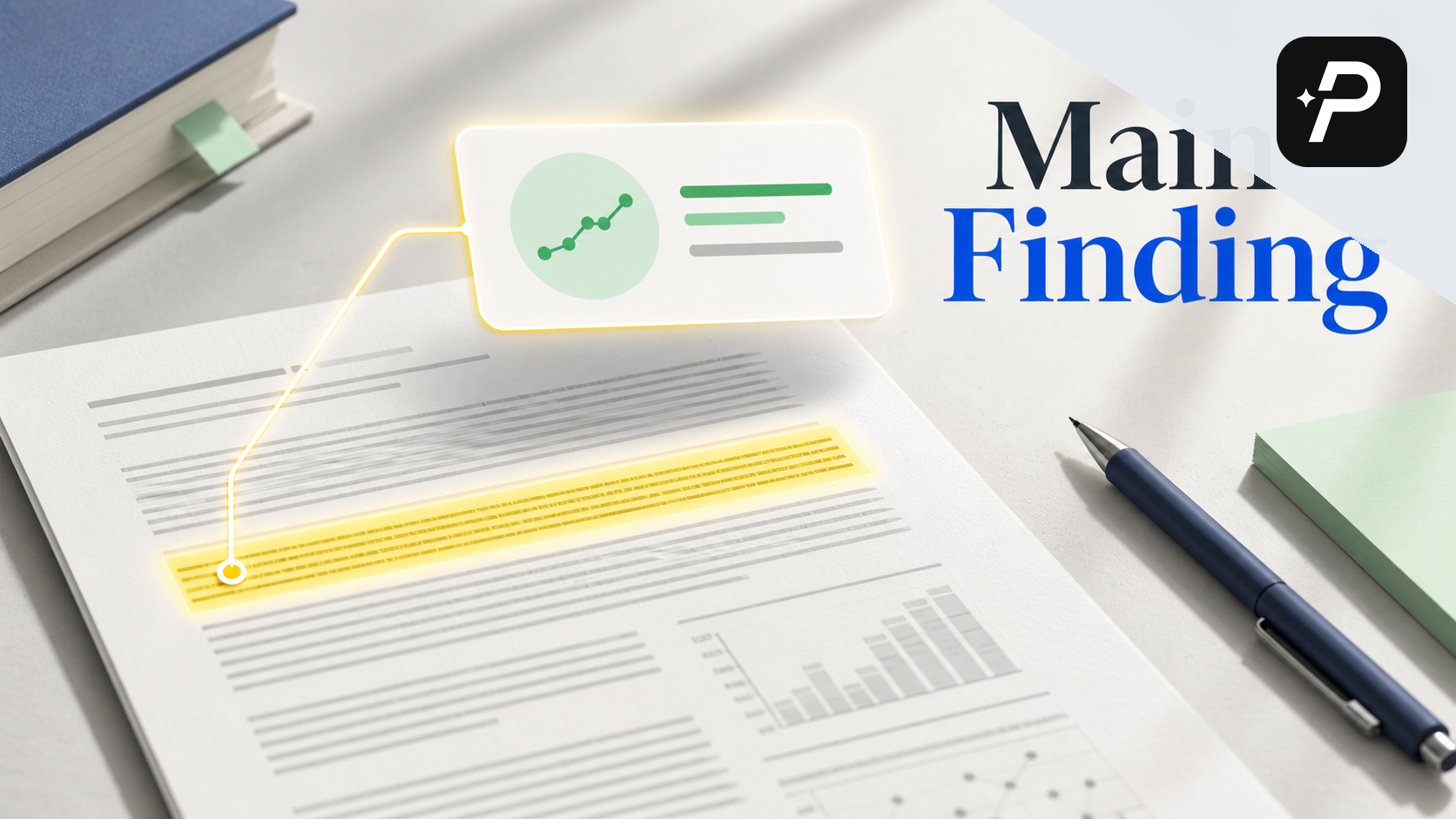
You have a stack of papers for your literature review, a seminar discussion tomorrow, and no time to read every word of every study. The main finding of a research paper is usually buried under methodology, jargon, and background sections. But you don't need to read the whole paper to get the answer.
The trick is knowing where to look and how to test what you find. Here is a practical path through any paper that gets you to the core claim in minutes.
Why Reading a Paper from Start to Finish Is a Mistake
Reading a research paper like a novel is the slowest way to identify its main finding. Academic papers are structured to build an argument, but the payoff rarely appears in the order it is written. The introduction sets up the problem. The methods explain the process. The results present the data. The interpretation lives in the discussion.
If you read linearly, you spend time on background you may already know. In a literature review, you need each paper's specific contribution, not the full history of the field. Jumping to key sections first lets you triage quickly and decide whether a paper deserves a deeper read.
A better approach is an inverted scan: abstract first, then discussion, then results. You get the answer first, then work backward to understand the evidence. This method works whether you are screening ten papers for a seminar or building a reading queue for a new research topic.
Start with the Abstract, but Read It Critically
The abstract is a miniature version of the paper. It summarizes the problem, methods, and key results. But you need to read it with a specific question in mind: What did the authors actually find?
Not what they studied. What the outcome was.
An abstract might say, "We investigated the effect of X on Y." That is the research question. The main finding is the sentence that follows: "We found that X significantly increased Y in the presence of Z."
Look for phrases like "we found," "the results indicate," "our analysis shows," or "this suggests." These signal that the authors are stating their finding, not describing their approach.
If the abstract uses a structured format with headings, go straight to "Results" or "Conclusions." That is where the finding is stated explicitly. If the abstract is vague or focuses more on the research question than the answer, move to the discussion.
A quick test: cover the abstract's first two sentences and read only the rest. If you can still tell what the paper found, the abstract is doing its job. If you only know what the paper studied, treat the abstract as a starting point rather than an answer.
Go to the Discussion for the Plain-Language Answer
The results section shows the data. The discussion explains what the data means. That is where the main finding gets stated in language you can actually use.
Authors typically restate their key results in the discussion and then interpret them in the context of the broader field. They explain why the finding matters, how it answers the research question, and what the implications are.
The opening paragraph of the discussion often contains a summary of the main finding. The final paragraph usually restates the conclusion and suggests future directions. Read those two bookends and you will have the "so what" of the paper without wading through statistical analyses.
For example, a study on remote work might present survey data in the results section. The discussion is where the authors say, "These results suggest that hybrid arrangements reduce burnout without lowering productivity." That sentence is the main finding. Everything before it is evidence.
Use the Results Section to Find the Headline Evidence
The discussion gives you the interpretation. The results section gives you the evidence that supports it. If you want to verify the main finding quickly, find the figures and tables that the discussion references most often. Those are the ones that support the core claim.
Skim the subheadings within the results section. Many papers organize findings under descriptive headings. The subheading that matches the main research question is likely where the core result sits. Within that section, look for the most striking data point—the largest effect size, the most significant p-value, or the clearest pattern in a graph.
For qualitative research, the main finding might be a central theme or narrative pattern. Look for the theme the authors return to repeatedly. That repetition signals that the finding is central to the paper's contribution.
If you are comparing multiple studies, this is where you start sorting evidence. A paper's headline result may conflict with another study's conclusion. Knowing how to locate the exact evidence behind each claim helps you spot those conflicts early, which matters when you are building a literature review evidence map.
Apply the "So What" Test
Once you have a candidate for the main finding, test it. The main finding of a research paper is a fact that matters. It should change how we think about the topic, or provide new evidence that supports or challenges existing theories.
Ask yourself: If this finding is true, what are the implications? Does it confirm a hypothesis? Does it open a new research direction? Does it have practical applications?
If the statement you identified has no clear implications, you might be looking at a secondary result, not the main one.
This test also separates the finding from the authors' recommendations. The finding is what they observed. The recommendation is what they suggest doing about it. A paper might find that a certain teaching method improves test scores. That is the main finding. The recommendation to implement the method in schools is a separate point. Cite the finding, not the recommendation, when you describe the paper's contribution.
Watch Out for the "Findings Section" Confusion
Search for help with this task online and you will mostly find articles about how to write a findings section, not how to read one. That distinction matters.
The "Findings" or "Results" section is a container for the data. The main finding is the interpretation of that data. You cannot stop at the results section and expect the answer to be obvious. You have to move to the discussion to get the full picture.
When you are triaging papers, remember that the label "Findings" does not automatically give you the answer. You have to extract the claim from the narrative.
This confusion also affects how researchers talk about papers. Someone might say, "The findings show X," when the paper actually reports data that the authors interpret differently. If you are summarizing a study for a thesis or literature review, go back to the discussion to confirm what the authors themselves claim, rather than relying on how others describe the results.
How to Confirm the Finding with AI Tools
If you are working with a large volume of literature, AI tools can speed up the triage process. WisPaper's Deep Search lets you ask a natural-language question like "What was the main outcome of this study?" instead of parsing section headings yourself. This can help you bypass structural confusion and get straight to the answer.
Paper cards in WisPaper show source labels, summaries, publication details, and author information. The summary is designed to highlight the key contribution, which gives you a strong hint about the main finding. But verify the summary against the original text before you cite it. The card is a starting point, not the final word.
If you have saved a paper to your library, you can use Library QA to ask specific questions about the text. Ask "What is the primary result of this paper?" or "What did the authors conclude about X?" The tool scans the paper and provides an answer based on the text. This is useful for confirmation, not a substitute for your own reading. For thesis writers who need to represent studies accurately, this kind of double-check can prevent misinterpretation.
When you are screening many papers at once, use these tools to rank candidates before committing to a full read. You can also use WisPaper's Deep Search to run a broader question across the literature and see which papers return the most relevant findings.
When the Main Finding Is Hard to Find
Some papers resist quick reading. Highly technical studies, theoretical articles, and papers with complex structures can hide their main finding even from experienced readers.
Try these strategies:
- Read the limitations section. Limitations often reveal what the authors believe is their most important contribution. If they say "Our study is limited by X," the main finding is probably about Y.
- Look for press releases or plain-language summaries. Many institutions publish summaries of their research. These often state the main finding in accessible language.
- Find a review or commentary on the paper. Other researchers summarize the main finding in their own words. Be aware that they might interpret the paper differently than the authors do.
- Explain the paper to someone else. The act of explaining forces you to identify the core message.
If you are still stuck, consider whether the paper's role in your work is actually central. Some papers matter for their methods or their theoretical framing, not for a single headline finding. Knowing what you need from a paper before you read it will save you time. If a paper is relevant only for its methodology, you can skip the hunt for a main finding entirely.
How to Triage Multiple Papers at Once
When you have dozens of papers to screen, finding the main finding in each one individually still takes too long. Build a simple triage workflow:
- Skim the abstract for a result statement. If the abstract ends with a clear claim, record it.
- Read the discussion's opening paragraph. Compare it to the abstract's claim. If they match, you have your finding.
- Check the most-cited figure or table. Confirm that the evidence supports the claim you recorded.
- Flag papers where the abstract and discussion disagree. These need a full read to resolve.
- Move on. Do not read the introduction or methods unless the paper passes this screen.
This workflow works well when you are building a reading queue for a new research topic. You can screen twenty papers in under an hour and keep only the ones with clear, relevant findings.
The same approach helps you avoid source overload in a literature review. Instead of accumulating papers that might be useful, you filter for the ones with findings you can actually use.
How This Fits into a Literature Review
Identifying the main finding is the first step in synthesis. Once you know what each paper found, you can group studies by agreement or disagreement, compare effect sizes, and identify patterns across the literature.
When you find that two papers report conflicting results, check whether they measured the same outcome or used different populations. The main finding in each paper may be correct within its scope, and the conflict may be an artifact of different methods. That kind of analysis is where a literature review earns its keep.
If you are finding conflicting evidence in a literature review, the ability to extract each paper's main finding quickly becomes essential. You need to compare claims across studies without getting lost in each paper's unique framing.
The same skill helps when you are building a conceptual framework from literature. The main findings of your key sources become the building blocks of your framework. Each finding contributes a piece of the structure you are constructing.
Before You Cite, Verify the Paper Is Still Valid
Finding the main finding matters little if the paper has been corrected or retracted. Before you build an argument on a study's conclusion, check its status. A retracted paper's main finding should not appear in your literature review as if it were established fact.
This verification step is easy to skip when you are moving fast, but it protects you from citing work that the field has already rejected. If you are unsure how to check, learn how to check whether a paper has been corrected or retracted before you rely on its findings.
The Last Step: Write Down the Finding in Your Own Words
Once you have identified the main finding, write it down in one sentence without looking at the paper. If you can do that, you understand the contribution. If you cannot, go back to the discussion and try again.
This written sentence becomes the basis for your annotations, your literature review, or your seminar notes. It also gives you a reference point when you encounter the paper again later. You will not need to re-read the whole article to remember what it contributed.
For thesis writers, this habit pays off across an entire project. When you return to a paper months after first reading it, a one-sentence summary of the main finding tells you immediately whether the paper is relevant to your current chapter. That saves you from re-reading dozens of papers during the writing phase.
If you are finding research gaps with AI, your recorded findings become the raw material. The gaps appear when you compare what studies found against what they did not address. Without clear summaries of each paper's main finding, those gaps stay invisible.
FAQs
Keep Reading
Is This Paper Relevant to Your Topic? How to Decide
You have a PDF open, a highlighter ready, and a creeping doubt. The paper is well-written and the title looks promising, but you cannot tell if it actually belongs in your literature review or annotated bibliography. The

How to Read 20 Research Papers Without Losing Track
You have fifteen PDFs open, another five waiting in a folder, and a vague memory that one of them contained a definition you needed. The problem is not that you read slowly. It is that nothing outside your head is keepin
How to Synthesize Research Papers Instead of Summarizing Them
You have read ten papers. You have highlighted the key findings. You have written a paragraph about each one. But when you look at your draft, it reads like a list: "Smith found X. Jones found Y. Patel found Z." This is