
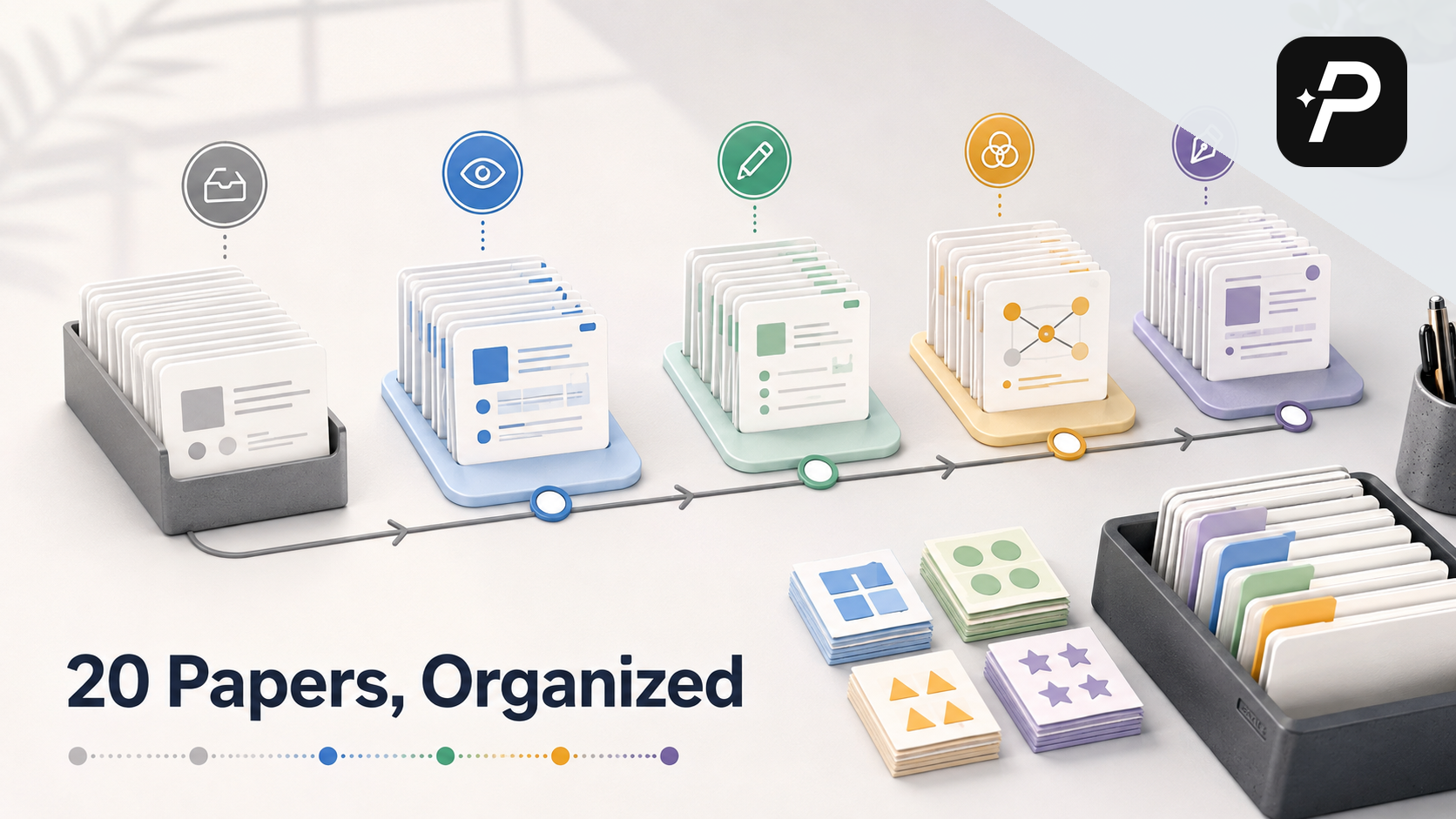
You have fifteen PDFs open, another five waiting in a folder, and a vague memory that one of them contained a definition you needed. The problem is not that you read slowly. It is that nothing outside your head is keeping track of what each paper says, why you saved it, and how it connects to your research question.
Reading twenty papers is manageable if you separate the work into stages: decide what matters before you read, capture the right details while you read, and build a system that lets you compare papers after you close them. This guide walks through that workflow.
Why Reading Twenty Papers Feels Different from Reading Five
With five papers, you can hold the main arguments in your working memory. With twenty, that stops working. The issue is not comprehension—it is retrieval. You read something important in paper seven, but by paper fifteen you cannot remember whether the finding came from paper seven or paper twelve.
Three specific mistakes create this problem:
- Reading without a filtering step. You treat every paper as equally important and read each one in full, which means you spend the same energy on a peripheral paper as on a foundational one.
- Taking notes that capture content but not relationships. Summaries tell you what each paper says, but they do not tell you how the papers speak to each other.
- Storing papers in scattered locations. A paper on your desktop, one in an email attachment, and three in a reference manager means you waste time hunting for sources you already found.
The fix is a workflow that moves information out of your head and into a system you can query. That frees your attention for the actual intellectual work: judging arguments, comparing methods, and finding gaps.
How Do You Decide Which Papers Deserve a Full Read?
Before you read anything deeply, screen the full set. Compile your candidate list of twenty to thirty papers from initial searches, then narrow it to the twenty most relevant based on titles and abstracts.
This screening step is where you apply a simple relevance test. For each paper, ask:
- Does the abstract address my research question directly, or only touch on it?
- Is the paper recent enough for my field, or has the literature moved on?
- Does the methodology match the kind of evidence I need?
Papers that fail these tests do not get deleted. They move to a "background" folder for potential citation of definitions or general context. The ones that pass become your core reading list.
If you are starting a new topic and do not yet have a candidate list, you need a different first step. A reading queue helps you build and prioritize that list before you open the first PDF. The key is not to skip triage. Reading twenty papers in full when only twelve are directly relevant wastes hours you could spend on synthesis. A separate guide on how to build a reading queue for a new research topic can help you set that queue before the reading batch begins.
What Is the Two-Pass Strategy for Reading a Batch of Papers?
Once your queue is set, do not read papers in the order you found them, and do not read them all at the same depth. A two-pass approach protects your focus.
First pass: the five-minute scan. For each paper, read the title, abstract, the final paragraph of the introduction (where authors usually state their contribution), and the conclusion. Skim the headings and look at the figures and tables. Then write one sentence answering: what is this paper's main claim, and does it matter for my work?
This pass creates a map of the landscape. You may discover that three of your twenty papers are less relevant than their titles suggested. Move them to the background folder. You may also notice that four papers cluster around the same sub-question—read those together so you can compare them directly.
Second pass: deep reading for the core set. Only the papers that survive the first pass get a full read. For these, work through the methodology, results, and discussion carefully. This is where you extract detailed evidence, note limitations, and record how the paper supports or challenges your argument.
The two-pass method has a second benefit. When you finish the first pass across all twenty papers, you have a rough sense of the whole field. That context makes the deep reads faster and more targeted, because you already know where each paper fits.
What Should You Record for Each Paper?
Random highlights and margin notes are not enough when you are juggling twenty sources. You need a consistent note schema—the same set of fields for every paper—so that comparison is possible later.
A workable schema includes:
- Full citation, so you do not have to reconstruct it during writing.
- Research question: what did the authors ask?
- Methodology: qualitative, quantitative, case study, review, or something else?
- Key findings: the two or three results that matter most.
- Limitations: what the authors say they could not do.
- Your connection: does this paper support, contradict, extend, or complicate another paper you have read?
The last field is the one that prevents the "twenty isolated summaries" problem. It forces you to note relationships while you read, instead of trying to reconstruct them weeks later.
How Do You Compare Papers Side by Side?
A literature matrix, sometimes called a synthesis matrix, is the practical tool for comparison. It is a simple grid: rows are papers, columns are your note fields.
When you need to write a literature review, the matrix lets you scan across a column to answer questions like: which papers used qualitative methods? Which ones found conflicting results on the same intervention? Which ones share a limitation you can address in your own study?
The matrix also reveals gaps. If every paper on one subtopic comes from the same research group, you may need to search for independent replication or alternative perspectives. That kind of analysis is nearly impossible when your notes live in separate documents with no shared structure.
How Do You Keep Papers Organized While You Work?
A literature matrix works best when the underlying papers are stored in one place. A centralized library—where you can upload PDFs, save papers from searches, and tag them with your own labels—prevents the "which folder was that in?" problem.
Organize the library by the same themes you use for reading groups. If you are reading three papers on measurement validity and five on intervention design, create collections or tags for each. This structure means you can pull up all sources for a given section of your thesis without remembering filenames.
The library also matters for a less obvious reason. When you are deep in a reading session, the interface you use affects how quickly you can reorient yourself. Paper cards that show the source label, a summary, publication details, and authors in a single glance let you scan a grid and remember what each paper is about without reopening the PDF. That reduces the friction of moving between papers and helps you maintain your reading flow.
If your current system is a desktop folder with files named "paper_final_v2.pdf," it is worth fixing before you start a large reading batch. A guide on how to manage a PDF library for literature reviews covers practical strategies for naming, tagging, and structuring files so you can find what you need instantly.
How Do You Check That You Actually Understood the Papers?
Reading is not the same as understanding. A useful test is to ask questions about your own library and see whether you can answer them without reopening the PDFs.
For example, after reading a set of papers on remote learning, you might ask: what sample sizes were used across these studies? Or: which papers mentioned limitations related to self-reported data? If you cannot answer from your notes, that is a signal you need to go back and re-read a specific section.
This is where a tool that answers questions based on your saved papers can help. When your library is organized in one place, you can query it directly instead of re-reading entire documents to find a single detail. That saves time during the writing phase, when you need to verify a claim or check a number quickly.
The same approach helps you identify gaps in your understanding. If you cannot answer a basic question about your sources, you likely skimmed a section that matters. Go back and read it properly before moving on.
What Do You Do When You Find Gaps in Your Sources?
After reading your initial twenty papers, you will likely notice places where the evidence is thin or the conversation is one-sided. Filling those gaps often means searching for additional literature.
Traditional keyword searches can be frustrating here, especially when you need to combine multiple concepts. Constructing a query like ("remote learning" OR "online education") AND ("student engagement" OR "motivation") requires you to anticipate every synonym the literature might use.
An alternative is to search using a natural-language research question. Instead of building a Boolean query, you can type something like, "What factors influence student engagement in remote learning environments?" and let the search tool interpret the question and find relevant papers. This works well when you are moving between reading and searching—you notice a gap in your matrix, and you can immediately search to fill it without breaking your workflow.
WisPaper's Deep Search supports this kind of natural-language query against academic literature. It is useful at the moment when you have read enough to know what you are missing, but you do not want to spend an afternoon constructing the perfect search string.
How Do You Avoid the Trap of Reading More and More?
Reading twenty papers is a significant task, but the real danger is that you will keep adding papers and never reach synthesis. Source overload happens when you have more material than you can meaningfully process. The symptom is a reading list that grows faster than your notes, and the result is analysis paralysis.
Set a limit for your initial reading phase. Decide that you will read twenty papers deeply and then stop to synthesize. This constraint forces selectivity and gives you a clear endpoint. When you hit saturation—new papers cite the same key works you have already read and present no fundamentally new arguments—you have enough to write.
If you find yourself constantly adding papers to your queue without removing others, step back. A practical guide on how to avoid source overload in a literature review can help you set boundaries. The goal is not to read everything on your topic. It is to read the right things well enough to make an argument.
How Does This Workflow Prepare You for a Supervisor Meeting?
Reading twenty papers is often preparation for a conversation where you need to demonstrate that you understand the literature and can articulate how it shapes your research direction. A disorganized reading process makes that conversation harder than it needs to be.
With the workflow described here, you arrive with a literature matrix and a centralized library. You can show your supervisor the matrix to illustrate the landscape of your research area and point to where your work fits. You can also use your notes to formulate specific questions about methodology or scope, rather than vague statements about "the literature."
For a structured approach to translating your reading into a productive meeting, a workflow on how to prepare for a supervisor meeting with an AI literature review workflow walks through the preparation steps. The effort you put into reading pays off when it directly informs discussion about your research direction.
FAQs
Keep Reading
How to Synthesize Research Papers Instead of Summarizing Them
You have read ten papers. You have highlighted the key findings. You have written a paragraph about each one. But when you look at your draft, it reads like a list: "Smith found X. Jones found Y. Patel found Z." This is
Summary vs. Synthesis in a Literature Review
Your supervisor wrote "this is just a summary" in the margin of your literature review draft. You had read every paper, taken detailed notes, and described each study in turn. The feedback feels unfair because you did th
Too Many Sources for Your Literature Review? How to Organize Them
You have 80 tabs open, three reference managers, and a folder called "final_final_lit_review" that contains 47 PDFs. If this sounds familiar, you are not alone. Hitting the wall of **too many sources literature review**