
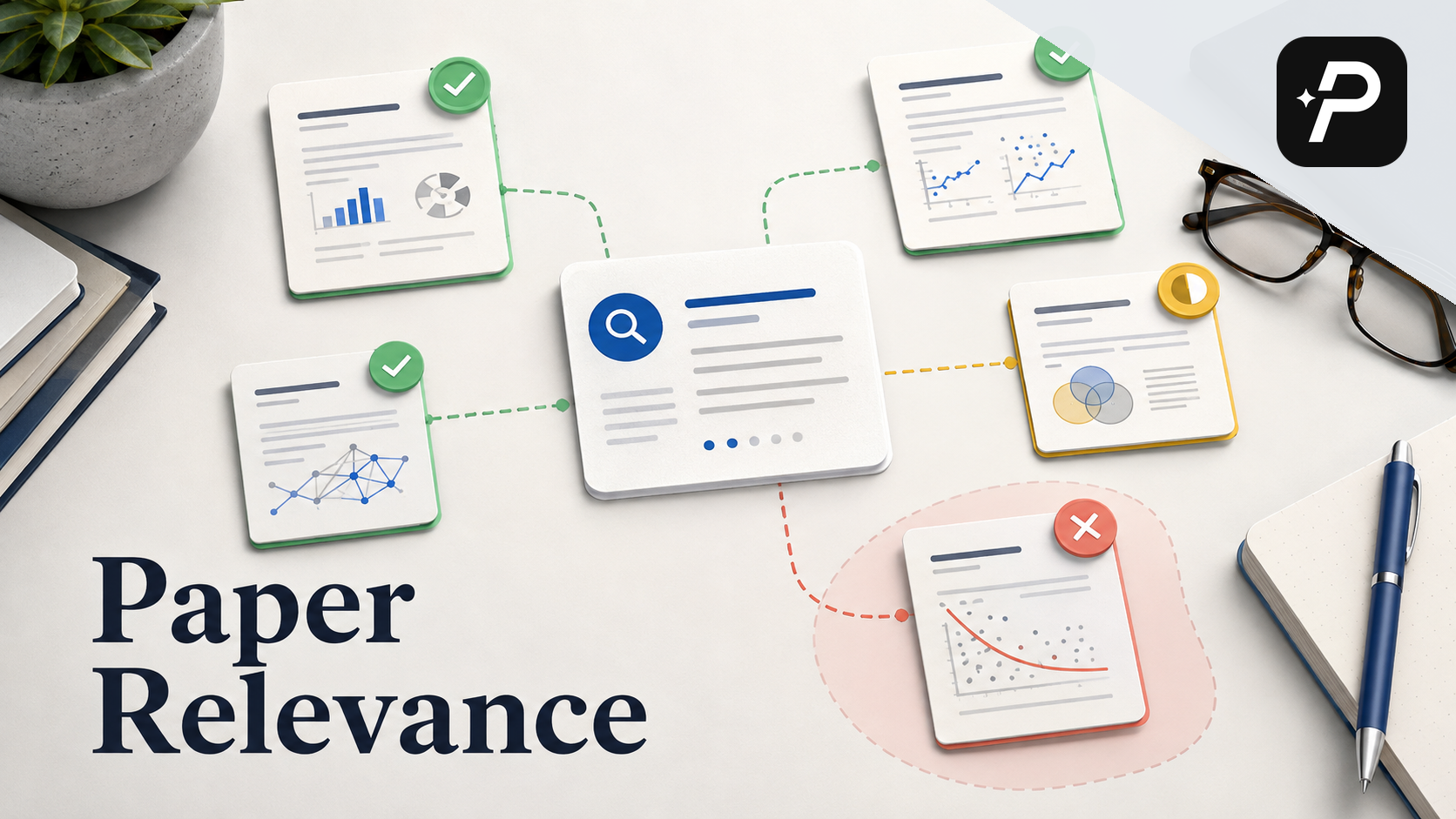
You have a PDF open, a highlighter ready, and a creeping doubt. The paper is well-written and the title looks promising, but you cannot tell if it actually belongs in your literature review or annotated bibliography. The question "is this paper relevant to my topic?" feels subjective, but it is not. Relevance is a decision you can break into specific checks.
This guide walks through those checks in the order you should apply them, so you can sort any paper into one of three groups: read fully, save for later, or exclude.
What Does Relevant Mean for a Research Paper?
Relevance is not the same as quality. A paper can be rigorous, well-cited, and methodologically sound, yet still have nothing to do with your work. Relevance means the paper has a clear, useful connection to the specific research you are doing right now.
That connection can take several forms. A paper might answer your research question directly. It might study the same population or setting you care about. It might use a method you are considering for your own study. Or it might provide evidence that supports, contradicts, or complicates a claim you want to make.
Most papers fall somewhere on a spectrum. A few will be directly on-topic and become core sources. Many will be tangentially related, offering background or context. Some will look relevant at first glance but fail once you check the details. Your job is not to find only perfect matches. It is to decide which papers deserve deeper reading, which deserve a quick note, and which should be excluded entirely.
The checks below give you a consistent way to make that call.
Does the Paper Answer Your Actual Question?
Start by writing your research question in plain language. If your topic is broad, break it into sub-questions. For example, if your topic is "the impact of remote learning on student engagement," your sub-questions might be:
- What specific aspects of engagement are measured?
- Which student populations are studied?
- What type of remote learning format is examined?
Now read the paper's abstract with those questions in front of you. Look for the paper's stated objective. Does it investigate the same relationship, concept, or phenomenon you are exploring?
A paper about teacher workload during remote learning might mention student engagement in passing, but it is not answering your question about student engagement. The title may be tempting, but the abstract should make the paper's actual focus clear.
One useful test: if someone asked you what this paper found, would your answer connect directly to your research question? If not, the paper might still be useful for background, but it is not a core source for your argument.
Does It Match Your Population, Setting, or Concept?
A paper can address your general topic and still be irrelevant because it studies a different population, setting, or version of the concept.
Population matters more than most students expect. If your research is about undergraduate students in large lecture courses, a study of primary school children in small classrooms may not transfer. The findings might not apply, and citing the paper could weaken your argument. Check the sample description in the abstract or methods section before you commit.
Setting matters in the same way. A study conducted in a clinical hospital may not apply to a community health context. Research based on data from one country may not transfer to another, especially if your topic involves policy, culture, or infrastructure.
Conceptual match is trickier. Two papers can use the same term but mean different things. One paper might define "engagement" as behavioral participation, while another defines it as emotional investment. Check the paper's definitions and theoretical framework. If the paper's concept is meaningfully different from yours, it may not be relevant even when the vocabulary looks identical.
A paper that matches your population and concept but uses a different method can still be relevant. A paper that matches your topic but studies a completely different population usually cannot.
Is the Method Useful for Your Purpose?
The method matters for relevance in two ways: it determines what kind of evidence the paper can provide, and it determines whether the paper can serve as a model for your own work.
First, think about what the method allows the authors to claim. A qualitative study with in-depth interviews can tell you about experiences and perceptions, but it cannot give you statistical generalizability. A randomized controlled trial can suggest causality, but it may not capture the complexity of a real-world setting. A systematic review synthesizes existing evidence but does not present new primary data.
Ask yourself whether this method produces the kind of evidence your research question needs. If you are arguing for a causal relationship, you need studies with strong internal validity. If you are exploring a poorly understood phenomenon, qualitative studies may be more relevant.
Second, consider whether the paper is methodologically useful as a template. If you are planning your own study, a paper that uses a method you are considering can be highly relevant even if its findings are not directly applicable. It can show you how to operationalize variables, structure an interview guide, or analyze data.
This check is especially useful for deciding whether to read the full text. If the abstract reveals a method that cannot serve your purpose, you can often exclude the paper without opening the PDF.
Does the Finding Support a Claim You Need to Make?
Relevance depends on the argument, not only the topic. A paper can be perfectly on-topic but still fail to support the specific claim you need to make.
Before screening papers, list the claims you expect to make in your writing. These might include:
- A claim about the current state of research, such as "studies have shown mixed results"
- A claim about a gap in the literature, such as "few studies have examined this population"
- A claim about a relationship, such as "X is associated with Y"
- A claim about methodology, such as "most studies use self-report measures"
Now match each paper to a claim. Does the paper's finding directly support, contradict, or complicate a claim you want to make? A paper that contradicts your argument is still relevant; in fact, it is essential for a balanced review. A paper that provides context but does not speak to your claims may be less relevant.
Be careful not to overstate what a paper shows. A paper that finds a correlation does not support a causal claim. A paper that studies a specific subgroup does not necessarily apply to your broader population. Relevance includes accuracy: the paper must support the claim you attribute to it.
Is It Worth Reading Fully, Saving for Later, or Excluding?
Once you have applied the checks above, you can place each paper into one of three categories.
Read fully. These papers answer your question, match your population and concept, use a useful method, and support a claim you need to make. They deserve your full attention. Read them carefully, take detailed notes, and prepare to cite them.
Save for later. These papers are partially relevant. They may have a useful method, provide background context, or address a sub-question you have not yet developed. Save them in your library, but do not read them in full yet. You may return to them if your argument shifts or if you need supporting material.
Exclude. These papers fail the relevance checks. They may be about a different population, use an irrelevant method, or not speak to your claims. Excluding a paper is not a judgment on its quality; it is a judgment on its fit with your work.
Make this decision consciously. A common mistake is to read every paper in full, hoping to discover relevance. That wastes time. Use the title and abstract for a first pass, then apply the checks above to decide which papers move to full reading. For a deeper look at this process, see our guide on how to screen 1000 papers and the difference between title abstract vs full text screening.
How Should You Record Relevance Decisions?
Relevance decisions are only useful if you can remember them. A pile of PDFs with no notes is a pile of undecided papers. You need a system for recording why a paper was included or excluded.
For each paper you screen, write a one or two sentence justification. This does not need to be elaborate. For an included paper, note which claim it supports and how it fits your topic. For an excluded paper, note which check it failed.
Here is a simple format you can adapt:
- Paper: Author, year, title
- Decision: Include / Exclude / Save for later
- Reason: Fails population check (studies adults, not adolescents) OR Supports claim about mixed evidence on intervention effectiveness
This record helps you avoid re-reading papers you have already screened. It provides a transparent trail for your supervisor or instructor. And it forces you to articulate your reasoning, which improves the quality of your decisions.
If you are building an annotated bibliography, this record becomes the foundation of your entries. Each annotation can summarize the paper's relevance to your topic and its role in your argument. For a workflow that connects screening to annotated bibliography writing, see our guide on the annotated bibliography ai workflow.
How Can WisPaper Help with Paper Triage and Library Organization?
WisPaper is designed to support your screening process, not replace your judgment. The tools help you move through papers faster and keep your decisions organized.
When you search for literature, WisPaper's Deep Search lets you ask a natural-language research question instead of constructing a long Boolean query. This can help you find papers that are more likely to be relevant in the first place, because the search is guided by your actual question.
As results come back, paper cards give you a first-pass triage view. Each card shows source labels, a summary, publication details, and authors. This is the information you need to apply the early relevance checks without opening the full PDF. You can quickly decide which papers look promising and which can be excluded.
For papers that pass the first pass, you can save them to My Library. This is where your relevance decisions live. You can upload papers you have found elsewhere, organize them by topic or project, and keep them in one place for later reading.
When you are ready to engage with the content, Library QA lets you ask questions based on the papers in your own library. This is useful when you need to check whether a specific paper addresses a particular concept or finding without re-reading the whole text.
WisPaper also offers Scholar Agent to help you explore research questions and paper directions inside the search workflow, and Inspiration Discovery can surface related angles when your topic is too broad, too narrow, or underdeveloped. These features can help you refine your question, which in turn makes your relevance checks more precise.
WisPaper does not make inclusion decisions for you. The tools help you gather, organize, and query information, but the judgment about whether a paper is relevant remains yours. For a discussion of what AI can and cannot do in the review process, see literature review mistakes ai cannot fix and the difference between an ai answer engine vs research library.
FAQs
Keep Reading
How to Read 20 Research Papers Without Losing Track
You have fifteen PDFs open, another five waiting in a folder, and a vague memory that one of them contained a definition you needed. The problem is not that you read slowly. It is that nothing outside your head is keepin
How to Synthesize Research Papers Instead of Summarizing Them
You have read ten papers. You have highlighted the key findings. You have written a paragraph about each one. But when you look at your draft, it reads like a list: "Smith found X. Jones found Y. Patel found Z." This is
Summary vs. Synthesis in a Literature Review
Your supervisor wrote "this is just a summary" in the margin of your literature review draft. You had read every paper, taken detailed notes, and described each study in turn. The feedback feels unfair because you did th