

You have read ten papers. You have highlighted the key findings. You have written a paragraph about each one. But when you look at your draft, it reads like a list: "Smith found X. Jones found Y. Patel found Z." This is the classic paper-by-paper summary trap, and it is one of the biggest reasons literature reviews feel flat.
The fix is learning how to synthesize research papers rather than just describing them. Synthesis is the act of combining sources to make a new point—one that no single paper makes on its own. It is the difference between reporting what researchers said and explaining what their combined work means. This guide shows you the concrete moves to make that shift, from grouping evidence to writing synthesized claims.
What Does It Mean to Synthesize Research Papers?
To synthesize research papers means to combine findings, methods, or arguments from multiple sources to create a new understanding. Think of it like cooking: a summary lists the ingredients, but synthesis is the dish. You take elements from different papers, mix them together, and produce something that did not exist before.
In academic writing, synthesis is not about finding one "correct" answer across your sources. It is about identifying relationships. Those relationships can be:
- Agreement: Multiple papers support the same conclusion.
- Complementarity: Papers look at different parts of the same problem.
- Contradiction: Findings conflict, and you need to explain why.
- Progression: Later studies build on or refine earlier ones.
When you synthesize, you are the one making the connections. The papers are your evidence, but the insight is yours. This is why instructors say a good literature review is an argument, not a summary. You are building a case about what the research shows, where it is solid, and where it is still uncertain.
Why Is Paper-by-Paper Summary Not Enough?
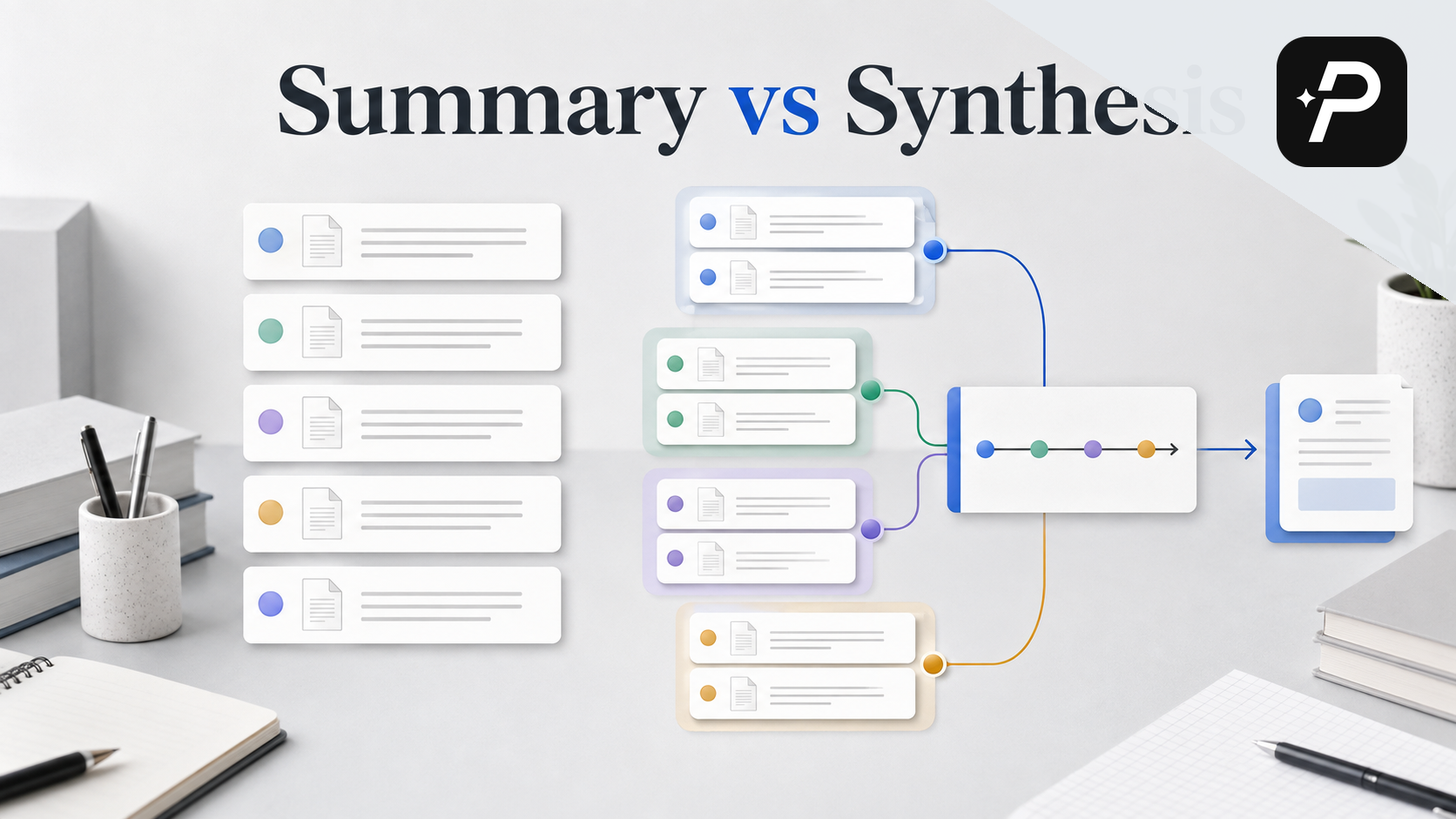
A summary tells the reader what one source says. A synthesis tells the reader what a set of sources means together. The problem with the summary approach is that it leaves the analytical work to the reader. You are handing over a pile of bricks and calling it a house.
Here is what happens when you rely on summaries:
- Your argument disappears. If each paragraph is about a different paper, there is no thread connecting them. The reader cannot see your point.
- You repeat yourself. Many papers in a field say similar things. Summarizing each one separately makes your review repetitive.
- You avoid hard thinking. Summarizing is safe. Synthesis requires you to make judgments about which findings matter and how they fit together.
- You lose the bigger picture. A field of study is a conversation among individual studies. Summaries show you read the transcript; synthesis shows you understand the dialogue.
Your reader promise is to show concrete moves from summary to synthesis. The first move is learning how to group papers by claim or theme instead of by author.
How Do You Group Papers by Claim or Theme?
Before you write a single synthesized sentence, you need to sort your sources. The goal is to stop thinking of papers as individual units and start thinking of them as members of groups. A synthesis matrix literature review is one systematic way to do this, but the core idea is simple: find the claims that repeat or connect across your sources.
Start by asking yourself these questions while reading:
- What do these papers agree on?
- What concepts or variables appear in multiple studies?
- What methods are commonly used?
- What gaps do several authors mention?
Write each paper's main finding on a sticky note or in a spreadsheet column. Then move the notes around until clusters emerge. You might find that three papers all tested the same intervention but in different populations. Four others might all rely on self-reported data. Two more might challenge the dominant theory.
This clustering is the foundation of organizing papers into themes. A theme is not the same as a topic. A topic is a subject area ("online learning"). A theme is a claim or angle ("online learning reduces engagement for first-generation students"). Group your papers by the claims they support or challenge, rather than by topic alone.
How Do You Compare Methods and Findings?
Once papers are grouped by theme, the next step is to compare them on a deeper level. This is where you move from "these papers are about the same thing" to "here is how they approach it differently and what that means."
When comparing methods, look for:
- Sample differences: Did the studies use students, professionals, or clinical populations?
- Design differences: Were the studies experimental, correlational, longitudinal, or qualitative?
- Measurement differences: How was the key variable defined and measured?
When comparing findings, look for:
- Effect direction: Do the results point the same way?
- Effect size or strength: Are some findings stronger than others?
- Boundary conditions: Do findings hold in some contexts but not others?
For example, you might write: "While both Chen and Alvarez found that feedback improves writing quality, Chen's randomized trial reported a large effect, whereas Alvarez's classroom study found only modest gains. The difference may stem from the intensity of the feedback: Chen provided iterative comments over a full semester, while Alvarez used a single round of peer review."
This kind of comparison shows you understand the research process as well as the conclusions. If you need a structured approach, see this guide on how to compare methods across research papers. Treat methodological differences as meaningful information, not background noise.
How Do You Handle Papers That Disagree?
Disagreement is not a problem to hide. It is an opportunity to show analytical depth. If every paper in your review agrees, either your topic is very narrow or you have not read widely enough. Contradictions in the literature are where interesting research questions are born.
When papers disagree, do more than list the conflicting findings. Diagnose the conflict. Ask why the results differ.
Common reasons for disagreement include:
- Methodological variation: Different measures or designs produce different results.
- Population differences: A finding that holds for adults may not hold for adolescents.
- Contextual factors: Time period, culture, or setting can change outcomes.
- Theoretical framing: Different assumptions lead researchers to look for different things.
Your job is to propose a plausible explanation for the discrepancy and then suggest what that means for the field. For instance: "The conflicting results on social media use and well-being may stem from measurement issues. Studies using time-use diaries tend to find small negative effects, while studies using global self-report scales often find no effect. This suggests that how we ask the question shapes the answer."
This approach turns a weakness into a strength. You are explaining why the literature is messy, not merely reporting that it is messy. For more help, learn how to find conflicting evidence literature review strategies that go beyond simple contradiction.
How Do You Turn a Group of Sources into One Paragraph?
This is the moment of transformation. You have your groups, your comparisons, and your explanations for disagreement. Now you need to write a paragraph that weaves multiple sources together into a single coherent point.
A strong synthesis paragraph follows a simple internal structure:
- Topic sentence: State the claim that the group of sources supports.
- Evidence: Bring in two or more sources that relate to the claim.
- Analysis: Explain how the sources relate to each other and to your claim.
- Transition: Link to the next point or theme.
Here is a template you can adapt:
"Several studies suggest that [YOUR CLAIM]. For example, [Author A] found that [FINDING], a result echoed by [Author B], who demonstrated [FINDING]. However, [Author C] reported a more nuanced picture, showing that [FINDING] only holds when [CONDITION]. This boundary condition matters because it suggests [IMPLICATION]."
Notice what is happening here. You are not saying "Author A says X. Author B says Y." You are saying "The evidence shows X, and here are the studies that support it, plus one that complicates it."
This is the core skill of literature review synthesis. You are building a paragraph around an idea, not around an author. The sources are your support system, not your outline.
If you struggle to move from notes to this kind of paragraph, try working backward. Write the topic sentence first. Then list the sources that support it. Then write the analysis. This paper notes to argument outline workflow can help you structure the transition from reading to writing.
What Does a Synthesized Sentence Look Like?
Sometimes the hardest part is knowing what synthesis looks like at the sentence level. Here are concrete examples that show the difference between summarizing and synthesizing.
Summary (what to avoid):
"Johnson (2021) found that sleep deprivation impairs working memory. Kim (2022) found that sleep deprivation impairs attention. Rodriguez (2023) found that sleep deprivation impairs decision-making."
Synthesis (what to aim for):
"Across multiple studies, sleep deprivation has been shown to impair a range of cognitive functions, including working memory (Johnson, 2021), attention (Kim, 2022), and decision-making (Rodriguez, 2023). This pattern suggests that sleep loss does not affect a single cognitive domain but rather degrades general executive function."
The second example groups the findings and then adds an interpretive layer. The writer draws a conclusion about what the results mean collectively.
Here are more sentence patterns that signal synthesis:
- "Taken together, these findings suggest that..."
- "While [Author A] emphasizes X, [Author B] and [Author C] show that..."
- "The evidence is mixed: some studies support X, but others point to Y."
- "This discrepancy may be explained by differences in..."
- "Building on the work of [Author A], recent studies have..."
Use these patterns to signal that you are combining sources instead of describing them one by one.
How Can WisPaper Help Organize and Question a Paper Set?
Synthesis is a thinking task, but it is much easier when your tools support comparison. WisPaper is designed to help you manage the research phase so you can focus on the writing.
My Library lets you save and upload papers in one place. Instead of juggling PDFs across folders and browser tabs, you have a single collection of your sources. This makes it practical to work with a large paper set because you can quickly return to any paper to check a detail or re-read a passage.
Library QA takes this a step further. Once your papers are in your library, you can ask questions across the entire set. For example, you might ask, "Which of these papers used a longitudinal design?" or "What do these studies say about the role of motivation?" The tool answers based on the papers in your own library, helping you surface connections you might have missed.
This does not replace your judgment. You still need to interpret the answers, decide which comparisons matter, and craft the argument. But WisPaper can help you move faster through the organizational work. When you are trying to synthesize research papers, the hardest part is often just keeping track of who said what and how it relates to everything else. A tool like this reduces that cognitive load.
For more advanced workflows, you can explore how thematic synthesis ai can assist in identifying patterns across a large corpus. The goal is to give you more time for the actual thinking and writing.
FAQ
What is synthesis in a literature review?
Synthesis in a literature review is the process of combining findings and ideas from multiple sources to create a new, integrated understanding. Instead of describing each paper separately, you group them by theme, compare their methods and results, and draw conclusions that span across the literature. The result is an argument that is greater than the sum of its parts.
How is synthesis different from summary?
A summary restates the main points of a single source. Synthesis combines multiple sources to make a new point. Summary answers "What did this paper say?" Synthesis answers "What do these papers mean together?" Summary is descriptive; synthesis is analytical. In practice, you will still use brief summaries of individual papers, but they should serve the larger synthesized argument.
How do I synthesize multiple research papers?
Start by grouping papers by theme or claim rather than by author. Then compare the papers within each group: look at their methods, samples, and findings. Identify where they agree, where they complement each other, and where they conflict. Finally, write paragraphs organized around a claim, using multiple sources as evidence for that claim. A synthesis matrix literature review can help you visualize the groupings.
Can I synthesize papers that disagree?
Yes. In fact, disagreement is often the most interesting material for synthesis. When papers conflict, your job is to explain why. Look for differences in methodology, population, or context that might account for the divergent results. Then propose an interpretation that accounts for both sides. This shows that you understand the complexity of the research area.
What should a synthesis paragraph include?
A synthesis paragraph should include a clear topic sentence that states the claim, evidence from at least two sources, and your analysis explaining how the sources relate to each other and to the claim. It should not be organized around a single author. The paragraph should end with a transition that connects to the next point in your argument.
FAQs
Keep Reading
Summary vs. Synthesis in a Literature Review
Your supervisor wrote "this is just a summary" in the margin of your literature review draft. You had read every paper, taken detailed notes, and described each study in turn. The feedback feels unfair because you did th

Too Many Sources for Your Literature Review? How to Organize Them
You have 80 tabs open, three reference managers, and a folder called "final_final_lit_review" that contains 47 PDFs. If this sounds familiar, you are not alone. Hitting the wall of **too many sources literature review**

How to Organize 20-30 Papers Into a Literature Review
You have 25 papers. They are sitting in a folder, a reference manager, or a stack of PDFs. Your supervisor wants a draft chapter next week, and you have realized the difference between a collection of sources and a liter