
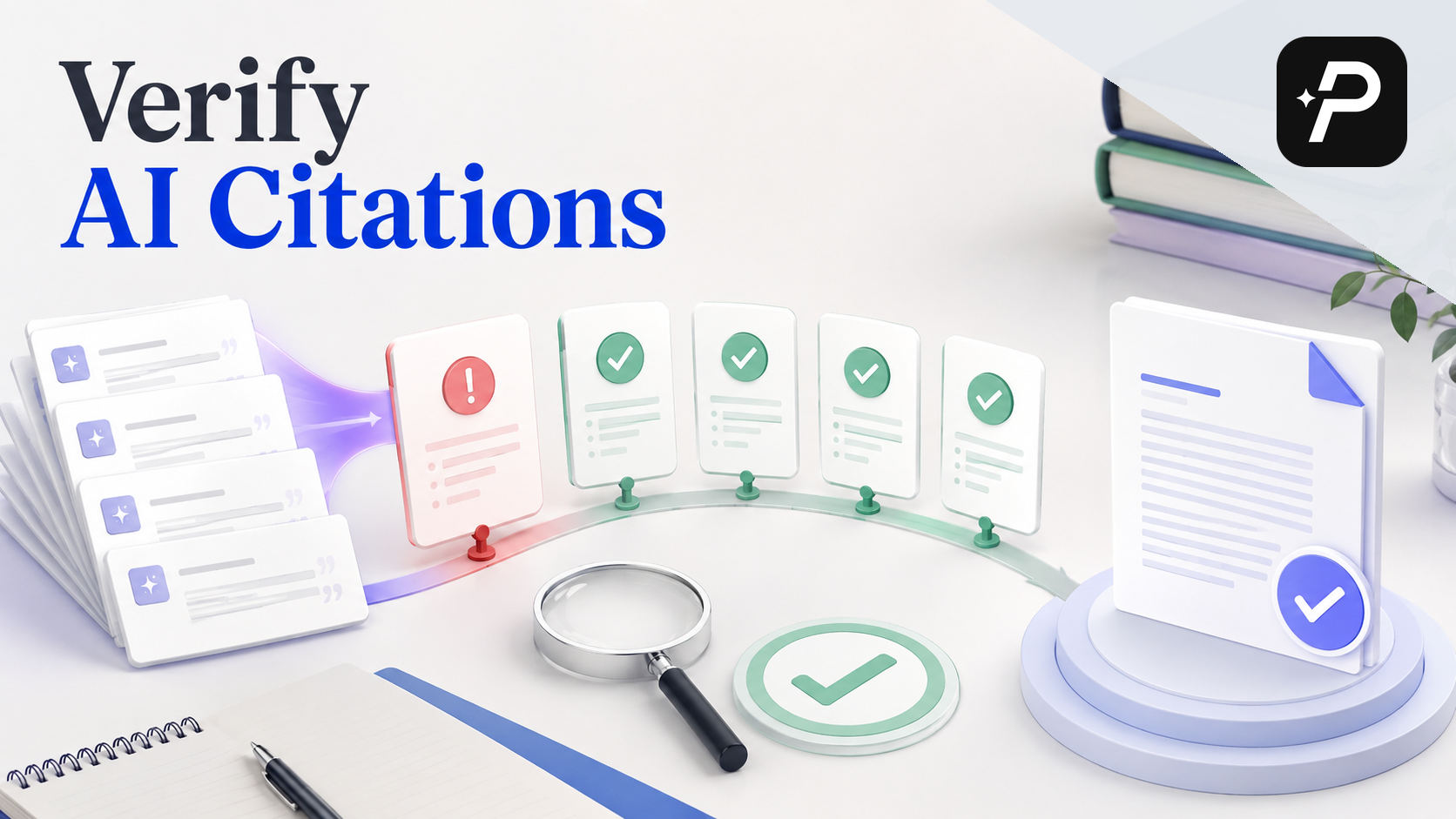
You have a draft ready. The literature review reads well, the argument is coherent, and the reference list looks complete. Then you remember that some of those references came from an AI assistant, and you wonder: did it invent any of them?
This is a legitimate concern. AI tools can produce citations that look perfectly formatted but do not correspond to any real publication. A fabricated title, a plausible author name, a journal that almost exists—each element can look correct while the paper itself is nowhere to be found.
The verification process does not need to be painful. This guide walks through a practical checklist you can run before submission, explains how to spot likely fabrications, and shows what to do when you find one.
Why do AI tools generate fake citations?
AI language models do not search a live database of published papers when they generate text. They predict the next word based on patterns in their training data. For a deeper look at this risk, see AI citation hallucination rates compared. When you ask for references on a topic, the model assembles citations from patterns it has seen. Sometimes those match real papers. Often they do not.
The typical failure modes are:
- Fabricated titles. The AI creates a title that sounds plausible for the topic but has never been published.
- Wrong author assignments. A real paper gets attributed to a different author, or the author name is invented.
- Altered journal names. The citation points to a journal that does not exist or has a slightly different name from the real one.
- Mismatched publication details. The year, volume, or page numbers do not align with the actual publication.
- Blended references. The AI merges details from two or more real papers into one fake citation.
None of this is malicious. The model is doing what it was trained to do. But the risk lands on you: submitting a paper with fabricated references can trigger academic misconduct investigations and damage your credibility.
The practical takeaway is simple. Treat every AI-generated citation as unverified until you confirm it yourself.
What should you check before submitting?
Work through this checklist systematically before you submit any manuscript, thesis, or assignment. For the broader version of the same process, use How to Verify AI-Generated Citations Are Real. A typical reference list takes about 15 to 30 minutes to verify.
Separate AI-generated citations from your own
Before verifying anything, identify which citations came from AI tools. Copy those into a separate document or mark them in your draft. This is not about hiding your process. It gives you a clear list of items that need extra scrutiny.
Citations you gathered from reading full-text papers still deserve checking, but they carry lower risk. The AI-generated ones are your priority.
Search for each citation in an academic database
For every AI-generated citation, search for the title in at least one academic database. Start with Google Scholar, then cross-check in PubMed, Scopus, Web of Science, or your university library catalog, depending on your field.
Put the exact title in quotation marks. If the paper exists, it should appear in the results. If you get zero results, the citation is likely fabricated.
If the title search fails, try searching by author name plus a keyword from the title. Sometimes the AI altered the title slightly, but the underlying paper exists.
Verify the DOI or PMID
A Digital Object Identifier (DOI) is the most reliable way to confirm a paper exists. If the AI-generated citation includes a DOI, click it or paste it into doi.org. It should resolve to the actual paper page on the publisher's website.
If the citation lacks a DOI, search for the paper on Crossref at search.crossref.org. Enter the title, and the system will show the registered DOI if one exists.
For biomedical papers, check the PubMed ID (PMID) or use PubMed search. A PMID that does not resolve means the citation is suspect.
Check the journal and publisher
Even when a paper exists, the journal name or publisher in the AI citation might be wrong. Visit the journal's official website and confirm that the volume and issue match the publication year. If you are unsure whether a journal is legitimate, check your library's journal list or the Directory of Open Access Journals.
Access the full text
A citation is only useful if you can read the paper. Click through to the full text. If you cannot access it through your institution, request it via interlibrary loan or check repositories like PubMed Central, arXiv, or institutional repositories.
If you cannot find the full text anywhere, treat the citation as unverified. Do not include it in your reference list.
Confirm the content supports your claim
This step is easy to skip, and it matters as much as the others. A citation can be real but still be cited incorrectly. Open the full text and check that the paper actually supports the claim you made in your writing. The same caution applies to an AI paper summary; the summary may point you toward a claim, but the paper has to confirm it.
This is especially important in literature reviews, where one citation may support multiple claims. Verify each claim against the source.
Record your verification
Keep a simple spreadsheet with columns for the citation, the database where you verified it, the DOI or PMID, and the date of verification. This record is useful when your supervisor asks about your sources and when you prepare your final reference list.
What signs suggest a citation is fabricated?
You can catch many fake citations by looking for patterns. Train yourself to notice these warning signs:
- Overly generic titles. Titles like "The Impact of Social Media on Mental Health" are easy for AI to generate. The problem is that the AI may have invented a specific paper with a generic title.
- Flawless formatting. AI-generated citations often have perfect formatting because the model is good at mimicking style guides. This makes them harder to spot visually.
- Missing DOIs. Most real papers have DOIs. If the AI citation lacks one, be suspicious.
- Unusual author combinations. If the authors seem unlikely to collaborate, or if the author list is suspiciously long or short, check carefully.
- Very recent publication dates. AI models are trained on data up to a certain point. If the citation has a recent date, the model may have extrapolated or invented it.
None of these signs alone prove a citation is fake. But they should prompt you to verify more carefully.
What should you do when you find a fake citation?
Finding a fake citation is not a disaster. It happens to almost every researcher who uses AI tools. What matters is how you respond.
Remove the citation from your reference list and your text. Then search for a real paper that covers the same point. Use the claim you were trying to support as a search query. If you cannot find a suitable replacement, adjust your argument. It is better to have a slightly weaker claim with a real source than a strong claim with a fabricated citation.
Note the fake citation in your verification record. If you work with a supervisor or a team, mention that you caught and corrected it. Transparency builds trust.
How can you build verification into your workflow?
Verification is not a one-time task at the end of your writing process. It works better when it is part of how you write.
Verify as you go
Check each source when you add it to your draft, not when the reference list is complete. This takes less time because you are not facing a large list at once.
Keep a source log
Maintain a running list of every source you use, along with the claim it supports. This log becomes the foundation of your reference list and makes final verification much faster.
Use your library
Your university library is an underused resource. Most libraries offer access to citation databases, and librarians can help you identify predatory journals and confirm whether a specific journal is legitimate. A quick consultation with a subject librarian can save you hours.
Do a dedicated verification pass
After you finish your draft, go through your reference list systematically using the checklist above. This is your final safety net before submission.
How can WisPaper support citation verification?
WisPaper includes features that fit into the verification workflow without replacing the final database check.
If you are trying to locate a paper based on a topic or idea rather than an exact title, WisPaper's Deep Search lets you search academic literature using a natural-language research question instead of building a long Boolean query. This can help you confirm whether an AI-suggested citation matches a real paper.
When you are unsure whether a source is relevant to your argument, Scholar Agent can help you explore research questions and paper directions within the search workflow. This is useful when you need to decide whether a citation actually fits before you commit to it.
If you have removed a fake citation and need alternative sources, Inspiration Discovery can surface related angles when your topic is too broad, too narrow, or underdeveloped.
Paper cards show source labels, summaries, publication details, authors, and preview information. You can use these to quickly screen whether a paper is relevant and real before adding it to your reference list.
After you have verified your sources, you can save them to My Library and use Library QA to ask questions based on the papers you have collected. For larger projects, a deep research source audit gives you a second pass over source quality after existence checks are complete. This helps you confirm that a source actually supports the claim you want to make, rather than relying on an AI summary that might be inaccurate.
The last step before you submit
Run the checklist once, in order: separate AI citations, search databases, confirm DOIs, check journals, access full texts, and confirm content matches your claims. Record what you verified and when.
When you find a fake citation, replace it with a real source or adjust the claim. Then move on.
The extra 15 minutes before submission is what separates a reference list you can defend from one you hope no one checks.
FAQs
Keep Reading
How to Use AI for Research Without Cheating
You have a research paper due, a thesis deadline, or a literature review to finish. You open ChatGPT, type in your topic, and get a polished paragraph in seconds. It feels productive—until the doubt sets in: *Is this che
Can You Use AI for a Literature Review?
Yes, you can use AI for a literature review—but the useful question is which parts of the task you hand off and which parts you keep. A literature review is not a summary of what you found. It is an argument about what t
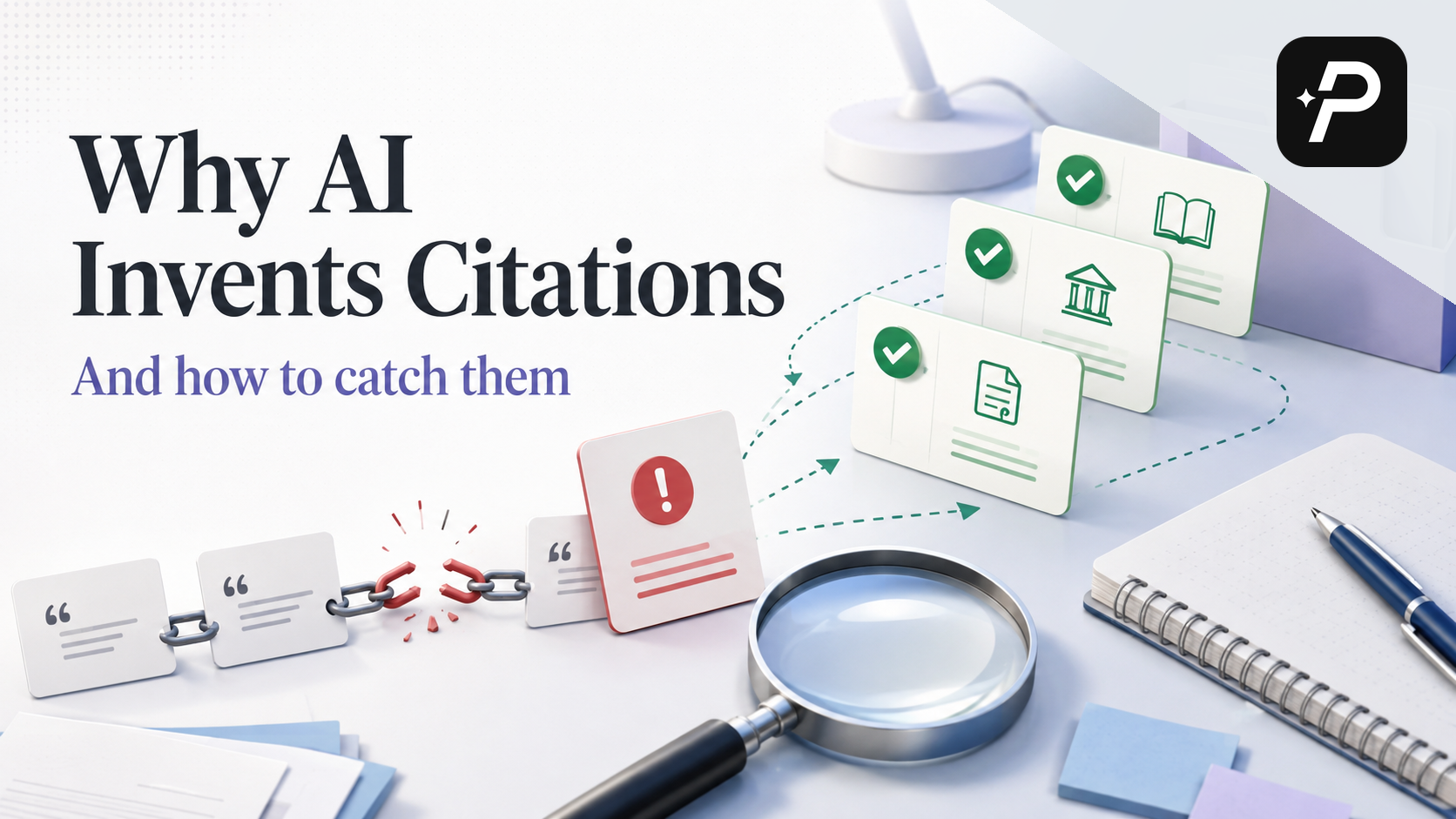
Why AI Invents Academic Citations and How to Catch Them
You ask ChatGPT for sources on your thesis topic. Within seconds, it returns a list of references. The authors sound right. The journal names are familiar. The years and volume numbers look plausible. Then you search for