
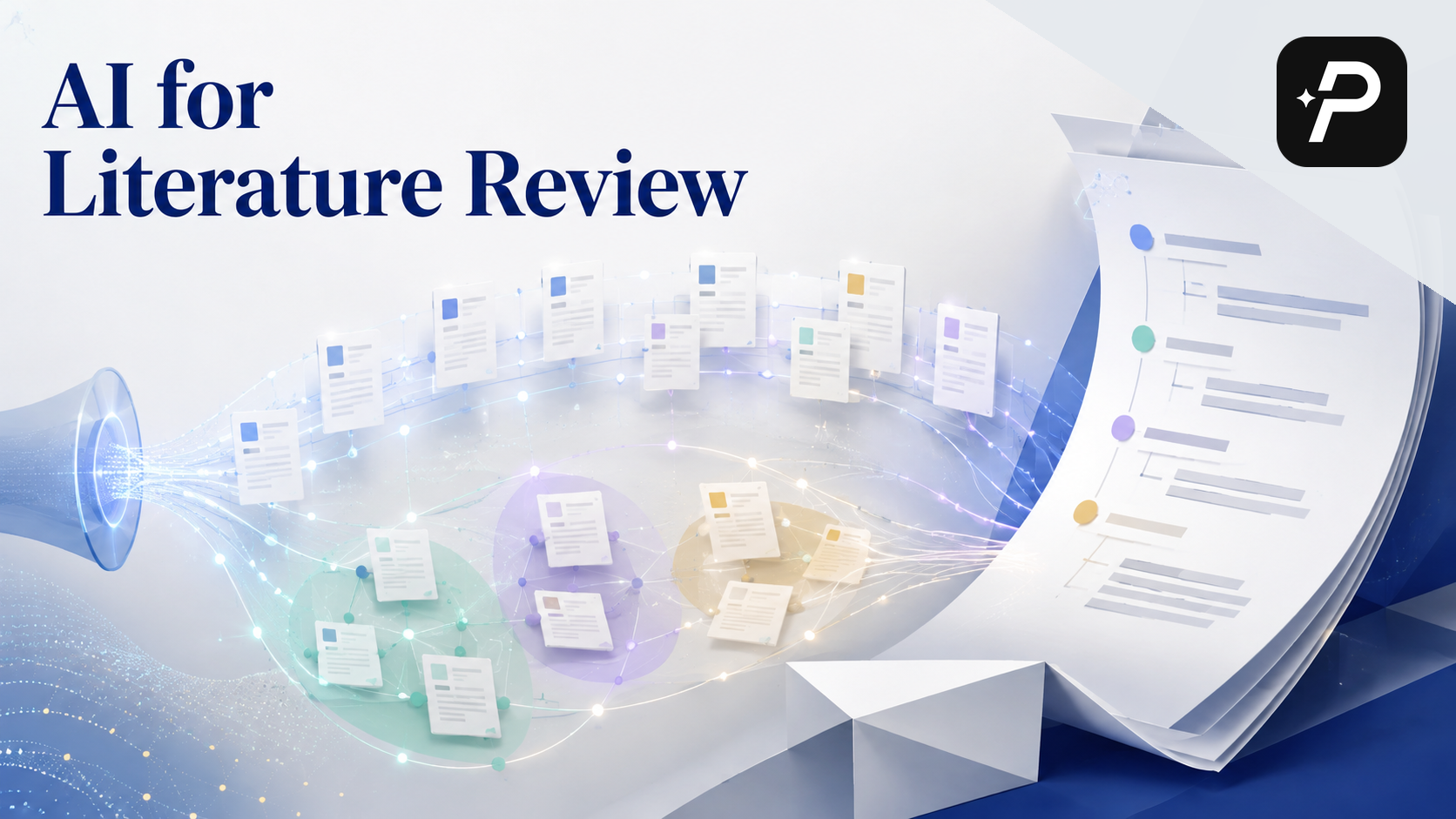
Yes, you can use AI for a literature review—but the useful question is which parts of the task you hand off and which parts you keep. A literature review is not a summary of what you found. It is an argument about what the existing research says, where it conflicts, and what is missing. AI can help you find and organize sources faster. It cannot decide which sources matter or why.
For students and early-stage researchers, the line between "using AI as a tool" and "letting AI do the work" can feel blurry. This guide walks through what AI can safely handle, where the risks show up, and how to build a workflow that keeps you in control of the final judgment.
What a Literature Review Actually Requires
Before deciding what AI can do, break the literature review into its parts:
- Searching for relevant papers across databases and repositories.
- Screening titles and abstracts to filter out irrelevant or low-quality sources.
- Reading and extracting key findings, methods, and limitations from selected papers.
- Synthesizing the information to identify themes, debates, and gaps.
- Writing a coherent narrative that positions your research within the existing body of knowledge.
AI tools are strong at steps 1 and 2. They can assist with step 3 by summarizing abstracts or pulling out key details. Steps 4 and 5 require critical thinking, domain knowledge, and a clear argument—things AI cannot reliably produce on its own.
When you ask "can you use AI for literature review," the honest answer is that AI can handle the heavy lifting of information management, but not the intellectual work of interpretation.
The Allowed Assistance vs. Final Responsibility Rule
The safest mental model is to treat AI like a research assistant, not a co-author. You remain responsible for:
- Verifying every citation the AI suggests.
- Reading the full text of any paper you cite.
- Ensuring the synthesis reflects your own understanding.
- Disclosing AI use if your institution or journal requires it.
AI is allowed to:
- Help you find papers you might have missed.
- Summarize abstracts to speed up screening.
- Organize notes and highlight connections.
- Suggest search terms or alternative phrasings.
This division of labor keeps you in control of the scholarly output. If you delegate the synthesis or the writing to AI, you risk producing a review that is shallow, inaccurate, or even fabricated.
Where AI Excels: Search and Discovery
The most practical use of AI in a literature review is the search phase. Traditional keyword-based searching in databases like PubMed, Scopus, or Google Scholar requires you to craft precise Boolean queries (e.g., ("machine learning" OR "deep learning") AND "cancer diagnosis"). This is time-consuming and easy to get wrong.
AI-powered search tools accept natural-language research questions. Instead of constructing a complex query, you can type something like:
"What are the recent advances in using transformer models for biomedical text classification?"
The AI interprets your question, identifies relevant keywords and synonyms, and returns a set of candidate papers. This is especially useful when you are new to a field and don't yet know the standard terminology.
Tools like Deep Search are designed for this exact purpose. They search academic literature using a natural-language research question, which lowers the barrier for students who are still learning the vocabulary of their discipline.
Where AI Helps: Screening and Organizing
Once you have a pool of candidate papers, the next bottleneck is screening. Reading hundreds of abstracts to decide what is relevant is tedious. AI can accelerate this by:
- Providing paper cards that show source labels, summaries, publication details, and authors. This lets you quickly assess whether a paper is worth your time.
- Ranking results by relevance based on your research question.
- Grouping papers by theme or methodology, which helps you spot clusters of related work.
For example, if your topic is too broad and returns thousands of results, AI can help you narrow it down. Conversely, if your topic is too narrow and returns almost nothing, AI can surface adjacent research that might inform your approach. This is where Inspiration Discovery becomes useful—it suggests related angles when your topic is underdeveloped.
You can then save the most promising papers to a personal library, such as My Library in WisPaper, and annotate them as you go.
The Risk Zone: AI-Generated Summaries and Citations
The biggest danger in using AI for a literature review is trusting its summaries and citations without verification. AI models are trained on vast amounts of text, but they do not have a reliable internal database of academic papers. This leads to two well-documented problems:
- Hallucinated citations: AI invents papers, authors, or journals that do not exist.
- Inaccurate summaries: AI misrepresents the findings or methods of a real paper.
These issues are not hypothetical. Studies have shown that AI citation hallucination rates can be alarmingly high, especially in less-common topics. If you cite a paper that doesn't exist, your literature review loses credibility and may be flagged for academic misconduct.
The rule is simple: never cite a paper you have not read in full. Use AI to find candidates, but always go back to the original source to verify the details.
If you want a deeper look at how to spot and avoid AI-generated citation errors, the article on AI Citation Hallucination Rates Compared: What Researchers Should Know provides a practical breakdown.
A Safer Workflow: From AI Search to Annotated Bibliography
A practical, integrity-safe workflow for using AI in a literature review looks like this:
Step 1: Define your research question. Write a clear, one-sentence question. If you can't articulate it, your search will be messy.
Step 2: Use AI for initial discovery. Enter your question into an AI-powered academic search tool. Review the returned paper cards and save the ones that look relevant to your library.
Step 3: Verify and read. For each saved paper, find the original source. Read the abstract and, for key papers, the full text. This is non-negotiable.
Step 4: Build an annotated bibliography. Write your own summary of each paper, noting the main finding, methodology, and how it relates to your research question. This becomes the raw material for your review.
Step 5: Synthesize. Group your annotations by theme or argument. Identify where papers agree, disagree, or leave gaps. This synthesis is the heart of your literature review.
Step 6: Write. Draft the review yourself, using your annotations as a guide. If you use AI to help with phrasing or structure, treat it as a writing assistant, not a ghostwriter.
This workflow is detailed further in the guide on Annotated bibliography with AI: a safer workflow, which walks through each step with examples.
Is Using AI for a Literature Review Cheating?
This is the question every student asks, and the answer depends on your institution's policies and your own transparency. Using AI to discover and organize literature is generally considered acceptable, much like using a reference manager or a search engine. Using AI to write the review without disclosure is usually considered academic misconduct.
The key is disclosure. Many journals now require authors to state whether AI was used in the preparation of a manuscript. If you use AI at any stage, check the guidelines and disclose accordingly.
The deeper question is whether AI-assisted literature reviews produce better or worse scholarship. A well-executed AI-assisted review can be more comprehensive because it covers more ground. But if the AI does the thinking, the review will lack the critical insight that comes from genuine engagement with the literature.
For a detailed exploration of this ethical gray zone, including institutional policies and real-world examples, see Is Using AI for a Literature Review Cheating?.
Systematic Reviews and AI: A Special Case
Systematic reviews have stricter methodological requirements than narrative literature reviews. They follow protocols like PRISMA (Preferred Reporting Items for Systematic Reviews and Meta-Analyses) to ensure transparency and reproducibility.
AI can assist in systematic reviews, but the bar is higher. You need to document exactly how you searched, what tools you used, and how you screened papers. This is good practice, and it is often a requirement for publication.
AI tools can help with:
- Search strategy development: Suggesting synonyms and related terms.
- Deduplication: Removing duplicate records from multiple databases.
- Title and abstract screening: Using AI to flag clearly irrelevant papers, which you then double-check.
However, the final inclusion decisions must be made by human reviewers. AI screening is a triage tool, not a substitute for human judgment.
If you are planning a systematic review, the article on AI in Systematic Reviews: A PRISMA-Aware Workflow outlines a step-by-step process that maintains methodological rigor.
Choosing the Right AI Tool for Your Stage
Not all AI tools are created equal, and the best choice depends on where you are in your research journey.
-
For undergraduate or early master's students: Free, user-friendly tools are often sufficient. You need basic search and summarization, not advanced analytics. The guide on Free AI Tools for Literature Review: A Grad Student Guide for 2026 lists options that won't break your budget.
-
For doctoral students or early-stage researchers: More powerful tools with citation mapping and library management features are worth the investment. You need to track a larger volume of papers and understand how they relate to each other.
-
For systematic reviewers: Tools that integrate with PRISMA workflows and provide audit trails are essential.
A broader comparison of the top tools, including their strengths and weaknesses, is available in 10 Best AI Tools for Literature Review in 2026.
Citation Mapping: Seeing the Bigger Picture
One of the most powerful AI-assisted techniques for a literature review is citation mapping. Tools like ResearchRabbit, Litmaps, and Connected Papers visualize how papers cite each other. This helps you:
- Find seminal papers that are cited by many others.
- Discover recent papers that cite a foundational work.
- Identify gaps in the research landscape.
AI-powered citation mapping goes a step further by suggesting papers based on citation patterns, rather than keyword matches alone. This can reveal connections you would miss with a traditional keyword search.
For example, if you find one highly relevant paper, you can use citation mapping to work backward to its references and forward to its citing papers. This creates a web of related literature that is far more comprehensive than a simple search.
The practical differences between the leading citation mapping tools are covered in Citation mapping tools compared: ResearchRabbit, Litmaps, Connected Papers, and AI search.
How to Disclose AI Use in Your Final Work
If you use AI in your literature review, transparency is your best defense. Different journals and institutions have different policies, but the general trend is toward requiring disclosure.
Common disclosure practices include:
- In the methods section: Describe what AI tools you used and for what purpose.
- In the acknowledgments: Thank the AI tool if it provided substantial assistance.
- In a dedicated statement: Some journals require a separate "AI Use Declaration" section.
The exact wording matters. Avoid vague statements like "AI was used in the preparation of this manuscript." Instead, be specific: "The AI tool [name] was used to identify candidate papers for screening. All papers were manually verified by the author."
For templates and examples of compliant disclosure statements, see How to Disclose AI Use in a Manuscript: Journal Policies and Templates.
Final Verdict: Yes, But With Boundaries
So, can you use AI for a literature review? Yes—and you probably should, at least for the search and screening phases. The volume of academic literature is growing faster than any individual can read, and AI tools are becoming essential for managing that scale.
But the final responsibility for the review's quality, accuracy, and integrity rests with you. Use AI to find more papers, organize your notes, and see the bigger picture. Then read, think, and write for yourself. That is the difference between using AI as a tool and letting it do your thinking for you.
FAQs
Keep Reading
Why AI Invents Academic Citations and How to Catch Them
You ask ChatGPT for sources on your thesis topic. Within seconds, it returns a list of references. The authors sound right. The journal names are familiar. The years and volume numbers look plausible. Then you search for
How to Check Whether an Academic Citation Actually Exists
You found the perfect reference for your literature review. The author, title, and journal all look right. Then you try to open the source and the DOI leads nowhere. The journal page returns a 404. A search across databa
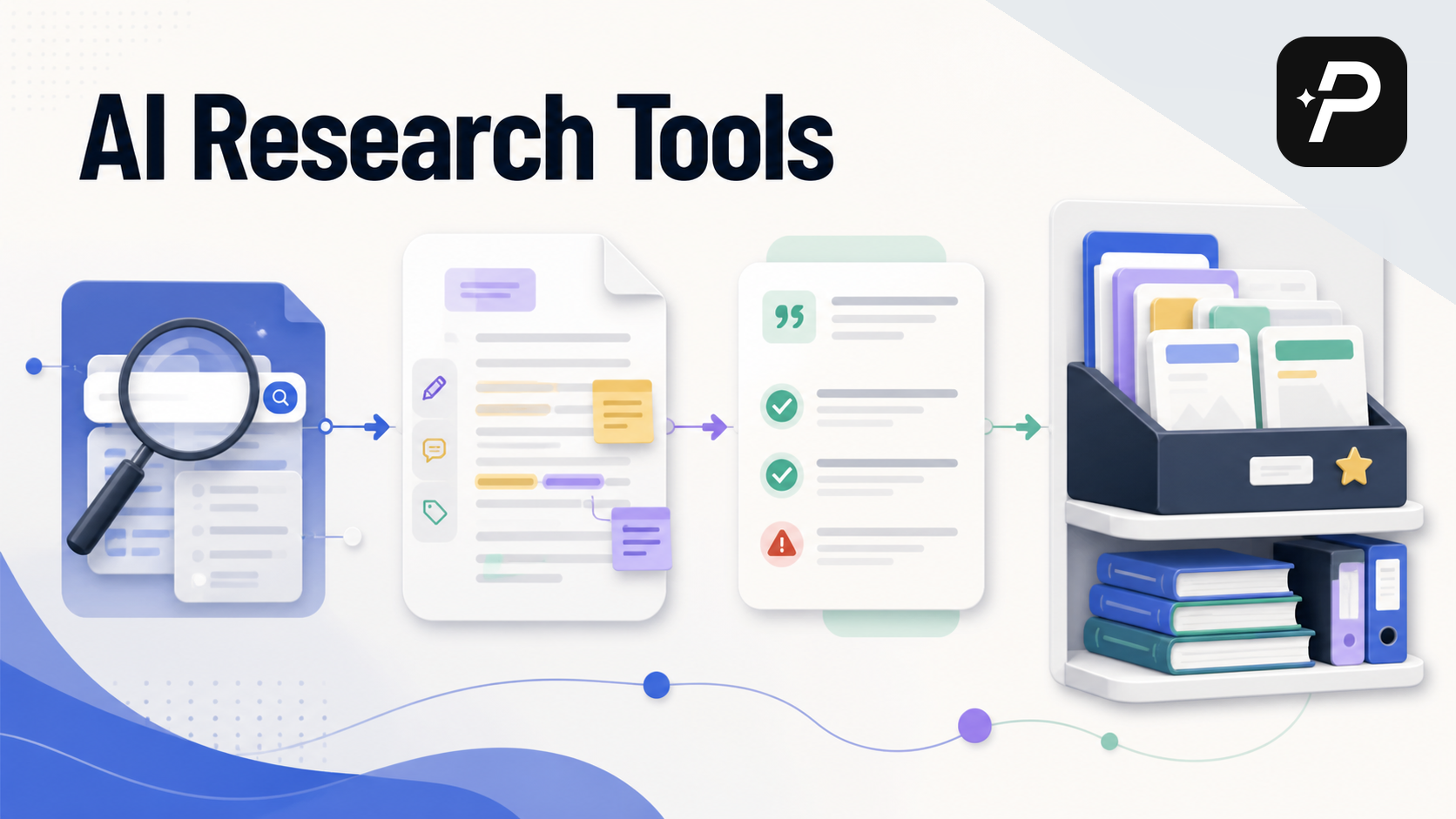
AI Research Tools for Students: Search, Read, Cite, and Organize
The research process often breaks down at a specific point: you have an assignment, you need credible sources, and you're not sure where to start. Maybe you've typed a question into Google Scholar and gotten thousands of