
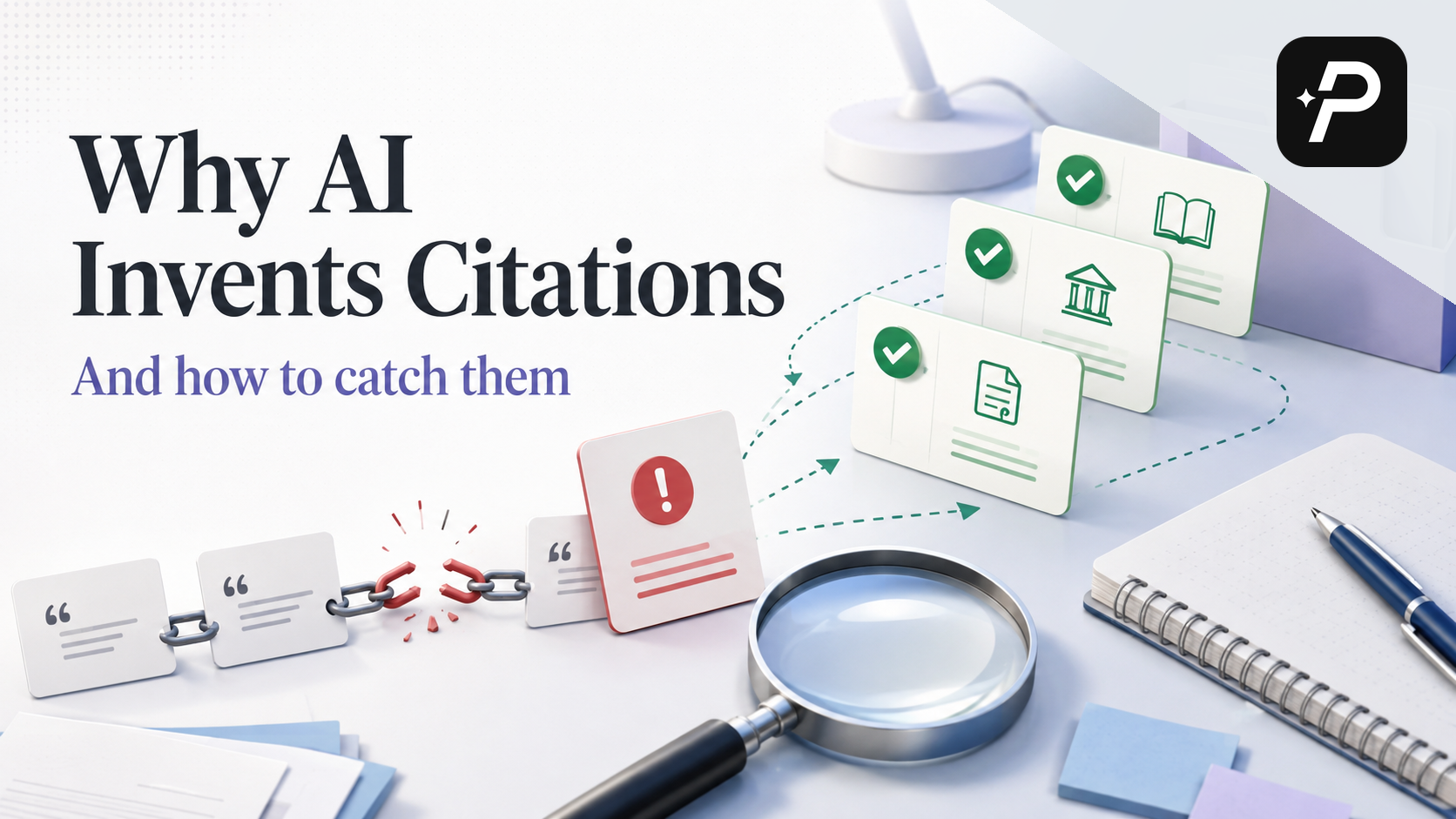
You ask ChatGPT for sources on your thesis topic. Within seconds, it returns a list of references. The authors sound right. The journal names are familiar. The years and volume numbers look plausible. Then you search for one of the papers in your library database, and nothing comes up. Google Scholar returns no results. The DOI leads nowhere.
What you are holding is a fabricated citation. The AI did not find that paper in a database—it generated text that looks like a paper because that is what the model was trained to do.
Universities have issued warnings about this. News outlets have reported on studies finding AI fabricating references in biomedical research. But to protect your own work, you need to understand the mechanism behind the problem, beyond the headlines.
What Does It Mean When AI "Hallucinates" a Citation?
A hallucinated citation is a reference that follows the correct formatting conventions—author names, journal titles, years, page numbers, DOIs—but points to a paper that does not exist or does not say what the AI claims it says.
There are several forms this can take:
- The complete invention. The paper never existed in any database. The AI assembled a plausible combination of author, title, and journal from patterns in its training data.
- The mashup. A real author is paired with a title they never wrote, or a real title is assigned to the wrong journal and year.
- The real paper with a false claim. The citation is genuine, but the AI attributes findings to it that the paper never reported. This is the hardest to catch because the reference checks out—only the content is wrong.
For a student or early-career researcher, the risk goes beyond wasted time. Submitting a manuscript with fabricated references, even unknowingly, can lead to accusations of academic misconduct. The problem is not your intent. It is the design of the technology.
Why Do AI Models Generate Fake References?
Large language models are trained on massive amounts of text from the internet, books, and academic repositories. During training, the model learns statistical patterns: which words tend to follow other words, how sentences are structured, and what a scholarly reference typically looks like.
When you ask for a citation, the model does not search a database. It generates text one token at a time, predicting the most probable next word based on its training data. From the model's perspective, a citation is just a sequence of tokens that looks like a citation. It has no internal index of verified papers, no connection to a live library catalog, and no way to check whether the reference it produces actually exists.
This is the core reason AI invents citations. The model is optimized for plausible text, not factual accuracy. If the training data contains many examples of papers by a certain author in a certain journal, the model will combine those elements into a reference that feels right, even if that exact combination never appeared in its training data.
Why Do Training Data Gaps Make the Problem Worse?
Most LLMs have a knowledge cutoff—a date after which they have not been trained on new information. If you ask for papers published after that cutoff, the model cannot know about them. It will either admit it does not know or invent plausible-sounding references to fill the gap.
Even within the training window, the model's exposure to academic literature is uneven. Paywalled journals and niche conference proceedings may be underrepresented. The model may have seen the title of a paper in a citation list but never the full text, so it cannot accurately summarize the findings. When pressed for details, it fills in the blanks.
This is especially risky in fast-moving fields. Ask a general-purpose chatbot for the latest studies on a narrow topic, and it may generate references that sound current but are entirely fabricated. This is not a failure of reasoning. It is a structural limitation of how the model stores and retrieves information.
Why Does AI Sound So Confident About Fake Citations?
The most dangerous aspect of AI-generated citations is the confidence with which they are delivered. The model does not hedge. It presents fabricated references with the same fluency and authority as real ones.
Experienced researchers can often spot a fake citation because they know the literature. They recognize that a certain author has never published on that topic, or that a particular journal does not cover that subject area. Early-stage researchers lack this background. They may assume the AI is correct because it sounds so definitive.
This is why understanding the mechanism matters. The problem is that the model makes mistakes that can look correct. It is that the mistakes are indistinguishable from correct answers unless you have external verification tools and a healthy dose of skepticism.
How Are Chatbots Different from Source-Grounded AI Tools?
Not all AI tools handle citations the same way. A general-purpose chatbot like ChatGPT operates on the text-generation mechanism described above. It has no built-in verification layer unless the developer has added one.
Source-grounded AI academic search tools are designed to address this problem. These tools connect the language model to live databases of scholarly literature. When you ask a research question, the tool searches actual repositories, retrieves real papers, and generates a response based on those retrieved sources. The citations are not invented from statistical patterns. They are pulled from a verified index.
WisPaper's Deep Search is an example of this approach. Instead of requiring a long Boolean query, you type a natural-language research question, and the tool searches academic literature directly. The results are grounded in actual sources, not in the model's memory of what a source might look like.
This distinction matters for anyone who needs reliable citations for a thesis or dissertation. A chatbot can help you brainstorm. It should not be your primary source of references.
What Patterns of Fabricated Citations Should You Watch For?
Even with source-grounded tools, you should develop a habit of verifying references. Here are the most common patterns you will encounter when using general-purpose AI chatbots:
The nonexistent paper. The reference looks perfect, but no trace of it exists in any database. This is the most straightforward fabrication.
The real author, fake title. The AI knows an author works in a field and pairs them with a plausible-sounding title the author never wrote.
The real title, wrong venue. The paper exists, but it was published in a different journal or conference than the one cited.
The correct citation, incorrect claim. The reference is real, but the AI attributes findings to it that are not in the paper. This is particularly dangerous because the citation checks out, but the content does not.
If you are working with sources found through AI tools, you may also want to check how different models compare on citation reliability. Some research tools report higher hallucination rates than others, and knowing which tools are safer can shape your workflow. A comparison of AI citation hallucination rates across research tools can help you decide which tools are worth trusting for source discovery.
How Can You Verify AI-Generated Citations Quickly?
Checking references does not have to take hours. A few targeted searches can confirm whether a citation is real.
Start by searching for the exact title in Google Scholar or your university library database. If nothing comes up, try searching for the author's name and the journal title separately. A real paper will usually appear in multiple places. If you find the paper, check that the year, volume, and page numbers match the citation. Then read the abstract to confirm it actually addresses the topic you asked about.
For a more systematic approach, follow a step-by-step checklist that catches the most common fabrication patterns. The key is to never assume a citation is correct just because it looks polished. A detailed verification workflow for AI-generated citations can walk you through the process.
This is especially important when using AI tools for deeper research tasks. If you use a tool like Gemini, Claude, Perplexity, or ChatGPT Deep Research, you need to audit the sources they return. These tools vary in how they handle citations, and a source audit of deep research tools can show you what to check before you trust their output.
What Are the Risks of Using Unverified AI Citations?
The consequences of submitting fabricated citations can be severe. At minimum, you will have to retract or correct your work, which is time-consuming. In more serious cases, you could face allegations of academic misconduct.
Even if you are not caught, unverified citations undermine the quality of your research. Your literature review is supposed to map the existing scholarship on your topic. If half of your references do not exist, your review is meaningless. You will miss key debates, fail to cite foundational works, and build your argument on a shaky foundation.
For thesis writers, this is a particular concern. Your committee will likely check your references, especially if they suspect AI involvement. A single fabricated citation can cast doubt on your entire body of work.
How Can Source-Grounded Tools Reduce the Risk of Fabricated Citations?
The most effective way to avoid fabricated citations is to use tools grounded in real academic databases. When the AI model is connected to a live search index, it cannot invent references because the output is constrained by what the search actually returns.
WisPaper's Scholar Agent is designed to help you explore research questions and paper directions inside the search workflow. Instead of asking a chatbot to "find papers on X" and hoping it does not hallucinate, you can use Scholar Agent to refine your research question and identify relevant papers from a verified corpus. The tool surfaces related angles when your topic is too broad, too narrow, or underdeveloped, helping you shape a better research question before you dive into the literature.
Paper cards in WisPaper show source labels, summaries, publication details, authors, and preview information, so you can quickly assess whether a paper is relevant without opening the full text. If a citation looks suspicious, you can trace it back to its source within the tool.
This grounding also helps when your search question is complex. Traditional search engines may miss relevant papers because they require exact keyword matches. A tool that searches using natural language can find more of the literature, which means you are less tempted to rely on a chatbot's invented references. For researchers who need to go beyond Google Scholar, AI academic search tools that use natural-language queries can surface papers that keyword-based searches miss.
How Can You Manage Verified Sources Safely?
Another layer of protection comes from managing your own reference collection. WisPaper's My Library feature lets you save or upload papers that you have verified. Once a paper is in your library, you know it is real because you have confirmed it yourself.
Library QA takes this a step further. It answers questions based on the papers in your own library, not on the model's general training data. When you ask a question, the response is grounded in the specific texts you have uploaded. This eliminates the risk of the model inventing a citation to a paper you have never seen, because the answer space is limited to your verified collection.
This workflow is especially useful for thesis writers managing dozens of sources. Instead of juggling PDFs, citation managers, and AI chat windows, you can keep your verified sources in one place and ask questions about them directly. The answers will always trace back to a paper you have already vetted.
What Workflow Keeps AI Use Safe for Literature Reviews?
To use AI productively without falling victim to fabricated citations, separate exploration from verification.
First, use AI for brainstorming and exploration. Ask general questions about your topic, get suggestions for keywords, and identify potential research angles. At this stage, treat any citations the AI provides as leads to investigate, not as confirmed sources.
Second, move to a source-grounded tool for the actual literature search. Use Deep Search or Scholar Agent to find real papers on your topic. The results will be grounded in actual databases, so you can trust that the papers exist.
Third, verify any citations that come from general-purpose chatbots. Run them through your library database or Google Scholar. If you cannot find a paper, do not use it.
Fourth, store your verified sources in My Library. This creates a clean separation between "sources I am considering" and "sources I have confirmed." When you write your literature review, you can draw exclusively from your verified library.
This workflow also helps you avoid source overload. When you are reviewing a large body of literature, it is easy to lose track of which papers you have verified and which are still unconfirmed. Keeping your confirmed sources in one place prevents that confusion.
What Should You Do If You Find a Fabricated Citation in Your Draft?
If you find a fabricated citation in a draft you have already written, do not panic. Assess the extent of the problem first. Check every reference that came from an AI tool. If only one or two are fake, remove them and replace them with real sources.
If the fabrication is more extensive, you may need to revisit your literature review. Instead of starting from scratch, use your verified library and the AI search tools to find real papers that cover the same ground as the fabricated references.
Be transparent with your supervisor or advisor if the issue is significant. Explain that you used AI assistance and discovered that some references were fabricated. Most advisors will appreciate your honesty and your proactive approach to fixing the problem. Journal policies on AI disclosure vary, so check the requirements for your target publication. A guide on how to disclose AI use in a manuscript can help you navigate these conversations.
How Do You Decide Whether Using AI for a Literature Review Is Acceptable?
The answer depends on how you use it. Using AI to brainstorm keywords, refine research questions, or screen papers for relevance is different from asking it to generate a reference list you plan to submit without checking.
Some supervisors and journals have specific policies about AI use. If you are unsure, ask before you submit. And if you do use AI as part of your review process, be prepared to explain which parts of the work were AI-assisted. A clear discussion of whether using AI for a literature review counts as cheating can help you understand where the line is drawn.
Similarly, if you are building an annotated bibliography with AI assistance, the same verification rules apply. You can use AI to summarize papers you have already found, but you should not let it invent sources for you. An AI-assisted annotated bibliography workflow can show you how to structure the process safely.
FAQs
Keep Reading
How to Check Whether an Academic Citation Actually Exists
You found the perfect reference for your literature review. The author, title, and journal all look right. Then you try to open the source and the DOI leads nowhere. The journal page returns a 404. A search across databa

AI Research Tools for Students: Search, Read, Cite, and Organize
The research process often breaks down at a specific point: you have an assignment, you need credible sources, and you're not sure where to start. Maybe you've typed a question into Google Scholar and gotten thousands of
Can You Use AI for a Literature Review?
Yes, you can use AI for a literature review—but the useful question is which parts of the task you hand off and which parts you keep. A literature review is not a summary of what you found. It is an argument about what t