
AI-generated citations can look convincing even when they are wrong. The title may sound academic, the journal may exist, the author list may look plausible, and the formatting may fit APA, MLA, Chicago, or Vancouver style. None of that proves the source exists.
The risk is now visible in research workflows. A JMIR study testing large language models for systematic-review-style references reported hallucination rates of 39.6%, 28.6%, and 91.4% across the tested systems. Nature also reported in 2026 that tens of thousands of publications from 2025 might include invalid AI-generated references.
That does not mean researchers should avoid every AI tool. It means citation verification has to become a normal part of AI-assisted writing. If you use AI to search, summarize, extract, or draft, the bibliography still needs a human-controlled check before submission. The same principle applies whether you are using general chatbots, ChatGPT Deep Research for literature reviews, or specialized AI tools for literature review.
What Counts As A Fake Or Unsafe AI Citation?
An AI citation can fail in several different ways. Some failures are obvious. Others are harder to catch because part of the reference is real.
The main failure types are:
- A fabricated paper that does not exist in scholarly indexes.
- A real title paired with the wrong author, journal, year, or DOI.
- A real DOI that resolves to a different paper.
- A real paper attached to a claim it does not support.
- A real paper that has been retracted, corrected, or flagged after publication.
- A citation that looks complete but lacks enough metadata to be traced.
The dangerous case is not always the fully fake paper. It is often the mixed citation: real author, real journal, wrong title, or a real paper used for the wrong sentence. Those errors can pass a quick visual scan because the reference looks scholarly.
The verification goal is simple. Do not ask, "Does this citation look academic?" Ask, "Can I open the source, match the metadata, and confirm that the cited claim is supported?"
Start With The Exact Title
The fastest first check is the exact title. Copy the title from the AI-generated citation, put it in quotation marks, and search it in scholarly sources. Start with Google Scholar, Semantic Scholar, Crossref Metadata Search, PubMed for biomedical topics, the publisher site, or your university library.
Crossref Metadata Search is useful because it searches metadata for journal articles, books, standards, datasets, and more. If the title appears there, compare the result against the AI citation. If the title does not appear, do not assume the paper exists just because the journal name looks real.
Use exact-title search first because it catches the most embarrassing errors quickly. A title that cannot be found anywhere is a stop sign. A similar title with different authors or a different year is not "close enough." It means the citation needs to be rebuilt from the real source.
If the exact title appears, open the record. Do not stop at the search result snippet. Search results can carry stale metadata, partial author lists, or duplicated records.
Match The Metadata Field By Field
Once you find a likely source, compare the bibliographic fields one by one. This is boring work, but it is where many AI-generated citations fail.
Check these fields against the publisher record or a trusted index:
- Title: Match the full title, including subtitles.
- Authors: Match the order and spelling of names.
- Year: Match the official publication year.
- Journal or venue: Match the journal, conference, book, or preprint server.
- Volume, issue, and pages: Match whatever the source provides.
- DOI or stable URL: Match the identifier to the same source.
If one minor field differs, investigate before keeping the citation. Online-first dates, print dates, and issue assignment can vary, but a wrong author or wrong title is not a harmless formatting issue.
This step matters even when the paper is real. AI systems can blend metadata from neighboring papers. The result may be a citation that points to a real scholarly object but gives the wrong details. A reader may still find something, but not the thing your sentence claims to cite.
Resolve The DOI And Check Where It Lands
A DOI is a strong identifier, but it is not proof by itself. AI can produce a plausible-looking DOI, and copied references can carry DOI errors.
Paste the DOI into a resolver or a DOI search tool. Then compare the landing page against the citation. The DOI should resolve to the same title, authors, venue, and year. If the DOI lands on a different paper, delete the AI-generated reference and rebuild the citation from the correct record.
The order matters. Do not search the DOI alone and then accept whatever appears. A DOI that resolves is only useful if it resolves to the same paper.
For literature reviews, the DOI check has another advantage. It forces you to connect the citation to the publisher record or a stable index rather than relying on a model's formatted output. That reduces the chance that a fake or mixed citation survives into your final bibliography.
Verify The Claim, Not Just The Reference
Many citation checks stop too early. A paper can exist, the DOI can be correct, and the metadata can be clean, while the cited sentence is still unsupported.
Open the paper and inspect the part that matters. For a background claim, the abstract and introduction may be enough. For a methods claim, check the methods section. For a result claim, check the results, tables, figures, or statistical reporting. For a limitation claim, check the discussion or limitations section.
Ask a narrow question: "Does this paper support the sentence I am attaching it to?" If the answer is only "sort of," rewrite the sentence or find a better source.
This is especially important when using AI summaries or extraction tables. AI can produce a clean synthesis that compresses details too aggressively. If you are also working on extracting data from research papers, keep source-page or section notes next to each extracted claim.
Check Citation Context When The Paper Is Central
Some papers are background sources. Others carry a major part of your argument. For the central papers, citation context is worth checking.
Citation context tools show how later papers discuss a source. scite says its Smart Citations show whether studies support or contradict a claim, and its site says it has indexed 1.6B+ citations. That kind of context can help you see whether a paper is treated as settled evidence, disputed evidence, a method reference, or a passing mention.
Citation context does not replace reading the original paper. It also does not decide whether you can cite the source. It gives you a signal about how the literature has responded to the source.
Use context checks when:
- The paper is central to your argument.
- The result seems surprisingly strong.
- Later papers may have challenged the finding.
- The source is old but still heavily cited.
- You are citing a claim outside your closest area of expertise.
For routine background sources, a title, DOI, metadata, and claim-support check may be enough. For cornerstone evidence, look at how the field has treated the paper.
Check Retractions, Corrections, And Updates
A verified citation can still be unsafe if the paper has been corrected or retracted. Before citing a central paper, check whether the record has post-publication updates.
Publisher pages may show Crossmark status. Crossref explains that the Crossmark button gives readers quick access to the current status of a content item, including corrections, retractions, or updates. PubMed also links retraction notices and retracted publications in its records; NLM explains that retraction notices and retracted articles receive linked publication types in PubMed citation records.
For biomedical papers, PubMed is often a good first stop. For broader research, check the publisher page, Crossmark if present, Retraction Watch, and the paper title plus words such as "retraction," "correction," or "expression of concern."
This check is not only about misconduct. Papers can be corrected for data errors, author issues, or reporting problems. A correction does not always mean you must avoid the source, but you need to understand what changed before relying on it.
Rebuild The Citation From The Source
Do not keep an AI-formatted citation just because the paper is real. Once you verify the source, rebuild the citation from the publisher page, DOI metadata, PubMed record, Crossref record, or your reference manager.
This prevents subtle carryover errors. If the AI output had the wrong issue number, capitalization, page range, author order, or DOI suffix, those mistakes can survive unless you replace the whole reference.
The clean workflow is:
- Verify the source exists.
- Confirm that metadata matches.
- Confirm that the source supports the claim.
- Check for retractions or updates when the paper matters.
- Add the source to your reference manager from a trusted record.
- Cite from the reference manager, not from the AI output.
This fits well with a broader free AI literature review stack. Let AI help you find or inspect sources, but let trusted records supply the final bibliography.
Keep A Citation Verification Log
For a class paper, a quick manual check may be enough. For a thesis, systematic review, grant proposal, or journal submission, keep a simple verification log.
The log can be a spreadsheet with columns like:
| Citation | Exists? | DOI match? | Metadata match? | Claim supported? | Retraction check? | Action |
|---|---|---|---|---|---|---|
| Author and short title | Yes or no | Yes or no | Yes or no | Yes or no | Checked or not checked | Keep, fix, replace, or delete |
The value is not bureaucracy. The value is memory. When you return to the draft later, you can see which references were checked and which ones still need attention.
This also helps if your journal, supervisor, or institution asks how AI was used. You can say that AI-assisted suggestions were manually verified before citation. If you need wording for that, use a guide on how to disclose AI use to a journal.
Do Not Use AI To Fill Missing References
The riskiest prompt is some version of "add citations for this paragraph." A general model may produce plausible references that fit the sentence rhetorically, not sources it has actually verified.
A safer prompt asks for search terms, known authors, possible databases, or a checklist of what kind of evidence would support a claim. Then you search real scholarly sources yourself.
For example, avoid asking:
- "Add citations to every sentence."
- "Generate references for this literature review."
- "Find sources that prove this point."
Ask instead:
- "What search terms should I use to find studies on this claim?"
- "What kind of study would support or weaken this sentence?"
- "What metadata should I verify before citing this source?"
The difference is control. You want AI to help plan the search, not invent the bibliography.
A Practical Verification Workflow
Use this workflow whenever a citation came from AI output, an AI summary, or a draft generated with AI assistance:
| Check | What to do | Delete the citation if... |
|---|---|---|
| Title exists | Search the exact title in scholarly indexes and publisher pages. | No matching record appears. |
| Metadata matches | Compare author, year, journal, volume, issue, pages, and DOI. | Core fields point to a different paper. |
| DOI resolves | Open the DOI and inspect the landing page. | The DOI points elsewhere or does not resolve. |
| Claim is supported | Read the section that supports the sentence. | The paper does not make the claim. |
| Status is clean enough | Check publisher updates, PubMed, Crossmark, or retraction sources. | The source has an update that undermines your use. |
| Citation is rebuilt | Import the source into a reference manager from a trusted record. | The only source for the reference is AI text. |
This workflow is slower than accepting AI output, but faster than repairing a bibliography after a supervisor or reviewer finds fake references. It also improves the writing. When every cited sentence has been checked against a real paper, the literature review becomes more precise.
For draft-stage work, connect this verification process to your writing workflow. The guide on writing a literature review faster is useful only if the speed gain does not weaken citation quality.
Where TrueCite Fits
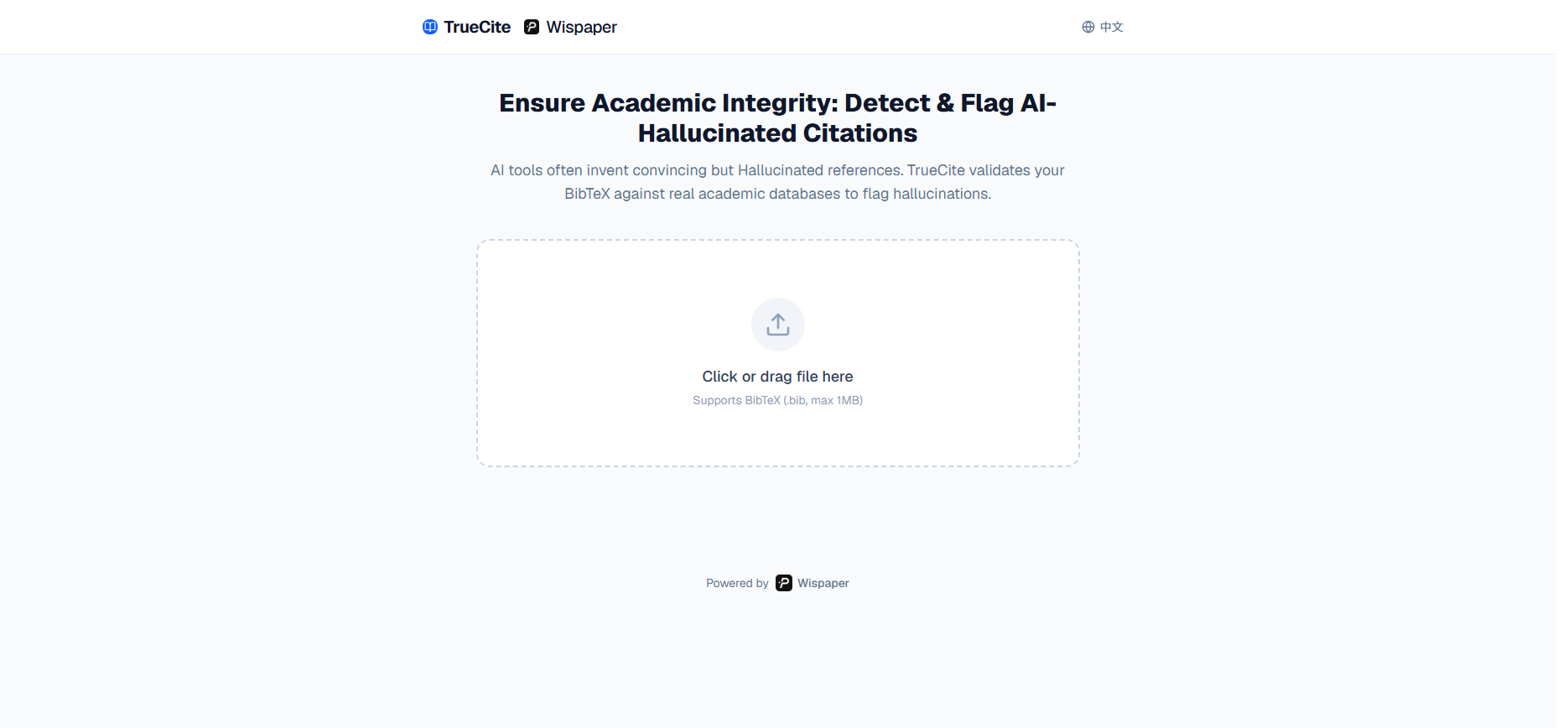
TrueCite, powered by WisPaper, checks BibTeX files against real academic databases to flag hallucinated references. It is useful when a researcher needs a focused citation-verification step before relying on AI-generated references.
FAQs
Keep Reading

Scholarly Sources for Assignments: Where to Find Them and How to Use Them
You have an assignment due, and the instructions say "use scholarly sources." That usually means peer-reviewed journal articles, academic books, or conference papers. But if you have ever typed your research question int
How to Find Peer-Reviewed Articles for a Research Paper
Your instructor wrote "peer-reviewed sources only" in the rubric. You need to find them, but you are not entirely sure what counts as peer reviewed or where to look. A quick Google Scholar search returns a mix of PDFs, p

Good Sources for a College Research Paper: What Counts and What Does Not
You have a thesis, a deadline, and a blank page. The next step is finding sources, but the search results are overwhelming, and it is hard to tell what your professor will actually accept. A "good" source has to be accur