
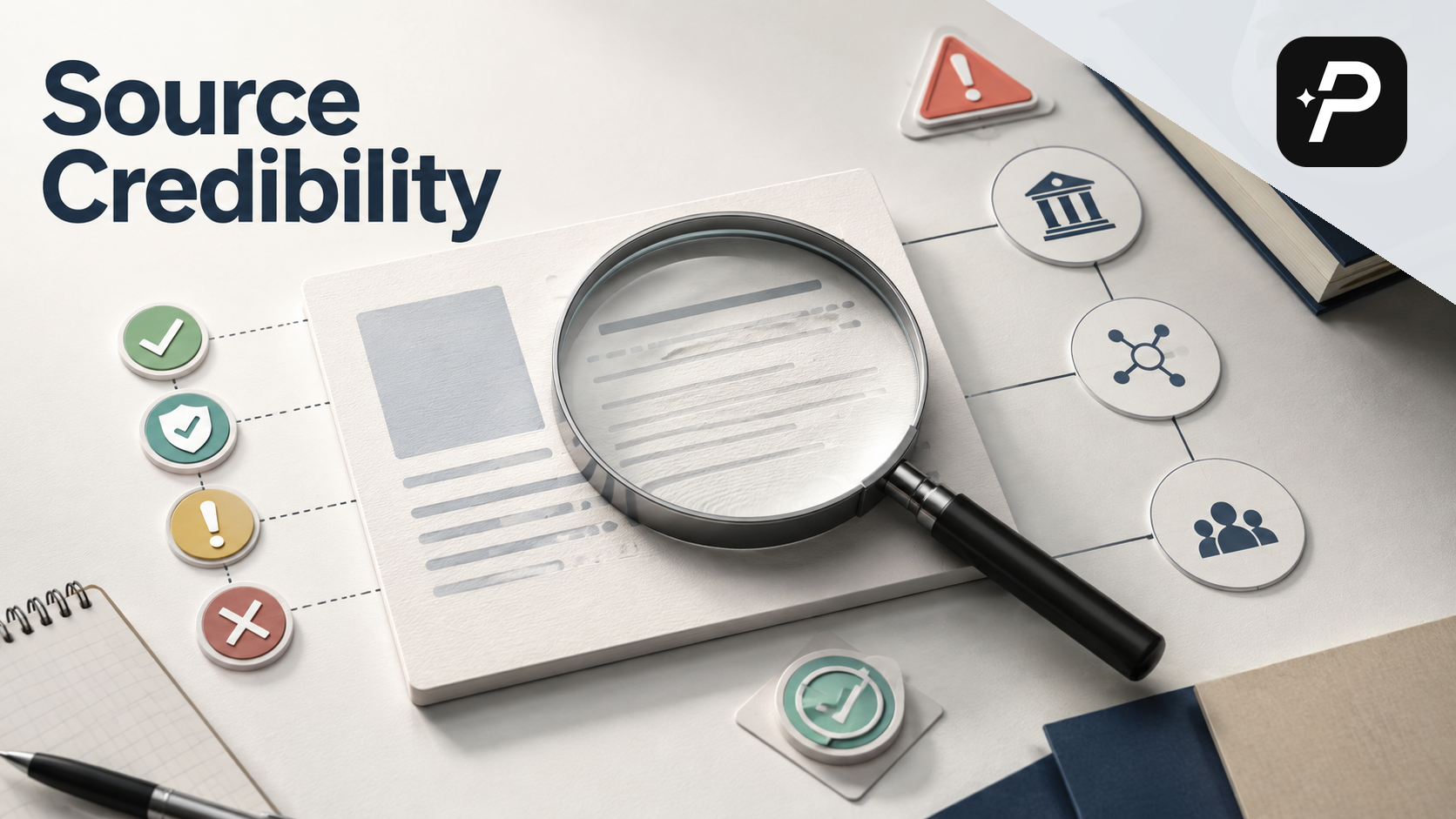
You found a source that seems perfect. The topic matches, the argument looks convincing, and you are ready to add it to your reference list. Then the doubt hits: is this source credible enough to cite?
Students face this question constantly. Between websites, preprints, blog posts, and AI-generated suggestions, the line between reliable evidence and questionable material has blurred. This checklist helps you make a clear decision: cite it, use it as background, or discard it.
What Makes a Source Credible Enough to Cite?
Credibility is not one quality. It is a combination of factors that tell you whether a source is trustworthy, accurate, and appropriate for academic use. When you ask whether a source is credible, you are really asking four separate questions:
- Who created it?
- What kind of source is it?
- Does it support your specific claim?
- Is it current and verifiable?
A source becomes credible enough to cite when it passes all four checks. If it fails one, you may still use it for background reading, but you should not place it in your reference list as evidence for a claim.
Who Created the Source, and Why Does That Matter?
The first step is to identify the author or organization. A name by itself is not enough; you need to understand their authority and potential bias.
Check the author's qualifications
Ask yourself:
- Does the author have a degree or professional experience in this field?
- Have they published other work on this topic?
- Are they affiliated with a university, research institute, or recognized organization?
An article about climate change written by a climate scientist at a university carries more weight than the same topic written by a marketing professional with no scientific background.
Look for organizational authority
Sometimes the "author" is an institution. Government agencies, academic journals, and established research bodies generally produce reliable content. But be careful with think tanks, advocacy groups, and commercial websites. These organizations may have an agenda, and their content can be biased even when it looks professional.
Watch for hidden bias
Every source has a perspective. The question is whether that perspective interferes with accuracy. A pharmaceutical company's report on its own drug will likely highlight benefits and downplay risks. A blog funded by an industry lobby group may present selective data. When you evaluate source credibility, ask: does this creator have a reason to present the topic in a particular way?
Is the Source Scholarly, Professional, or Popular?
Not all credible sources are scholarly, and not all scholarly sources are relevant. Understanding the difference helps you match the source to your assignment's expectations.
Scholarly sources
These are written by experts for other experts. They include:
- Peer-reviewed journal articles
- Academic books from university presses
- Conference proceedings
Scholarly sources go through rigorous review processes. They include citations, methodology sections, and often data or original research. If your assignment requires academic evidence, these are your primary targets.
Professional sources
These are written by practitioners for people in a field. Examples include:
- Industry reports
- Professional association publications
- Technical standards documents
Professional sources are credible for applied topics. If you are writing about nursing practices, a guideline from a nursing association is highly relevant. However, these sources are not always peer-reviewed, so you should verify their methodology.
Popular sources
These include news articles, magazines, blogs, and general websites. Popular sources can be credible for current events, public opinion, or introductory context. But they are rarely appropriate as the main evidence for an academic argument. A news article about a study is not the same as the study itself. If you find a claim in a news piece, trace it back to the original research.
Does the Source Actually Support Your Claim?
You might have a perfectly credible source that does not support your argument. This is a common mistake: students find a reliable paper, but it only tangentially relates to their thesis. The source is credible, but it is not the right source for this specific citation.
Match the claim to the evidence
Before you cite, ask:
- Does this source directly address the claim I am making?
- Does it provide data, examples, or reasoning that supports this specific point?
- Am I using the source's actual conclusion, or am I stretching its findings?
Beware of citation bloat
Some students add sources to their reference list to look well-researched, even when those sources do not support the surrounding text. This is a form of academic dishonesty. If a source does not support your claim, do not cite it, no matter how impressive it looks.
Check for nuance
A source might support your claim in general but disagree with your specific framing. For example, a study might show that online learning improves test scores, but only for certain subjects. If you cite that study to claim "online learning is always better," you are misrepresenting the source.
Is the Source Current Enough for Your Topic?
Timeliness is a key part of the citation decision. The answer depends on your field and your claim.
Fast-moving fields
In computer science, medicine, and technology, research changes quickly. A source from five years ago may be outdated. For these topics, look for recent publications, ideally within the last three to five years.
Slow-moving fields
In history, philosophy, and mathematics, older sources remain valuable. A foundational text from 1950 can still be credible and relevant. In these cases, currency matters less than the source's contribution to the field.
Check the publication date
Look for:
- The publication date on the article or book
- The "last updated" date on websites
- The data collection period in research papers
If a source is older but still cited by recent papers, it is likely still relevant. You can check this by looking at the source's citation count or by searching for recent works that reference it.
Can You Verify the Citation Details?
A credible source must be verifiable. If you cannot find the original source or confirm its details, you cannot cite it properly.
Confirm the full reference
You need:
- Author name(s)
- Publication year
- Title
- Journal or publisher
- DOI or URL
If any of these are missing, the source may be unreliable or incomplete. This is especially important with AI-generated citations, where tools can produce references that look real but do not exist. Learn how to verify AI citations before they end up in your paper.
Check for corrections and retractions
Even published research can be flawed. Before citing a paper, check whether it has been corrected or retracted. A retracted paper should not be cited as evidence. You can learn more in our guide on how to check paper correction and retraction.
When Is a Credible Source Still Not the Right Source?
You have a source that is authoritative, current, and relevant. It passes every check. But it might still be the wrong source for your paper.
The source is too broad
A textbook chapter on cognitive psychology is credible, but if your claim is about a specific memory phenomenon, you need a more focused study. Broad sources are useful for background, but they do not provide the precise evidence needed for a narrow claim.
The source is too narrow
A case study about one patient is credible but cannot support a general claim about a whole population. Be careful not to overgeneralize from a single example.
The source is not peer-reviewed
Preprints and conference papers can be credible, but they have not undergone full peer review. For some topics, they are the best available evidence. For others, you should wait for the published version. Our guide on whether to include preprints and conference papers in a literature review can help you decide.
The source is grey literature
Grey literature—reports, working papers, and government documents—can be highly credible, especially for policy topics. But it requires extra scrutiny. Learn more about AI search for grey literature to understand how to evaluate these sources.
How Can WisPaper Help You Inspect Academic Sources Before Using Them?
WisPaper helps you evaluate sources during the search and screening process. It does not make the final credibility judgment for you—that responsibility stays with you—but it gives you the tools to make better decisions faster.
Deep Search for natural-language queries
Instead of struggling with complex Boolean strings, you can use Deep Search to find academic literature by asking a natural-language research question. This helps you discover sources you might have missed with traditional keyword searches.
Paper cards for quick screening
When you find a source, the paper card shows you source labels (e.g., journal, preprint, conference), summaries, publication details, authors, and preview information. This lets you quickly assess whether a source is worth a deeper read without opening every full text.
Scholar Agent for exploring research directions
If you are unsure whether your topic is well-defined, Scholar Agent can help you explore research questions and paper directions within the search workflow. This is useful when you are still shaping your argument and need to understand the landscape.
Inspiration Discovery for underdeveloped topics
When your topic is too broad, too narrow, or underdeveloped, Inspiration Discovery surfaces related angles you might not have considered. This helps you refine your research question and find more targeted sources.
My Library and Library QA
You can save papers to My Library and use Library QA to ask questions based on the papers you have uploaded. This is helpful for comparing sources and checking whether they support your claims.
Final Checklist: Is This Source Credible Enough to Cite?
Before you add any source to your reference list, run it through this quick checklist:
- Author: Is the author qualified and identifiable?
- Organization: Is the publisher or organization reputable?
- Type: Is the source scholarly, professional, or popular—and is that appropriate?
- Relevance: Does the source directly support your specific claim?
- Currency: Is the source current enough for your topic?
- Verification: Can you confirm the citation details and check for retractions?
If you answered "no" to any of these, the source may still be useful for background reading. But it is probably not credible enough to cite as evidence in your paper.
The final judgment is yours. Tools like WisPaper can help you find and screen sources faster, but you are responsible for the quality of your references. Use this checklist every time, and you will build a reference list you can defend with confidence.
FAQs
Keep Reading
How Many Sources Does a Research Paper Need?
If you are staring at a blank page with a half-finished outline and a growing sense of panic, you have probably asked the same question that every student and early-stage researcher eventually faces: how many sources for
How to Find Recent Research Articles on a Topic
Finding recent research articles on a topic sounds straightforward. You open a database, type a few keywords, and sort by date. But anyone who has tried knows the search results come back noisy, half of them irrelevant,
How to Research a College Paper Fast Without Using Bad Sources
The deadline is close. You have a blank document open, a growing sense of panic, and a research paper that needs to be written. When you are researching a research paper short on time, the instinct is often to grab the f