
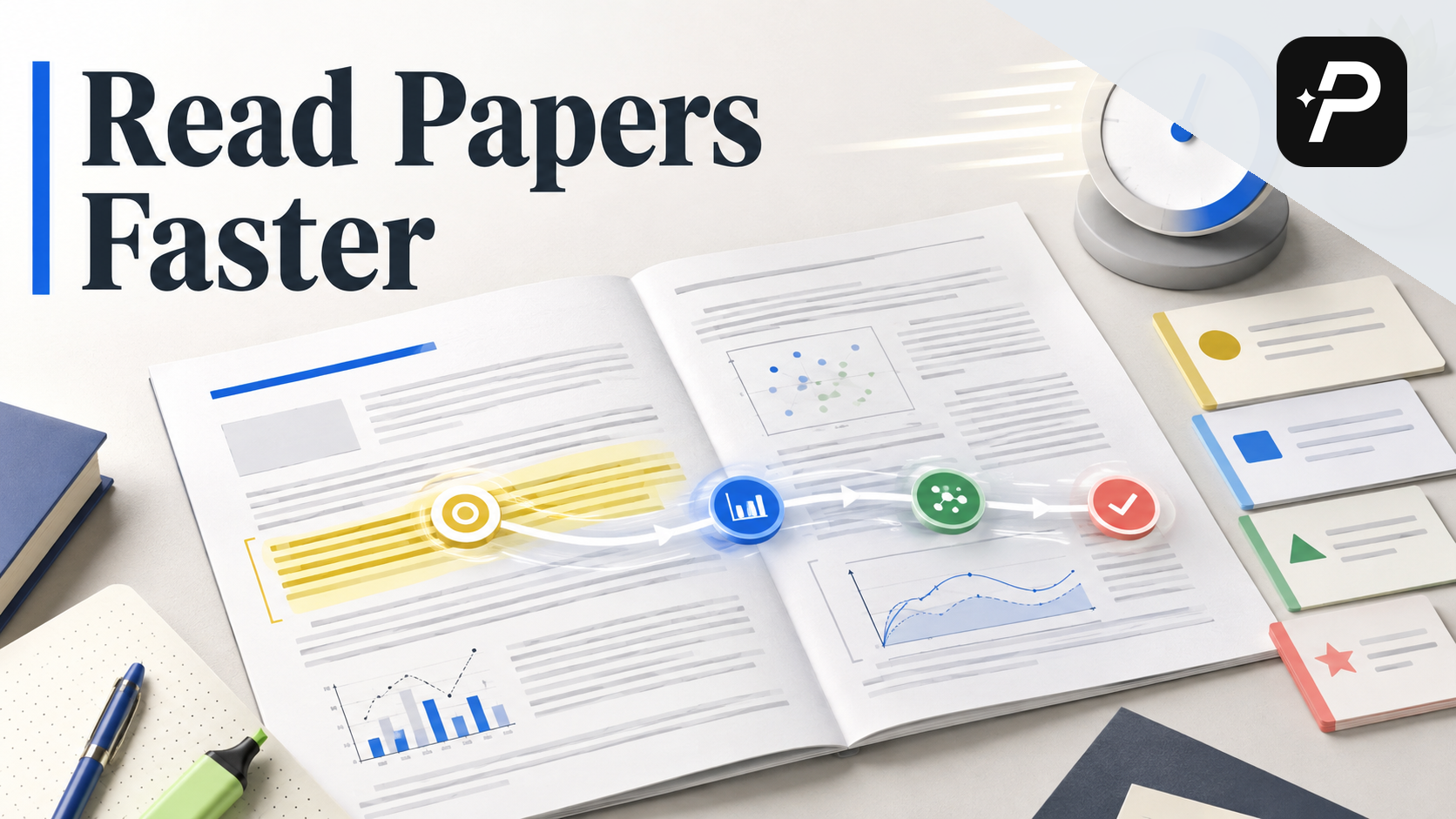
Reading research papers is a core part of academic life, but the sheer volume of literature can quickly become overwhelming. Whether you are building a thesis bibliography, preparing for a seminar, or scoping out a new field, the pressure to "read everything" can lead to burnout. The goal isn't to read faster by rushing through every word; it is to read more intelligently by deciding what deserves your full attention.
This guide will show you how to read research papers faster without missing the point. You will learn a practical triage system to filter out irrelevant work, a strategic skimming method for the rest, and a deep-reading approach for the few papers that truly matter. By the end, you will have a workflow that saves time while ensuring you retain the critical insights you need for your own research.
How can you read research papers faster?
The secret to reading papers quickly isn't a magic speed-reading technique. It is a shift in mindset from "reading every line" to "extracting the core message." Most papers are structured to be read in a non-linear fashion. You don't need to start at the abstract and grind through to the conclusion to understand the contribution.
To read research papers faster, you need a three-stage workflow: Triage, Skim, and Deep Read.
- Triage (30 seconds): This is the initial filter. You look at the title, abstract, and keywords to decide if this paper is even relevant to your current question. If it isn't, you discard it immediately.
- Skim (5-10 minutes): For papers that pass the triage, you skim the introduction, section headings, figures, and conclusion. This gives you a structural overview of the paper's argument and findings without reading the details.
- Deep Read (30-60+ minutes): This is reserved for the few papers that are highly relevant, methodologically important, or directly cited in your work. Here, you read the entire paper carefully, taking notes and questioning the methodology.
This approach prevents you from wasting 30 minutes on a paper that only has a tangential connection to your topic. By actively deciding how much effort a paper deserves before you start reading, you reclaim hours of your week. This is the foundation of reading papers efficiently.
Which papers deserve full reading?
Not all papers are created equal. Treating a seminal paper in your field the same as a minor conference submission is a recipe for wasted time. You need to categorize papers based on their potential impact on your work.
Here is a quick classification system to help you decide:
- Tier 1: Deep Read. These are papers that are directly relevant to your research question, introduce a method you plan to use, or are foundational works cited by many others. They deserve your full, undivided attention.
- Tier 2: Skim. These papers are relevant to your broader topic but not central to your specific argument. You need to know their main finding and contribution, but you don't need to understand every methodological detail.
- Tier 3: Triage and Discard. These papers only superficially match your search terms. They might be from a different discipline or address a different aspect of the problem. You should discard these without guilt.
To help you categorize, ask yourself these questions during the triage phase:
- Does the abstract directly address my research question?
- Is this paper from a top journal or a well-known author in the field?
- Is it recent, or is it a classic that has been superseded?
- Does the paper introduce a new method, dataset, or theory that I should know about?
If you answer "no" to most of these, it is likely a Tier 3 paper. If it is relevant but not critical, it is a Tier 2 paper. Only a small fraction should make it to Tier 1. This conscious filtering is the most effective way to read papers quickly without missing the point.
What should you skim first?
When you pick up a paper for the first time, resist the urge to read the abstract and then dive into the introduction. Instead, use a structured skimming approach to build a mental map of the paper. This is how you read academic papers faster while retaining the big picture.
Here is the order to skim a research paper:
- The Abstract: This is your summary. Read it carefully to understand the problem, the proposed method, and the key results.
- The Introduction (Last Paragraph): The final paragraph of the introduction usually outlines the paper's structure and contributions. This tells you what the authors believe is most important.
- Section Headings: Scan the headings and subheadings. This gives you the skeleton of the argument.
- Figures and Tables: Look at every figure and table. Read the captions carefully. A good figure caption explains the key takeaway of the visual. This is often where the "point" of the paper is most clearly visible.
- The Conclusion: Read this to understand the authors' final takeaway, limitations, and suggestions for future work.
By following this order, you are essentially reading the paper in a "Z" pattern. You get the beginning, the end, and the visual highlights. After this 5-10 minute skim, you should be able to answer the question: "What did this paper do, and what did they find?" If you can't, it might be a Tier 1 paper that requires a deep read. If you can, you have successfully skimmed it.
How do you read for relevance?
Skimming gives you the structure, but the next step is to read for relevance. This is an active process where you keep asking, "What does this mean for my research?" The point is to extract what matters, not to absorb every sentence.
To read for relevance, focus on the introduction and conclusion of each section. For example, in a methods section, you don't need to understand every equation immediately. Instead, read the first and last paragraphs to understand the high-level approach. Ask yourself:
- What is the main contribution? (Usually in the introduction and conclusion)
- What are the key results? (Usually in the abstract, figures, and conclusion)
- What are the limitations? (Usually in the discussion/conclusion)
- How does this relate to my work? (This is the most important question)
If a section is too dense, don't get stuck. Mark it and move on. You can always return to it later if it becomes critical. The goal is to understand the paper's narrative arc: the problem, the approach, the result, and the interpretation.
Reading for relevance turns a passive session into a research task. You are asking the paper to earn its place in your project.
How do you read methods and results without getting stuck?
The methods and results sections are often the most technical and intimidating parts of a paper. It is easy to get bogged down in mathematical formulas or complex statistical analyses. The key is to read these sections with a specific purpose in mind, not to understand every detail.
Here is a strategy for tackling these dense sections:
- For the Methods Section: Your goal is to understand the approach, not the implementation. Read the first paragraph to understand the study design. Look for the "big idea" of the method. If the authors used a new dataset, note what it is. If they used a specific model, understand the general category it belongs to, such as a transformer or regression model. Don't worry about the specific hyperparameters or equations on your first pass.
- For the Results Section: Your goal is to understand the findings, not the statistics. Look at the figures and tables first. What are the main trends? Are the results supporting the authors' hypothesis? Read the captions and the text around the figures to understand what is being shown. Pay attention to the text that explains the significance of the results, rather than reading the numbers alone.
If you find yourself stuck on a specific equation or statistical test, ask yourself: "Is it essential for me to understand this to get the paper's main point?" Often, the answer is no. You can treat the method as a "black box" that produces a result you can interpret. This approach is crucial for reading papers quickly without getting lost in the weeds.
How do you take notes that speed up later writing?
Reading a paper is only half the battle. The other half is capturing the information in a way that is useful for your future writing. Poor note-taking leads to re-reading papers and wasted time. A good note-taking system is an investment that pays off during your literature review.
Instead of highlighting entire paragraphs, create a structured note for each paper you read. This is a critical component of learning how to read research papers faster in the long run. Here is a template you can use:
- Citation: The full citation in your preferred format (APA, MLA, etc.).
- One-sentence summary: What is the single most important takeaway from this paper?
- Key findings: Bullet points of the 2-3 most important results.
- Methodology (Brief): What did they do? (e.g., "Used a survey of 500 participants," or "Proposed a new neural network architecture.")
- Strengths: What did this paper do well?
- Weaknesses/Limitations: What are the gaps or flaws?
- Relevance to my work: How will I use this paper in my own research? (e.g., "This supports my argument in section 2," or "This is a method I can apply to my dataset.")
By writing these notes in your own words, you are actively processing the information. When it comes time to write your literature review, you can simply look at your notes instead of re-reading the entire paper. This system is a cornerstone of an efficient reading workflow.
How do you avoid speed-reading the wrong papers?
The biggest risk of trying to read research papers faster is that you might skim a paper that actually deserved a deep read. This can lead to a superficial understanding of a key concept and potentially embarrassing mistakes in your own work. Speed is useless if you miss the point.
Here is how to avoid this pitfall:
- Trust but verify: If a paper is highly relevant to your core argument, don't rely solely on a skim. Even if you plan to skim it, be prepared to upgrade it to a deep read if you find yourself confused or if the content is more complex than you expected.
- Check the "Related Work" section: If you are reading a paper and it cites several other papers that are also highly relevant to you, it might be a sign that you need to read the original sources for a deeper understanding.
- Be wary of complex methods: If a paper's method is central to your own work (e.g., you plan to replicate it), you must deep-read the methods section, even if it is difficult.
- Don't ignore the limitations: If the authors list limitations that directly impact your research question, you need to understand them thoroughly.
The goal is not to read everything quickly; it is to read the right things carefully and the rest quickly. This balance is what separates efficient researchers from those who are either overwhelmed or superficially informed. To further refine your process, you can learn how to build a reading queue for a research topic to ensure you are prioritizing the right papers from the start.
How can WisPaper support faster paper triage?
Managing a large volume of PDFs is a logistical challenge. WisPaper is designed to streamline this entire process, from discovery to note-taking, helping you read research papers faster and more effectively.
Here is how WisPaper can fit into your workflow:
- Smart Search and Screening: Instead of crafting complex Boolean queries, you can use Deep Search to find papers using a natural-language research question. This helps you get to a relevant list of papers much faster. As you scan the results, paper cards show you source labels, summaries, publication details, and author information, allowing you to make quick triage decisions without opening every PDF.
- Inspiration Discovery: If your topic is too broad or too narrow, Inspiration Discovery can help you find related angles and new directions. This is useful for expanding your search if you are not finding enough relevant papers or for narrowing it down if you are overwhelmed. You can also use the Scholar Agent to explore research questions and paper directions inside the search workflow.
- My Library and Library QA: Once you have identified the papers you want to read, you can save them to My Library. This centralizes your PDFs, eliminating the need to manage files across multiple folders. After you have read a few papers, you can use Library QA to ask questions based on the papers in your own library. This is a powerful tool for synthesizing information and clarifying concepts without having to re-read entire documents.
By integrating WisPaper into your workflow, you can significantly reduce the time spent on administrative tasks like searching and file management, freeing you up to focus on the actual reading and critical thinking. For more tips on managing your sources, check out this guide on how to manage a PDF library for a literature review.
FAQs
Keep Reading
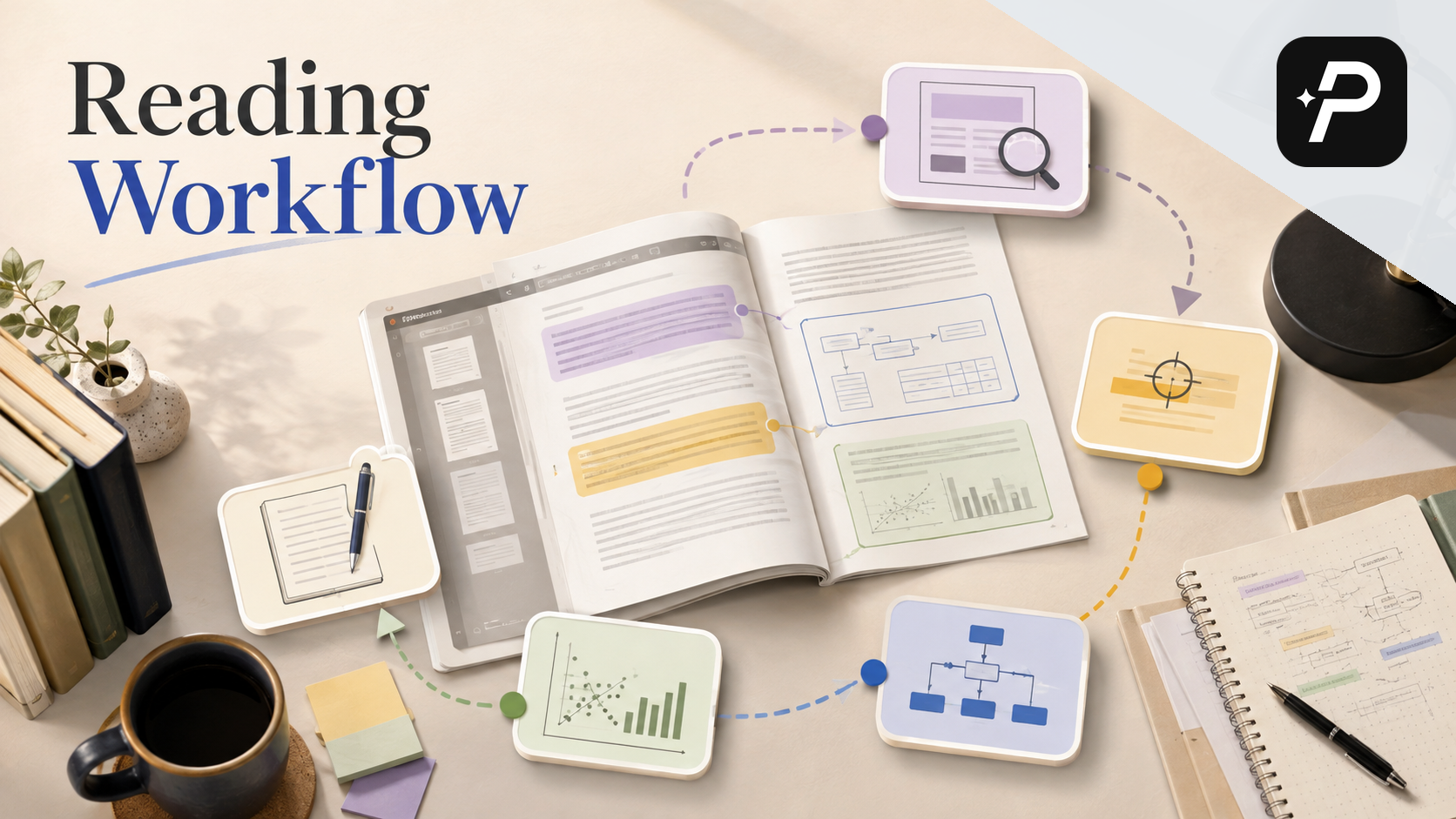
Can't Understand Research Papers? Start With This Reading Workflow
If you've opened a research paper, read the first paragraph three times, and still closed the PDF with nothing sticking, that's not a comprehension failure. It's a strategy failure. Academic papers are not written to be
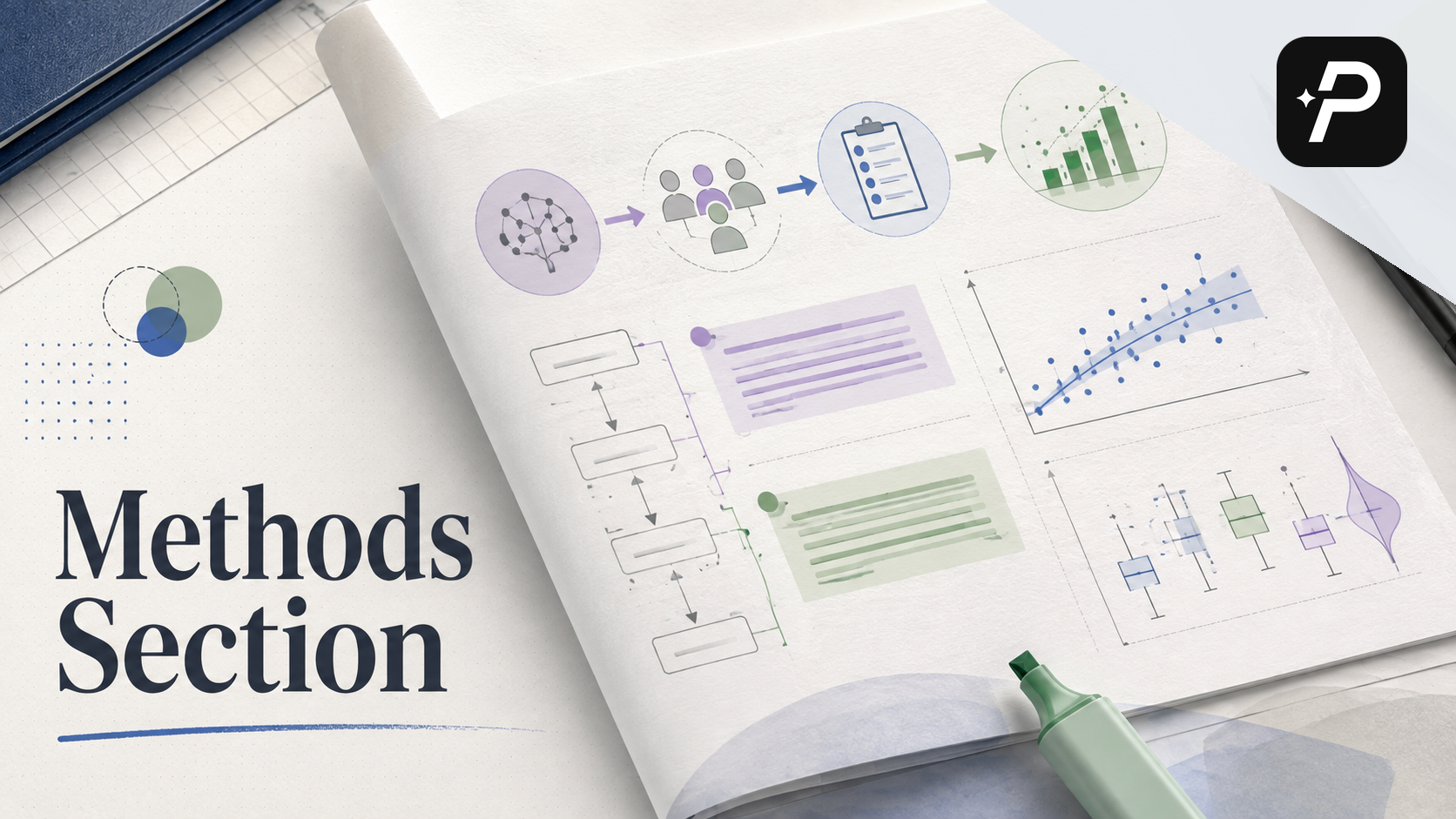
How to Understand the Methods Section of a Research Paper
The methods section is often the most intimidating part of a research paper. It is dense, technical, and packed with jargon that seems to assume you already know the experiment by heart. If you are a student, thesis writ
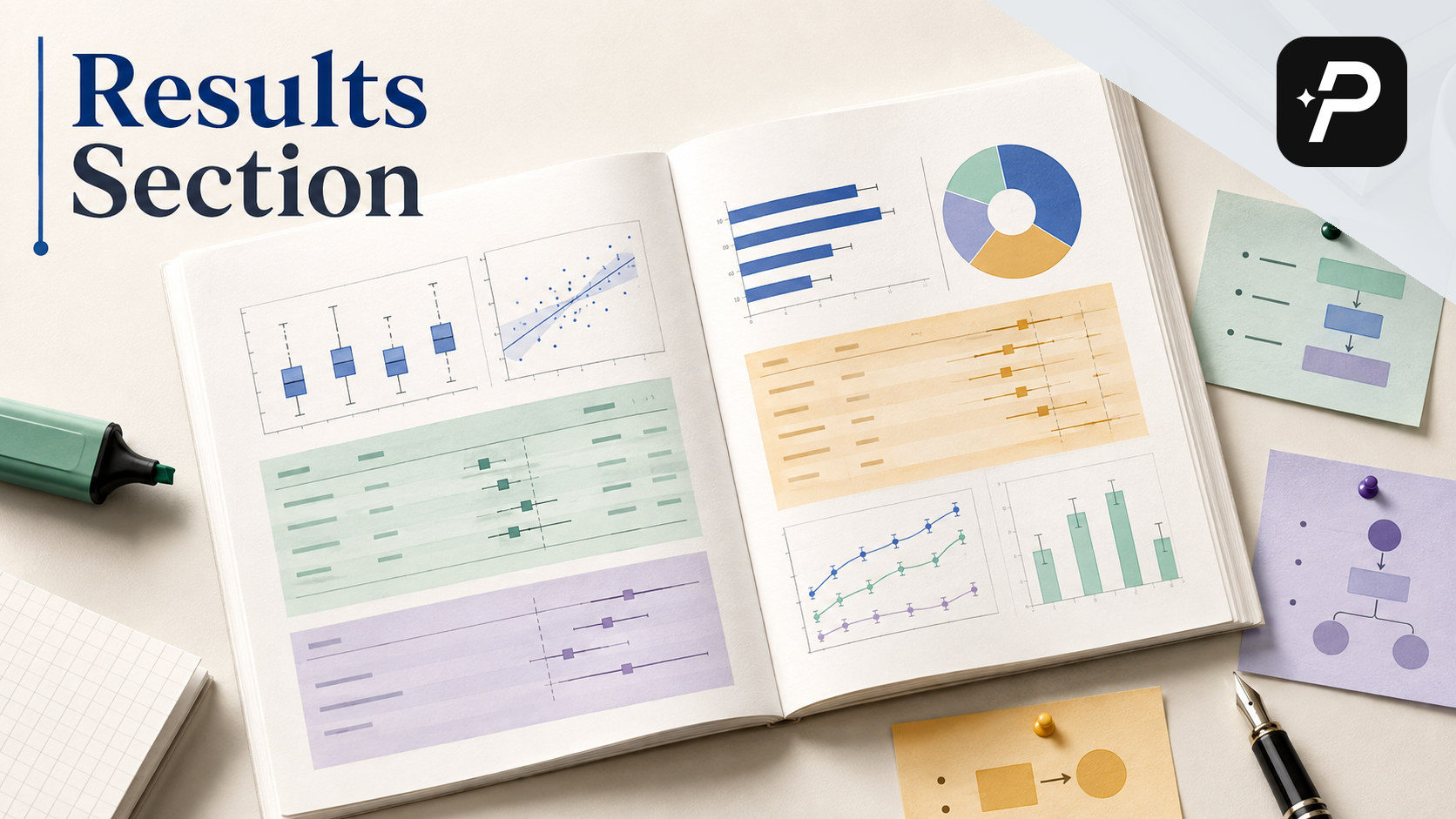
How to Understand the Results Section of a Research Paper
The results section is where a study shows what it actually found. For many students and early-stage researchers, it is also the most intimidating part of a paper. Statistical tests, dense tables, and figures can feel li