

Coauthor Approval by Email vs. Shared Sign-Off Sheet: Which Keeps Your Research Submission Ready?
When a client deck, decision memo, or project closeout is waiting on coauthor sign-off, the question is rarely philosophical. It is operational: which approval method closes the loop with fewer missed replies, less versi

Cover Letter vs. Manuscript Highlights: Which One Actually Moves Your Submission Forward?
When a course paper becomes a journal manuscript, two short documents suddenly appear on the checklist: the cover letter and the manuscript highlights. They are not interchangeable, and treating them as if they were is o

Data Availability Statement vs. Data Management Plan: Which Document Does Your Paper Actually Need?
If you are finishing a thesis chapter or preparing a first manuscript, you have probably seen two similar-sounding requirements: a **data availability statement** and a **data management plan**. They are not the same doc
Descriptive Title vs. Question Title for a Research Paper: A Decision Framework for Evidence-Focused Teams
You are drafting a focused evidence brief for a clinician group, and the title decision is no longer cosmetic. It determines which reviewers open the paper, which search queries surface it, and whether a busy reader can

How to Add New Evidence During Manuscript Revision
Revision starts the moment a draft leaves your desk and returns with notes in the margin. For students and early-career researchers, the most difficult revision request is rarely "shorten this paragraph" or "fix the p-va
How to Archive Searches You No Longer Need
Most researchers do not lose a literature search because the database stopped working. They lose the *why*. Six months after a screening pass, the folder is still there, but the connection between the eligibility criteri
How to Build a January Reading Plan from Your Research Backlog
A research backlog rarely fails because you stopped caring. It fails because it has no shape: forty open tabs, a folder called “to read eventually,” three supervisor comments you half-remember, and a stack of PDFs that n
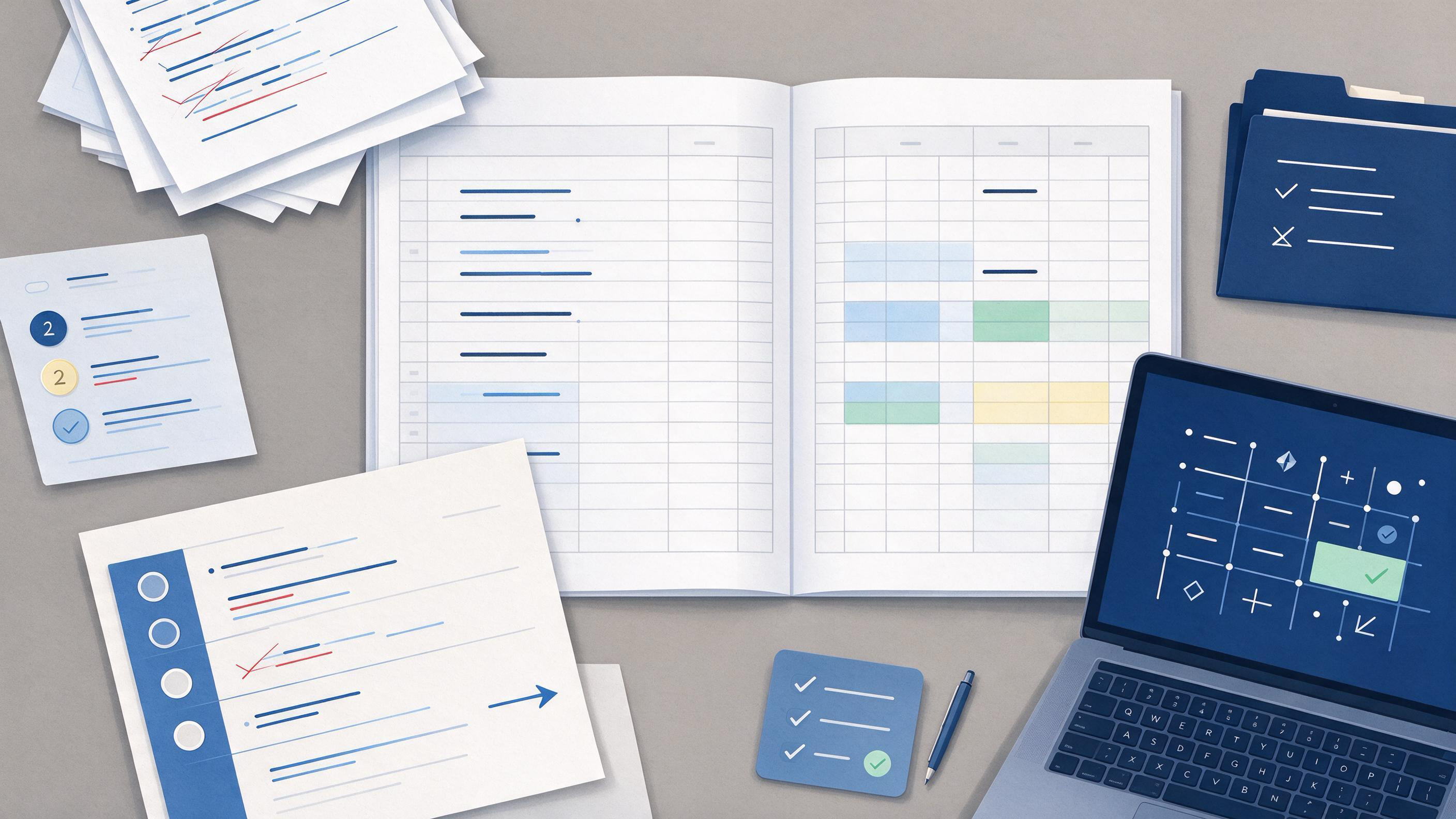
How to Build a Response Matrix for Reviewer Comments
You have a decision letter open in one tab, a marked-up manuscript in another, and a growing list of comments that do not map cleanly onto a single revision. Before you touch the draft, stop and build the artifact that w

How to Build a Submission-Day Timeline
A submission-day timeline is a reverse-planned schedule that turns the final push of a manuscript into a sequence of checkable handoffs. The goal is not to describe the ideal manuscript in the abstract, but to know, on a

How to Build an Abbreviation List and Remove Undefined Acronyms
A manuscript returns from coauthors with comments in the margin: one asks what FMT means in the methods, another flags that ANOVA appears on page 6 without ever being spelled out, and a third notes that the abbreviation