
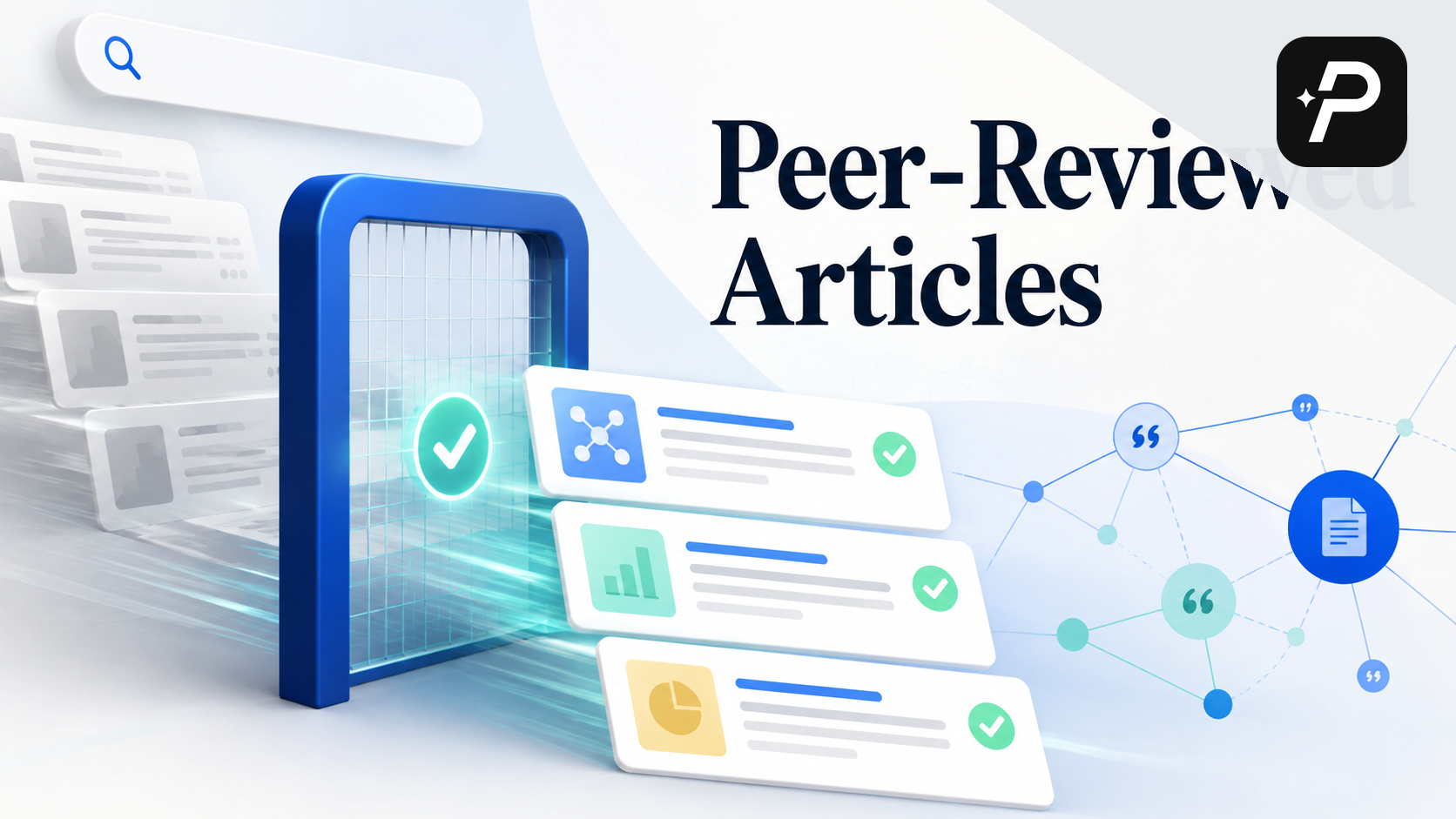
Your instructor wrote "peer-reviewed sources only" in the rubric. You need to find them, but you are not entirely sure what counts as peer reviewed or where to look. A quick Google Scholar search returns a mix of PDFs, preprint servers, and journal pages, and you are left guessing which ones meet the standard.
This guide walks through the full process: what peer review actually means, where to search, how to verify that an article is genuinely peer reviewed, and how to choose which sources to cite. You will end up with a repeatable workflow instead of a pile of open tabs.
What Does Peer Reviewed Mean?
Peer review is a quality-control process that academic journals use before publishing an article. When a researcher submits a manuscript, the editor sends it to several independent experts in the same field. These reviewers evaluate the methodology, accuracy, originality, and relevance of the work. They may request revisions, reject the paper, or recommend acceptance.
The key point is that the article has been examined by qualified peers—other researchers—who were not involved in the study itself. This process does not guarantee that every claim is correct, but it does mean the work has passed a basic threshold of scholarly scrutiny. That is why instructors ask for peer-reviewed articles: they want sources that have been vetted by the academic community rather than blog posts, opinion pieces, or unreviewed preprints.
Peer review happens before publication. Once an article is published, it is not "re-reviewed" unless a correction or retraction occurs. For that reason, you should also check whether an article has been corrected or retracted after publication, especially if you are citing older research.
Where Can You Find Peer-Reviewed Articles?
The most reliable places to find peer-reviewed articles are subscription databases provided by your university library. These databases index journals and often include filters that let you limit results to scholarly or peer-reviewed publications. Common examples include:
- JSTOR – strong in humanities and social sciences
- PubMed – biomedical and life sciences
- IEEE Xplore – engineering and computer science
- Scopus and Web of Science – multidisciplinary, with robust citation data
- EBSCOhost and ProQuest – platforms that host many subject-specific databases
Your library website will have a list of databases organized by subject area. If you are unsure which one to use, the library's research guides are a good starting point. They are usually written by librarians who know which databases cover which disciplines.
You can also use open-access repositories like DOAJ (Directory of Open Access Journals), which lists peer-reviewed journals that are freely available. Government and institutional repositories may also host peer-reviewed articles, though you will need to verify each one individually.
How Do You Use Library Databases Without Getting Lost?
Library databases can feel overwhelming because they are dense with filters, operators, and field codes. The trick is to start simple and refine gradually.
Begin with a clear research question. Break it into key concepts. For example, if your question is "How does sleep deprivation affect academic performance in university students?", your concepts are "sleep deprivation," "academic performance," and "university students."
Enter these concepts as separate search boxes if the database supports Boolean searching. Connect them with AND. This narrows your results to articles that mention all three ideas. If you get too few results, try synonyms: "sleep restriction" instead of "sleep deprivation," or "college students" instead of "university students."
Use the peer-reviewed filter. Most databases have a checkbox or dropdown labeled "Scholarly (Peer Reviewed) Journals." This filter does the initial screening for you, but it is not a guarantee—you should still verify each article individually.
Finally, use the abstract to decide whether an article is relevant. You do not need to read the full text of every search result. Skim the abstract for the study design, sample size, and main findings. If it matches your research question, save it. If not, move on.
Can Google Scholar Find Peer-Reviewed Articles?
Google Scholar is a popular starting point because it is fast and familiar. It searches across many academic sources, including journals, conference papers, theses, and preprints. However, it does not have a dedicated filter for peer-reviewed content.
When you search Google Scholar, you will see results from preprint servers like arXiv and SSRN, which do not use the same peer-review process as journals. You may also encounter predatory journals that claim to be peer reviewed but do not follow rigorous standards. Google Scholar does not distinguish between these.
You can still use Google Scholar effectively, but you need to adjust your workflow. Use it to discover relevant articles, then verify each one's peer-review status using the journal's website or your library's database. If you are already using a library database, you may not need Google Scholar at all. For a deeper comparison of these approaches, see our guide on ai academic search beyond google scholar.
How Do You Check Whether an Article Is Actually Peer Reviewed?
This is the step that separates a strong research paper from a weak one. Even if you found an article in a database, you should verify that it is genuinely peer reviewed. Here is a simple checklist:
-
Check the journal as well as the article. Go to the journal's homepage. Look for a section titled "Editorial Policy," "Peer Review Process," or "Instructions for Authors." It should describe how manuscripts are evaluated.
-
Look for a peer-reviewed label in the database. Some databases display a small icon or note indicating that a journal is peer reviewed. If you see this, you can trust it—but only if the label comes from the database itself, not from the article page.
-
Check the article type. Peer-reviewed journals also publish editorials, book reviews, and commentaries. These are not peer reviewed in the same way as research articles. Look for the article type in the database record. If it says "research article" or "original research," you are on the right track.
-
Look for a methodology section. Peer-reviewed research articles almost always include a methods or methodology section that describes how the study was conducted. If the article lacks this, it may be an opinion piece or a review, not original research.
-
Use Ulrich's Periodicals Directory. Many libraries provide access to Ulrich's, which lists whether a journal is "refereed" (the publishing industry term for peer reviewed). This is a reliable way to confirm a journal's status.
If you are still unsure, ask a librarian. They are trained to answer exactly this kind of question.
What Should You Do If You Cannot Access the Full Text?
You will often find a promising article in a database, only to hit a paywall when you click through to the full text. This is frustrating, but there are several legitimate ways to get access:
-
Check your library's holdings. The database you are searching may not have full text, but your library might subscribe to the journal through a different provider. Use the "Find It" or "Check for Full Text" button in the database to see all access options.
-
Use interlibrary loan (ILL). Most university libraries offer ILL, which lets you request a copy of an article from another library. It usually takes a few days, so plan ahead.
-
Search for the author's accepted manuscript. Many researchers deposit versions of their papers in institutional repositories or on platforms like ResearchGate. The version may not be the final published PDF, but the content is the same. This is often called a "post-print" or "accepted manuscript."
-
Email the author. Researchers are generally happy to share their work with students. A polite email asking for a copy is often successful.
-
Use open-access extensions. Browser extensions like Unpaywall can automatically find open-access versions of an article when you visit a paywalled page.
What you should not do is use unauthorized pirate sites. These are illegal and can expose you to malware. Stick to the legitimate routes above.
How Do You Decide Which Peer-Reviewed Articles to Use?
Once you have a list of peer-reviewed articles, you still need to decide which ones to actually read and cite. Not all peer-reviewed articles are equally useful for your specific paper. Here is a triage process:
-
Start with recent articles. Depending on your field, research from the last five to ten years is usually more relevant than older work. Older articles can still be foundational, but they should be supplemented with current research.
-
Check the citation count. A high citation count often indicates that the article has influenced the field. You can see this in Google Scholar or Scopus. However, do not rely on this alone—newer articles will naturally have fewer citations.
-
Read the abstract first. Ask yourself: Does this article address my research question? Does it provide evidence I can use? If the answer is no, move on.
-
Look at the journal's reputation. Peer-reviewed journals vary in quality. A paper in a top-tier journal like Nature or The Lancet has undergone more rigorous scrutiny than one in a lesser-known journal. That does not mean the latter is bad, but you should weigh the source accordingly.
-
Check for retractions or corrections. Before citing an article, search for any correction or retraction notices. This is especially important for high-profile papers. For a practical guide, see our article on how to check paper correction retraction.
How Can WisPaper Support Academic Source Discovery?
WisPaper is designed to help you move through the discovery phase of academic research more efficiently. When you are searching for peer-reviewed articles for a research paper, the platform offers features that can save you time:
Deep Search lets you describe your research topic in natural language instead of constructing a long Boolean query. You can type a question like "What is the effect of remote work on team collaboration?" and the search will surface relevant academic literature. This is especially useful when you are new to a topic and do not yet know the right keywords.
Inspiration Discovery helps when your topic is too broad, too narrow, or still underdeveloped. If your initial search returns either thousands of results or almost none, this feature can suggest related angles and alternative directions you may not have considered.
Paper cards provide a first-pass screening tool. Each card shows the source label, a summary, publication details, authors, and preview information. You can quickly scan these cards to decide which articles are worth a deeper read, without opening every PDF.
Scholar Agent can help you explore research questions and paper directions within the search workflow. If you are unsure how to frame a question or which direction to pursue, it can assist in refining your approach.
My Library lets you save or upload papers. Once you have a collection, Library QA can answer questions based on the papers you have saved, helping you synthesize information across multiple sources.
WisPaper does not confirm whether an article is peer reviewed. You should always verify that status using the journal's website or your library's database. WisPaper helps you find and organize sources; the verification step remains your responsibility. For more on the limitations of AI-assisted search, see our discussion of deep research peer reviewed literature limits.
FAQs
Keep Reading
Good Sources for a College Research Paper: What Counts and What Does Not
You have a thesis, a deadline, and a blank page. The next step is finding sources, but the search results are overwhelming, and it is hard to tell what your professor will actually accept. A "good" source has to be accur
Can't Find Sources for Your Research Paper? A Step-by-Step Fix
You have the topic. You have the assignment. You have been staring at a search bar for forty minutes, and every query either returns 100,000 irrelevant results or three results from 1987. The cursor blinks. The deadline
Is This Source Credible Enough to Cite? A Student Checklist
You found a source that seems perfect. The topic matches, the argument looks convincing, and you are ready to add it to your reference list. Then the doubt hits: is this source credible enough to cite? Students face this