
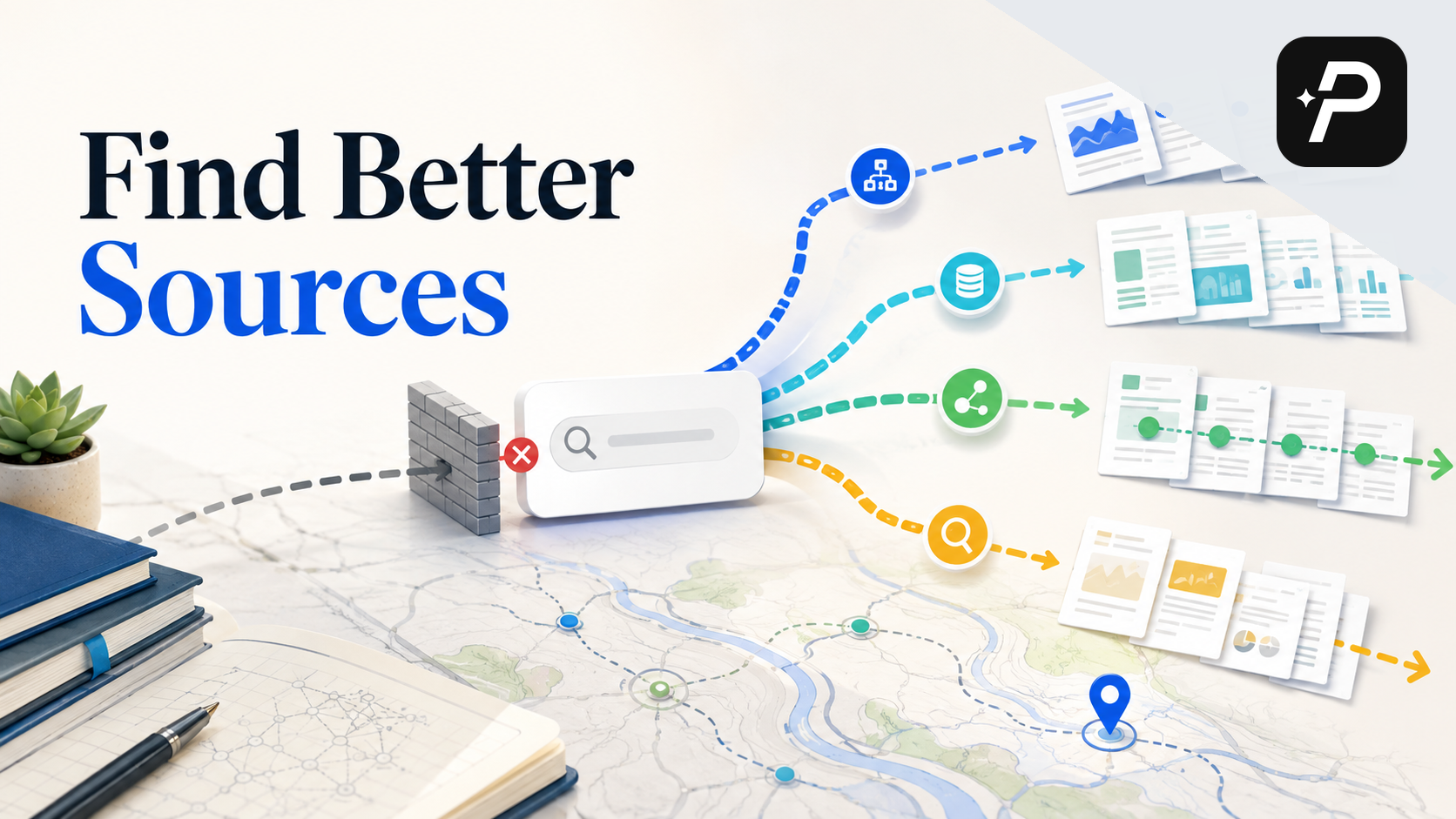
You have the topic. You have the assignment. You have been staring at a search bar for forty minutes, and every query either returns 100,000 irrelevant results or three results from 1987. The cursor blinks. The deadline does not care.
Before you conclude that the research does not exist, or that you picked the worst topic in human history, work through this troubleshooting sequence. It is ordered the way most searches actually fail, from the query itself to the scope of the topic to the tools you are using. Each step gives you a concrete test and a decision rule so you know when to move on.
Is Your Search Query the Problem?
The most common reason a search fails is not a lack of sources. It is a mismatch between how you talk about the topic and how the academic literature indexes it.
Consider what a student might type: "Why do people feel lonely on social media?"
That is a fine question for a conversation. It is a terrible search query. Academic databases do not search for meaning. They search for strings of text in titles, abstracts, and keywords. The word "feel" appears in thousands of papers about emotion and perception. The phrase "on social media" is too broad to narrow anything down.
Here is the test: if your query contains everyday verbs like "feel," "think," "affect," or "impact," you are likely searching in natural language, not academic language.
The fix is to translate the question into the vocabulary of the field. For the loneliness example, you would search for "social media use" AND "loneliness" AND "young adults." You might add "belongingness" or "social connectedness" depending on the angle. The database does not need your question. It needs your concepts.
A second version of this problem is the reverse: your query is too technical and you are missing the simpler term that most papers use. If you search for "adolescent nocturnal media engagement" and get nothing, try "smartphone use before bed" or "sleep and screen time."
The practical rule: if a search returns zero or near-zero results, change the vocabulary before you change the database. Look at the language in your textbook, your lecture slides, or one relevant paper you already have. Pull three nouns from those sources and combine them.
Are You Using the Right Search Operators?
Most students know about Boolean operators but rarely use them beyond a single AND. The difference between a failed search and a workable one is often just the structure of the query.
Say you need sources on remote work and mental health, but you keep getting papers about ergonomics and home office setup. Your query "remote work AND mental health" is too broad because the database treats "mental health" as a single concept and pulls in anything adjacent.
Try nesting: ("remote work" OR "telework" OR "telecommuting") AND ("anxiety" OR "depression" OR "psychological well-being").
The OR operator expands your vocabulary. The parentheses group the concepts. The AND connects them. This is not a trick. It is how databases parse your intent.
Another operator that solves a specific failure mode is the asterisk for truncation. If you search for "teen" you miss "teens," "teenage," and "teenagers." Searching "teen*" catches all of them. This matters more than you might think because many databases do not automatically stem words.
If you are using Google Scholar, the rules are slightly different. Google Scholar ignores some operators and handles phrases differently. Quotation marks still work for exact phrases, but the AND operator is implied. On Scholar, the fix for a bad search is usually to add more specific terms rather than to restructure the Boolean logic.
The test: if your search returns results that are all about the wrong subtopic, you need OR to expand the right terms and AND to constrain the wrong ones.
What If the Topic Is Too New for Traditional Sources?
Some topics have almost no peer-reviewed literature because the phenomenon is recent. Think about the rise of generative AI in classrooms, the mental health effects of TikTok, or the impact of a policy passed six months ago. If your topic is younger than the typical publication cycle, the peer-reviewed research may genuinely not exist yet.
The publication cycle for a peer-reviewed journal article is often one to three years from submission to print. A phenomenon that emerged two years ago might only now be appearing in early-view articles. A phenomenon from last year might only exist as conference papers or preprints.
This is a common failure mode for students who pick topics from the news. The news covers things that just happened. Academia covers things that happened long enough ago for someone to study them.
What to do instead: do not abandon the topic. Change the source type. Look for preprints on arXiv or SSRN, conference proceedings, working papers from research institutes, and government or NGO reports. These are faster to publish and often cover emerging issues.
This is where AI search for grey literature can help, because grey literature is notoriously hard to find with standard academic databases. It lives in institutional repositories, policy documents, and industry reports that do not follow the same indexing rules as journals.
The decision rule: if your topic is less than three years old, expect to rely on a mix of preprints, conference papers, and institutional reports. If your topic is less than one year old, you may need to reframe the research question to connect it to an older, established body of literature.
Is Your Topic Too Broad or Too Narrow?
Both ends of the spectrum produce the same result: no usable sources. But they require opposite fixes.
A topic that is too broad returns thousands of results, none of which are specific enough to use. If you search for "climate change" you will get everything from atmospheric chemistry to climate fiction. The problem is not that sources do not exist. The problem is that no single source addresses your specific angle.
The fix is to add a second and third concept. "Climate change" becomes "climate change AND coastal flooding AND insurance premiums." You are not changing the topic. You are specifying the intersection where your paper lives.
A topic that is too narrow returns almost nothing. If you search for "the effect of a specific municipal recycling program in a small town on the behavior of residents in one apartment complex," you will find nothing, because no one has studied that exact case.
The fix here is to move up one level of abstraction. The specific case becomes an example of a broader phenomenon. Instead of the one apartment complex, search for "recycling behavior" AND "multi-family housing." You will find studies on similar populations and settings, and you can apply their findings to your specific case.
The test: if you have more than 5,000 results, add a concept. If you have fewer than 10, remove a concept or generalize it.
Have You Tried Citation Chaining Instead of Keyword Searching?
Keyword searching assumes you know the right words. Citation chaining assumes you have one good paper and lets the literature build itself.
Start with one paper that is close to your topic. It does not have to be perfect. It just has to be relevant. From that paper, you can move in two directions.
Backward citation chaining means looking at the references in that paper. Every paper cites the work that came before it. Those older papers are the foundation of the field. If you need to understand the origins of a concept or the classic studies, this is where they are.
Forward citation chaining means finding papers that have cited your seed paper. This shows you how the research evolved after your seed paper was published. You can do this in Google Scholar by clicking the "Cited by" link under a result, or in a database like Scopus or Web of Science.
The reason this works when keyword search fails is that citation networks do not rely on vocabulary. A paper about "social isolation" might be highly relevant to your paper on "loneliness," but if the author used different terminology, a keyword search would miss it. Citation chaining bypasses that problem entirely.
This is covered in more detail in the guide on citation network search vs keyword search, but the immediate takeaway is this: one good paper can unlock dozens of others without you ever typing another search query.
The workflow: find one seed paper, mine its reference list for the foundational work, then check who has cited it for the recent work. Using seed papers to find better literature is a skill that pays off across your entire academic career.
What If You Are Searching the Wrong Databases?
Google Scholar is the default, but it is not the only option, and it is not always the best one for your field.
The failure mode here is subtle. You search Google Scholar, you find some results, but they are all a few years old or they are from low-quality sources. You assume the literature is thin. In reality, the literature may be rich, but it is indexed in a subject-specific database that Google Scholar does not cover well.
For example, if you are writing about education, ERIC indexes education research more thoroughly than Google Scholar. For psychology, PsycINFO has better subject headings and more comprehensive coverage. For medicine, PubMed is the standard. For engineering, IEEE Xplore and the ACM Digital Library matter more than a general search engine.
The test: look at the reference lists of the few relevant papers you have found. Which journals appear repeatedly? Go directly to those journals and search their archives. Or find out which database indexes those journals and search there.
There is also a newer option. AI academic search beyond Google Scholar covers tools that can search across multiple databases and surface papers a standard keyword search would miss. These tools are especially useful when you are not sure which database holds the literature you need.
Can You Use the Sources You Do Have to Find More?
You have found three papers that are close to your topic. They are not enough for a full paper, but they are enough to start. The mistake here is to keep searching with the same keywords and hope for more.
Instead, use those three papers as a map. Look at their introductions. The introduction of a paper usually summarizes the state of the field and cites the key works. Those citations are your next sources. Look at their literature review sections. They will describe debates and gaps you did not know existed, and they will cite the papers on both sides.
This is not the same as citation chaining, which is about following references. This is about using the structure of a paper to learn what the important questions are and who the important authors are.
Once you know the important authors, search for their names. An author search is often more productive than a keyword search because a researcher's body of work spans multiple related topics. If you find one paper by a scholar that is exactly on point, they likely have other papers that are almost on point.
The practical step: for each paper you have, write down five references from its introduction and five authors it cites repeatedly. Search for those. You will find that your source list grows faster from this method than from any number of new keyword searches.
How Do You Decide Which of Your Results Are Actually Useful?
You have found twenty papers. That is too many to read fully and too many to cite. The next failure point is not finding sources, but sorting them.
The mistake is to read each paper in full to decide if it is relevant. That is slow and exhausting. Instead, screen papers in two passes.
First pass: read the title and abstract. You can do this in seconds per paper. Ask one question: does this paper address my specific topic, or is it adjacent? Adjacent papers are useful for background but not central to your argument. Mark each paper as central or background.
Second pass: for the central papers, read the introduction and the conclusion. The introduction tells you what the paper claims to do. The conclusion tells you what it found. If both are relevant to your argument, the paper is a keeper. If not, set it aside.
This two-pass screening method is where paper cards with source labels and summaries become valuable, because you can see the key information without opening the full text. The goal is to get from twenty papers to eight or ten that you will actually read and cite.
The decision rule: a source is central if it directly supports or challenges a claim you plan to make. Everything else is background, and background sources should be limited to one or two per paper.
What If the Problem Is Your Research Question Itself?
Sometimes the search fails because the question is not researchable in its current form. This is not a reflection on you. It is a normal part of the research process, and it happens to experienced academics too.
A researchable question has two features. First, it is specific enough that someone could answer it with evidence. Second, it connects to an existing body of literature that you can find.
If your question lacks the first feature, it is too vague. "What is the impact of social media?" is not answerable because "social media" and "impact" are both too broad. The fix is to specify the platform, the population, the outcome, and the context.
If your question lacks the second feature, it may be too novel or too disconnected from existing scholarship. The fix is to find the closest existing body of work and reframe your question to engage with it.
This is the point where refining a research question with AI literature search is most useful. The tool can show you what the literature actually discusses, which often reveals that your question needs to be adjusted to fit the evidence that exists.
The honest assessment: if you have tried multiple databases, multiple search strategies, and citation chaining, and you still have almost nothing, the question likely needs to change. That is not failure. It is the research process working as intended. The literature tells you what is knowable, and you adjust your question to what can be answered.
How Do You Keep Track of What You Find?
You have solved the search problem. Now you face a new one: you have found twenty sources across three sessions, and you cannot remember which one argued what.
The fix is a search log. Not a bibliography, but a working document where you record each search you ran, the terms you used, the database you used, and which results you kept. This serves two purposes.
First, it prevents duplicate work. If you need to search again tomorrow, you can see exactly what you already tried and what worked. You do not have to reconstruct your steps from memory.
Second, it becomes the skeleton of your literature review. When you record each source, add a line about what it argues and how it fits your paper. When you sit down to write, you are not starting from a blank page. You are organizing notes you already made.
A literature search log template for AI-assisted reviews can give you a structure to follow, but the core habit is simple: write down what you searched, what you found, and what it means. Do this as you go, not after.
The common mistake is to bookmark papers in a browser and assume that is enough. Bookmarks do not tell you why you saved a paper or how it connects to your argument. A log does.
How WisPaper Helps When Standard Searches Fail
When you have exhausted your usual workflow, WisPaper offers a different starting point. Instead of constructing a Boolean query, you can use Deep Search, which takes a natural-language research question and searches academic literature directly. This is useful when you know what you want to study but cannot figure out the right keywords.
The Scholar Agent can help you explore the research question itself, suggesting directions and related angles while you are still in the search workflow. This is not the same as asking an AI to write your paper. It is using the tool to see what angles the literature supports before you commit to an argument.
If your topic is too broad or too narrow, Inspiration Discovery can surface related angles you had not considered. This is especially useful when you are stuck in the middle stage, where the topic is not obviously broken but the search is not producing what you need.
Paper cards show source labels, summaries, publication details, and preview information, so you can screen results quickly without opening every PDF. My Library lets you save papers and organize them as you go, and Library QA can answer questions based on the papers you have saved in your own library.
One caution: any AI tool can generate plausible-looking citations that do not exist. If you use AI to help find sources, verify what it gives you. The guide on how to verify AI-generated citations covers the specific checks you should run before citing anything that came from an AI-assisted search.
FAQs
Keep Reading
Is This Source Credible Enough to Cite? A Student Checklist
You found a source that seems perfect. The topic matches, the argument looks convincing, and you are ready to add it to your reference list. Then the doubt hits: is this source credible enough to cite? Students face this
How Many Sources Does a Research Paper Need?
If you are staring at a blank page with a half-finished outline and a growing sense of panic, you have probably asked the same question that every student and early-stage researcher eventually faces: how many sources for
How to Find Recent Research Articles on a Topic
Finding recent research articles on a topic sounds straightforward. You open a database, type a few keywords, and sort by date. But anyone who has tried knows the search results come back noisy, half of them irrelevant,