
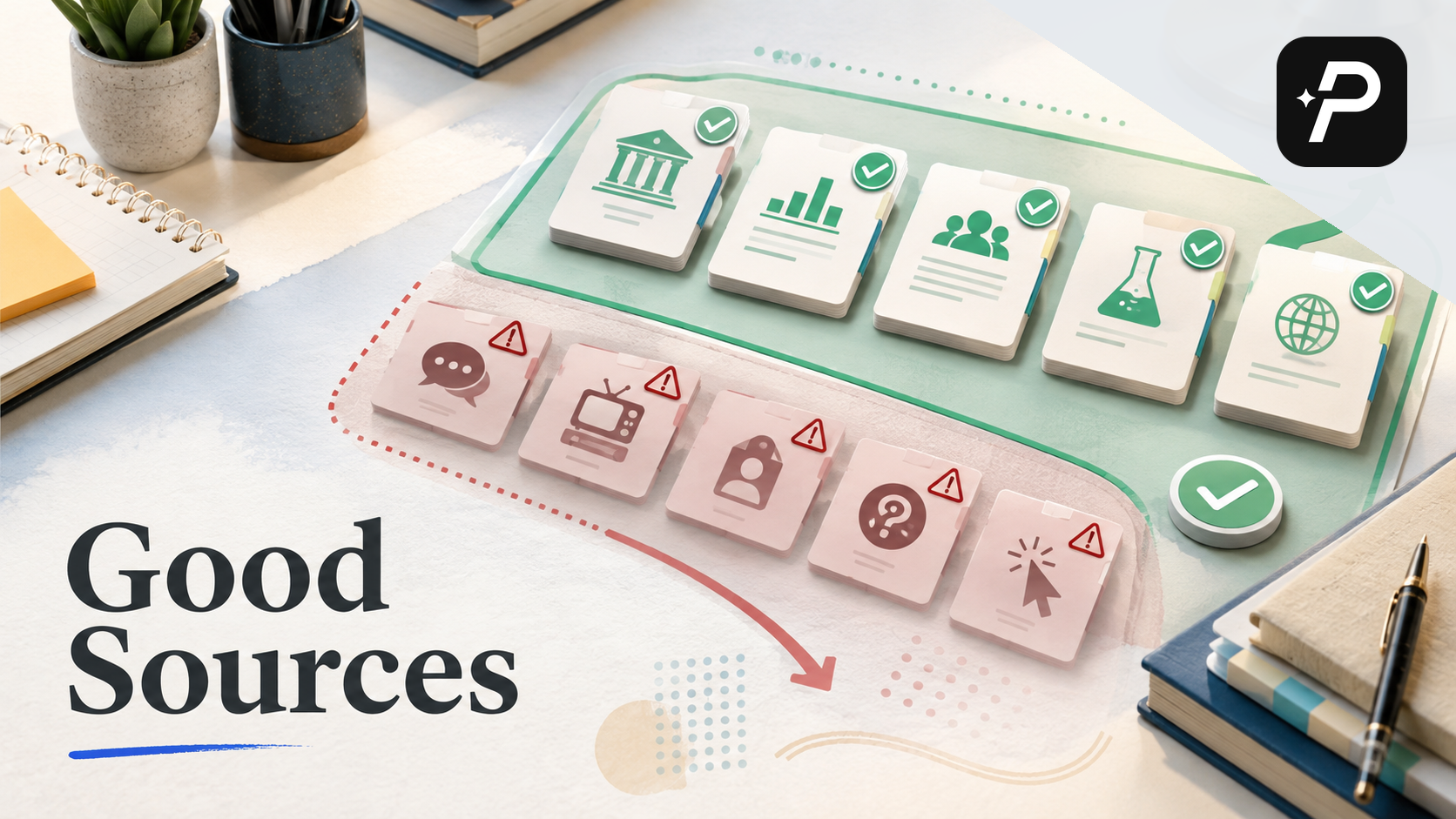
You have a thesis, a deadline, and a blank page. The next step is finding sources, but the search results are overwhelming, and it is hard to tell what your professor will actually accept.
A "good" source has to be accurate, scholarly enough for the assignment, credible, relevant, recent enough for your topic, and citable. If a source fails any one of those checks, it weakens your argument, no matter how well it is written. This guide explains each criterion, shows you what to avoid, and gives you a practical workflow for building a source list that will hold up.
What Makes a Source "Good" for a College Research Paper?
The phrase gets thrown around a lot, but it is rarely defined. In academic writing, a good source fits the specific situation of your assignment. That means it is appropriate for the level of your paper, relevant to your thesis, and credible enough to support your claims without you having to apologize for it later.
For most college papers, the gold standard is the peer-reviewed journal article. Peer review means other experts in the field read the paper before publication and judged it sound enough to share with the academic community. The process is not perfect, but it provides a baseline of quality that blog posts, news articles, and opinion pieces cannot match. Peer-reviewed articles are not the only acceptable sources, though. Scholarly books from academic presses, government reports, and data from reputable research institutions can also be excellent choices, depending on your discipline.
Think of "good" as a set of filters rather than a single label. A source might be credible but outdated. It might be relevant but too narrow. It might be scholarly but impossible to cite properly because it lacks publication details. When you evaluate a source, you run it through a series of checks, and it must pass all of them to earn a place in your paper.
The Five Criteria for Evaluating Sources
To make the abstract idea of a "good source" concrete, use this five-part checklist. It is not a formal framework like the CRAAP test, but it is a practical way to think about what you are looking for before you invest time in reading a full text.
Scholarly or professional – Is the author an expert in the field? Is the publication aimed at researchers, practitioners, or academics? A study published in a psychology journal by a university professor is scholarly. A summary of that study in a magazine is not.
Credible – Does the publisher or platform have a reputation for accuracy? University presses, major academic journals, and government agencies generally do. Personal blogs, self-published e-books, and content mills do not.
Relevant – Does the source directly address your research question or a sub-question? A source that merely mentions your topic in passing is not relevant enough to cite.
Recent enough – In fast-moving fields like medicine, computer science, or psychology, a source from five years ago may be obsolete. In history or philosophy, a source from twenty years ago may still be the standard work. You need to match the recency to your discipline and your instructor's expectations.
Citable – Can you find the author, title, publication date, and page numbers? If you cannot build a proper citation, you cannot use the source, no matter how brilliant it is.
Scholarly vs. Popular Sources: Know the Difference
The most common mistake students make is treating popular sources as if they were scholarly ones. A popular source is written for a general audience, often by a journalist or staff writer. It is designed to inform, entertain, or persuade, and it rarely includes a reference list. Examples include news websites, magazines, and most blogs.
A scholarly source, by contrast, is written by and for experts. It uses specialized language, includes citations, and is published in academic journals or by university presses. The difference matters because your instructor is not asking you to summarize what the news says about a topic. They are asking you to engage with the research itself.
This does not mean popular sources are useless. They can help you understand the context of a topic, identify key debates, or find names of researchers you should look up. But they should be a starting point, not a destination. When you find a good news article about a study, your next step should be to find the original study and cite that instead.
What Does Not Count as a Good Source
Knowing what to leave out is just as important as knowing what to include. Some sources are so problematic that they can damage your grade even if they contain accurate information.
Wikipedia – You have heard this before, but it bears repeating. Wikipedia is a tertiary source. It can be useful for getting an overview of a topic or for finding the references listed at the bottom of an article. But you should never cite Wikipedia itself in a college paper. Your instructor will notice, and it signals that you have not done the work of finding primary or secondary sources.
Generic AI outputs – If you ask a chatbot to generate a paragraph on your topic, the output is not a source. It is a synthesis of other sources, often without reliable attribution. You cannot cite a chatbot, and you should not use its output as if it were a fact. AI tools can help you brainstorm or organize, but they do not replace the need for real, verifiable sources.
Opinion pieces and editorials – Unless your assignment is specifically about analyzing rhetoric or public opinion, opinion columns are not appropriate sources. They represent one person's viewpoint, not a research finding.
Unverified websites – Any website that does not list an author, a date, or a publisher is suspect. If you cannot tell who is responsible for the content, you cannot vouch for its accuracy.
Outdated data – In fields like technology, healthcare, or social media research, using data that is more than a few years old can undermine your argument. Always check the publication date and ask whether newer data might have changed the picture.
The Role of Primary and Secondary Sources
Your discipline will determine whether you need primary sources, secondary sources, or both. A primary source is original material from the time period or event you are studying. In history, that might be a diary, a newspaper from the era, or a government document. In literature, it is the novel or poem you are analyzing. In the sciences, it is the original research paper that reports new findings.
A secondary source interprets, analyzes, or summarizes primary sources. A textbook, a literature review, or a biography are all secondary sources. For many college papers, you will need a mix of both. The primary sources give you raw material to analyze, while secondary sources help you understand how other scholars have interpreted that material.
One common mistake is relying entirely on secondary sources and never engaging with the original research. If you are writing about a psychological study, you should read the study itself instead of relying only on a textbook summary. This takes more time, but it also makes your paper stronger and shows your instructor that you can handle complex material.
How to Find Good Sources Efficiently
Finding good sources is not about luck. It is about using the right tools and strategies. Most college libraries provide access to databases like JSTOR, PubMed, Scopus, or Google Scholar. These databases index scholarly literature and let you search by keyword, author, or date. They also often include filters that let you limit results to peer-reviewed articles only.
Start with a broad search using your main keywords, then narrow down by reading abstracts. An abstract is a short summary at the beginning of an article. It tells you the research question, the methods, and the main findings. Reading abstracts lets you screen dozens of papers in minutes without reading full texts.
If you find one highly relevant article, do not stop there. Use its reference list to find earlier work on the topic. This is called backward citation chasing. You can also look for newer papers that cite the article you found, which is called forward citation chasing. This technique helps you map the conversation around your topic and ensures you are not missing key voices. For a detailed walkthrough of this method, see this guide on backward and forward citation chasing.
Building a Reading Queue to Stay Organized
Once you start finding sources, the volume can quickly become overwhelming. This is where a reading queue becomes essential. A reading queue is simply a list of papers you plan to read, organized by priority. You do not need to read everything you find. You need to read the most important things first.
Start by saving every promising source into a single place. This could be a spreadsheet, a reference manager like Zotero, or a dedicated tool like My Library in WisPaper, which lets you save and upload papers for later review. Then, go through your list and rank each source by relevance and credibility. Read the most relevant sources first, and skip or skim the rest.
The goal is to avoid source overload, where you have so many papers that you cannot remember what any of them say. A reading queue forces you to be selective and keeps you moving forward. If you are working on a larger project, such as a thesis or a systematic review, you may need a more structured approach. This guide on how to build a reading queue for a new research topic offers a step-by-step method that works for both short papers and long-term projects.
Using AI Tools Without Breaking Academic Integrity
AI tools can help you find and screen sources, but you need to use them carefully. The line between using AI as a research assistant and using it to cheat is not always clear, so it helps to set boundaries.
You can use AI to help you refine your research question or to suggest search terms you might not have thought of. You can use it to summarize a paper you have already read, as long as you check the summary against the original. You can even use it to help you organize your notes or draft an annotated bibliography. But you should not use AI to generate content that you present as your own, and you should never cite an AI tool as a source.
Some AI-powered tools are designed specifically for academic work. WisPaper's Deep Search, for example, lets you search academic literature using a natural-language research question instead of a long Boolean query. This can be useful when you are exploring a new topic and do not yet know the right keywords. The Scholar Agent can help you explore research questions and paper directions inside the search workflow. These tools are meant to speed up the discovery process, not to replace your own judgment about what is worth citing.
For a safer approach to using AI in your workflow, especially when you are dealing with a large number of sources, review this guide on annotated bibliography with AI. It explains how to use AI for summarization and note-taking while keeping your own analysis at the center of the work.
Screening Sources Quickly and Effectively
When you have a long list of potential sources, you need a fast way to decide which ones deserve a full read. This is called screening, and it is a skill you can develop with practice.
Start with the title. Does it clearly relate to your research question? If not, skip it. Then read the abstract. Does the paper actually study what the title suggests? If the abstract does not mention your topic or population, move on. Next, check the publication venue. Is it a reputable journal or press? If you have never heard of it, do a quick search to see if it is peer-reviewed.
Finally, check the publication date. If the paper is older than your field's standard for recency, you may still want to read it if it is a seminal work, but you should also look for newer sources that might have updated the findings. This screening process can cut a list of 100 papers down to 10 or 15 in under an hour. If you are dealing with an especially large set of papers, you may want to use a more formal workflow. This guide on how to screen 1,000 papers in hours, not weeks offers techniques that scale beyond a single assignment.
Checking for Retractions and Corrections
A source can be published in a top journal and still be flawed. Sometimes papers are retracted because of errors or misconduct. Other times, they are corrected after publication. If you cite a retracted paper, you are citing work that the academic community has formally rejected. This is a serious problem that can undermine your entire paper.
Before you cite a source, take a minute to check whether it has been retracted or corrected. You can do this by searching for the paper's title plus the word "retraction" or by checking the publisher's website. Some databases also flag retracted papers automatically. This step is especially important if you are using older sources or sources from fields with high retraction rates. For a practical guide on how to do this check, see how to check whether a paper has been corrected or retracted.
Managing Your Sources for the Long Term
Finding good sources is only half the battle. You also need to manage them so that you can find what you need when you are writing. This means keeping track of what each source says, why you saved it, and how it relates to your argument.
One effective method is to write a one-sentence summary of each source as soon as you save it. This forces you to engage with the material and makes it easier to sort your sources later. You can also tag sources by theme or by the section of your paper where you plan to use them.
If you are working on a large project, such as a thesis or a literature review, you may need a more systematic approach. You might create a matrix that compares each source's research question, methods, and findings. This is a common technique in systematic reviews, and it helps you see patterns across studies. For a guide that walks through this process, see rapid review in weeks, not months. It is designed for researchers who need to synthesize a large body of literature quickly.
Avoiding Source Overload
One of the most common problems students face is having too many sources and not enough time to read them. This is called source overload, and it can lead to procrastination, anxiety, and poor writing. The solution is not to find fewer sources. It is to be more strategic about what you read and when.
Set a limit for the number of sources you will read in full. For a typical college paper, that might be 10 to 15 sources. You can find many more than that, but you do not need to read all of them. Read the most important ones deeply, skim the next tier, and skip the rest. This approach ensures that you have enough material to write a strong paper without drowning in information.
If you find yourself spending more time collecting sources than writing, you may need to step back and refocus on your research question. Every source you add should help you answer that question. If it does not, set it aside. For more strategies on managing large volumes of literature, see how to avoid source overload in a literature review.
FAQs
Keep Reading
Can't Find Sources for Your Research Paper? A Step-by-Step Fix
You have the topic. You have the assignment. You have been staring at a search bar for forty minutes, and every query either returns 100,000 irrelevant results or three results from 1987. The cursor blinks. The deadline
Is This Source Credible Enough to Cite? A Student Checklist
You found a source that seems perfect. The topic matches, the argument looks convincing, and you are ready to add it to your reference list. Then the doubt hits: is this source credible enough to cite? Students face this
How Many Sources Does a Research Paper Need?
If you are staring at a blank page with a half-finished outline and a growing sense of panic, you have probably asked the same question that every student and early-stage researcher eventually faces: how many sources for