

A rapid review is not a rushed literature review. It is a review with a narrower question, deliberate shortcuts, documented tradeoffs, and a real decision need. Speed is part of the design, but it is not the method by itself.
The key difference is transparency. A systematic review aims to answer a question with a full planned method. A rapid review accelerates parts of that process by narrowing scope, limiting search sources, simplifying screening, reducing duplicate steps, or focusing extraction on the fields needed for a decision. Those choices must be visible.
Cochrane's Rapid Reviews Methods Group says it published updated guidance on methods for conducting rapid reviews of effectiveness for Cochrane and other stakeholders. The WHO-affiliated Alliance for Health Policy and Systems Research guide says it provides guidance on how to plan, conduct, and promote the use of rapid reviews for health policy and systems decisions in practical settings. The point is clear: rapid reviews need method guidance, not just a faster calendar.
When A Rapid Review Makes Sense
A rapid review is most useful when a decision deadline is real and the question can be narrowed. It is weaker when the topic is broad, controversial, safety-critical, or likely to be used as if it were a full systematic review.
Use a rapid review when:
- A policy, product, clinical, or research decision cannot wait for a full review.
- The question is narrow enough to search and screen efficiently.
- Stakeholders accept documented method limits.
- The output will be used as timely evidence, not as a claim of exhaustive coverage.
- The team can explain what was shortened and why.
Do not use a rapid review as a branding trick. If the question needs a full systematic review, say that. If the evidence base is uncertain, say that too.
The honest framing is: "This review answers a narrower question faster, with documented limits." That is much stronger than pretending the limits do not exist.
Rapid Review vs Systematic Review
Rapid reviews and systematic reviews share a family resemblance. Both should use explicit methods, planned eligibility criteria, documented searching, screening decisions, extraction, and synthesis. The difference is that a rapid review intentionally restricts or simplifies parts of the process.
Common rapid-review adaptations include:
- Narrowing the research question.
- Searching fewer sources.
- Limiting date ranges, languages, or publication types when justified.
- Using a single reviewer for some tasks with verification.
- Prioritizing title and abstract screening.
- Extracting only decision-relevant fields.
- Using narrative synthesis instead of a more complex synthesis method.
Each adaptation has a cost. Searching fewer sources can miss studies. Simplified screening can miss eligible papers. Narrow extraction can hide context. A rapid review is defensible only when those costs are understood and reported.
If the project needs formal PRISMA-aware reporting, use AI-assisted systematic review methods before deciding which shortcuts are acceptable.
Start With The Decision Need
A rapid review should begin with a decision, not a topic. "AI in education" is too broad. "Which AI feedback tools have evidence of improving writing revision in undergraduate courses?" is closer to a reviewable question.
Before searching, write:
- Who will use the review?
- What decision will it inform?
- What evidence would change the decision?
- Which populations, settings, or study types matter?
- What will be excluded even if it looks interesting?
This prevents scope creep. Without a decision need, every adjacent paper looks relevant. With a decision need, the review can say no.
This also helps with AI. If you use AI to suggest search terms, screen papers, or build an extraction table, the tool needs a narrow question and clear criteria. Vague prompts create vague candidate lists.
Plan The Shortcuts Before The Search
Rapid review shortcuts should be planned, not discovered under deadline pressure.
Write a short methods plan that covers:
| Method area | Decision to make |
|---|---|
| Scope | What exactly is in and out of the question? |
| Search | Which databases, platforms, or citation methods will be used? |
| Limits | Are date, language, geography, or publication-type limits justified? |
| Screening | Who screens records and how are uncertain cases handled? |
| Extraction | Which fields are needed for the decision? |
| Appraisal | How will study quality or confidence be assessed? |
| Synthesis | How will findings be grouped and reported? |
| AI use | Which steps, if any, will AI assist? |
This plan does not need to be long. It needs to be clear enough that someone else can understand what was done.
The worst rapid reviews do the opposite: they cut methods quietly, then write as if the review were exhaustive. Readers can accept limits when the limits are visible.
Search Narrowly, But Do Not Search Randomly
The search should match the decision need. A rapid review may use fewer databases than a full systematic review, but it should not rely only on convenience.
A practical rapid search can combine:
- A focused database search.
- Citation chasing from key papers.
- Review articles to identify seed studies.
- Expert-recommended papers when appropriate.
- AI academic search for vocabulary discovery and candidate triage.
AI can help identify alternate terms and adjacent phrasing. It can also help surface papers that keyword search misses. But the final search should still be documented. Record sources, search strings, search dates, and any limits.
If your search is too noisy, use AI academic search beyond Google Scholar to discover better vocabulary before running the final search.
Screen With A Maybe Pile
Screening is where rapid reviews often gain time. It is also where they can lose quality.
Use simple labels:
- Include: clearly meets criteria.
- Exclude: clearly outside criteria.
- Maybe: needs closer review.
The maybe pile matters because rapid reviews move quickly. It gives uncertain papers a second look instead of forcing a rushed decision.
AI can assist by ranking likely relevance, summarizing abstracts, or flagging uncertain records. Treat that as triage, not final eligibility. If the review will be published or used for an important decision, document how AI-assisted screening was checked.
For source-heavy projects, extracting data from research papers should come only after screening. Extraction before screening creates extra work and blurs relevance decisions.
Extract Only What The Decision Needs
Extraction should be lean. Do not build a giant table because a full systematic review would have one. Extract the fields needed to answer the decision question.
Useful rapid-review fields often include:
- Study design.
- Population or setting.
- Intervention, exposure, method, or concept.
- Comparator or baseline, if relevant.
- Outcomes or findings.
- Main limitations.
- Notes on applicability.
AI can help pre-fill extraction fields, but every used field should be checked against the original paper. This is especially important for outcomes, methods, and limitations. A summary error can change the meaning of the evidence.
If you use AI for extraction, record the tool, inputs, extraction fields, and human verification process. That record also helps if the final manuscript needs an AI-use statement.
Synthesize For Decisions, Not Exhaustion
Rapid-review synthesis should be direct. The reader usually wants to know what the evidence suggests, where confidence is limited, and what decision-relevant gaps remain.
Use synthesis categories that match the decision:
- By intervention or tool type.
- By population or setting.
- By outcome.
- By method quality.
- By level of applicability.
- By consistency of findings.
Avoid turning the synthesis into a paper-by-paper parade. A rapid review should still explain patterns. It should not merely stack summaries.
This is where organizing papers into themes helps. Themes should come from the evidence and decision need, not from whatever labels sound tidy.
Report The Tradeoffs
A rapid review earns trust by naming its limits.
Report:
- Sources searched.
- Search dates.
- Eligibility criteria.
- Any date, language, or publication-type limits.
- Screening process.
- Whether one or more reviewers were used.
- AI tools used, if any.
- Extraction fields.
- Verification steps.
- Known gaps and likely missed evidence.
Do not hide shortcuts in soft language. If only English-language papers were included, say so. If one reviewer screened abstracts with verification of uncertain cases, say so. If AI ranked papers before human review, say so.
For manuscripts, this connects directly to how to disclose AI use to a journal. Disclosure should match the methods.
Quality Checks Before You Share The Review
Before sending a rapid review to a stakeholder, supervisor, client, or journal, run a short quality check. The review may be rapid, but the reader still needs to know what can and cannot be concluded.
Ask:
- Is the decision question visible in the introduction?
- Are the eligibility criteria specific enough to explain exclusions?
- Are the search sources and limits named?
- Are the main shortcuts stated directly?
- Are included studies traceable to source records?
- Are important findings checked against the original papers?
- Are limitations written in plain language?
- Is the conclusion narrower than the evidence?
That last point matters. Rapid reviews often become risky at the conclusion stage. The evidence may support "available studies suggest" but not "the intervention works." It may support "published evidence is limited" but not "there is no effect." Keep the strength of the conclusion aligned with the strength of the evidence.
If AI helped draft any part of the review, check the draft for overconfident language. Models tend to make evidence sound smoother than it is. Replace polished certainty with accurate uncertainty.
Common Rapid Review Failure Modes
Most rapid review problems are not mysterious. They come from speed hiding method choices.
Watch for these failure modes:
- The question is too broad for the available time.
- Search limits are chosen for convenience but not reported.
- Screening reasons are not saved.
- AI summaries are used without checking papers.
- Extraction fields are too broad for the decision.
- Limitations are softened because the output needs to sound useful.
- The final document reads like a full systematic review even though shortcuts were used.
The fix is not to slow everything down. The fix is to make the tradeoffs explicit. A rapid review can be valuable precisely because it gives decision-makers timely evidence with visible uncertainty.
Where WisPaper Fits
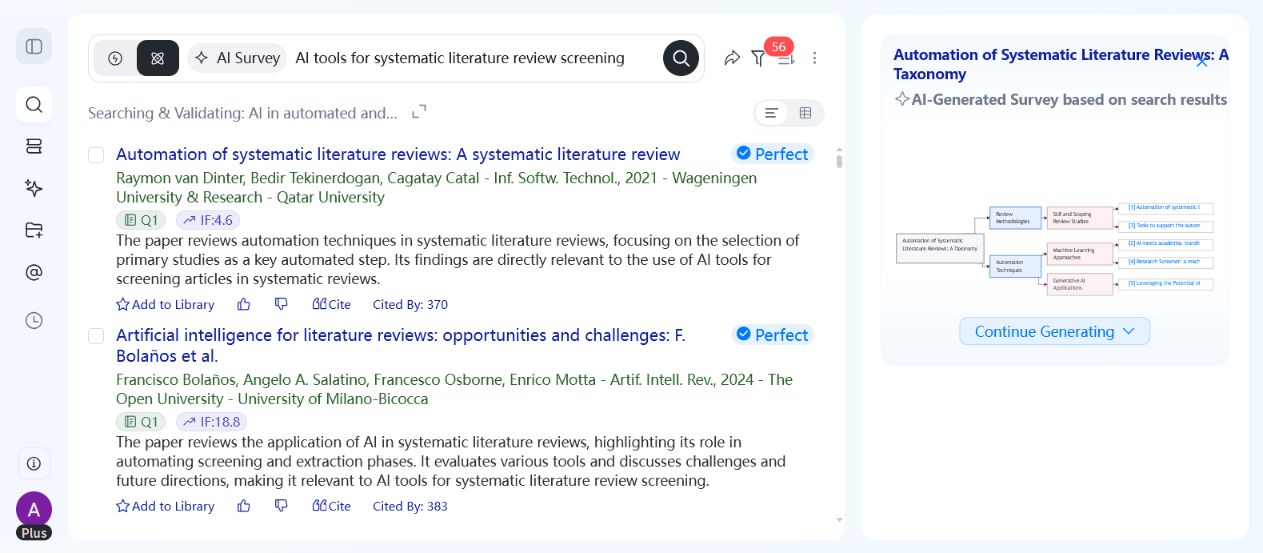
WisPaper helps researchers search and screen academic papers with AI. Its search workspace supports Deep Search, Scholar Agent, and Inspiration Discovery, while paper cards show source labels, summaries, and preview images so users can triage results before deciding what to read.
WisPaper also lets users build a paper library and ask questions against that library. Papers can be uploaded or added from search results, then used as the basis for library-specific QA.
FAQs
Keep Reading

Scholarly Sources for Assignments: Where to Find Them and How to Use Them
You have an assignment due, and the instructions say "use scholarly sources." That usually means peer-reviewed journal articles, academic books, or conference papers. But if you have ever typed your research question int

How to Find Peer-Reviewed Articles for a Research Paper
Your instructor wrote "peer-reviewed sources only" in the rubric. You need to find them, but you are not entirely sure what counts as peer reviewed or where to look. A quick Google Scholar search returns a mix of PDFs, p

Good Sources for a College Research Paper: What Counts and What Does Not
You have a thesis, a deadline, and a blank page. The next step is finding sources, but the search results are overwhelming, and it is hard to tell what your professor will actually accept. A "good" source has to be accur