
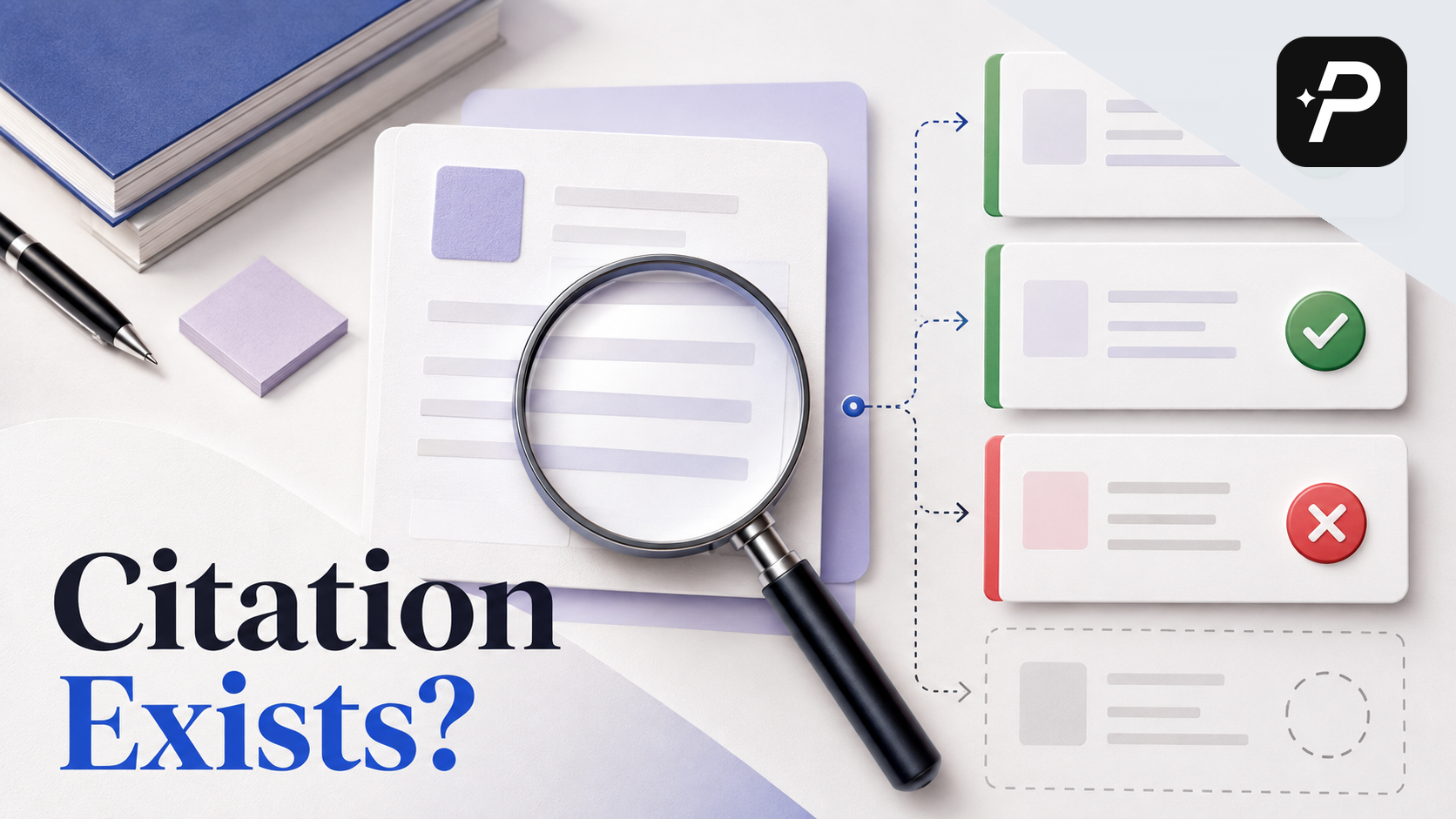
You found the perfect reference for your literature review. The author, title, and journal all look right. Then you try to open the source and the DOI leads nowhere. The journal page returns a 404. A search across databases turns up nothing.
This happens more often now that AI tools can generate plausible-looking references in seconds. If you need to check whether a citation is real, you're not alone. This guide walks through a practical verification process you can apply before putting any reference in your thesis, dissertation, or research paper.
The goal is to confirm that a source actually exists before you evaluate whether it's relevant to your argument. Existence checking comes first. Relevance checking comes second. A fabricated citation cannot support your work no matter how well it fits your narrative.
Why Do Fake Citations Appear in Academic Writing?
The most common cause today is AI hallucination. Large language models generate text that sounds plausible, but they don't maintain a verified database of sources. When you ask an AI assistant to "find references for this topic," it may invent authors, titles, journals, and DOIs that look convincing. This is a known limitation, not a rare glitch.
Human error also plays a role. A student might misremember a source they read months ago, or they might copy a reference from another paper that contained an error. Sometimes a citation is real but transcribed incorrectly, making it impossible to locate. The author's name might be misspelled, the year wrong, or the volume number off by one. In these cases, the citation "does not exist" as written, even though the underlying work does.
AI-assisted research has made this problem more visible. Tools like ChatGPT, Gemini, and Perplexity can generate reference lists in seconds, but those lists require rigorous checking. The distinction between a real source and a hallucinated one isn't always obvious at first glance.
What Is the First Thing to Check?
Start with the Digital Object Identifier. A DOI is a permanent link to a document and the most reliable identifier in academic publishing. If the citation includes a DOI, paste it directly into a browser or use the doi.org resolver. If the DOI resolves to a valid page with matching author and title information, the citation likely exists.
If there is no DOI, go to the publisher's website. For journal articles, visit the journal's page and search for the article title. For books, check the publisher's catalog. This direct approach is often more reliable than a general web search because it takes you to the authoritative source.
Be aware that some fabricated citations include DOIs that look real but lead nowhere. A hallucinated DOI might have the correct format but not resolve to anything. If the DOI doesn't resolve, don't assume the source is simply "hard to find." Run additional checks before considering it verified.
Which Databases Should You Search?
No single database covers every publication, so check several. Start with the major ones: Google Scholar, PubMed for biomedical and life sciences, Scopus, and Web of Science. Each indexes different journals and conference proceedings, so a source missing from one may appear in another.
When searching, use the exact title of the article or book chapter. Titles are usually unique enough to identify a specific work. If the title search fails, try searching by author name combined with the publication year. This can help you find a source even if the title was transcribed incorrectly.
Google Scholar is often the most accessible starting point for early-stage researchers. It's free and indexes a wide range of academic content. But it's not infallible. Some predatory journals and low-quality sources appear in Google Scholar, so cross-check results against the publisher's website or a more curated database.
How Do You Verify Books and Book Chapters?
University library catalogs are excellent resources for verifying citations, especially for books. Your institution's library likely has access to WorldCat, a global catalog that indexes the collections of thousands of libraries. If a book exists, it will almost certainly appear in WorldCat.
For journal articles, your library's database subscriptions can help you locate the full text or confirm that the article was published. Many libraries offer a citation linker tool that takes the details of a reference and searches across all the library's databases. This saves time compared to searching each database individually.
If you're not affiliated with a university, you can still use WorldCat to confirm that a book exists. The catalog provides bibliographic details, library locations, and sometimes links to digital copies.
What If the Citation Points to a Specific Journal?
Go to that journal's website and search for the article. Most reputable journals maintain an archive of all published issues, with search functions that let you look up articles by title, author, or year. If the journal has no record of the article, that's a strong signal the citation is fabricated.
For conference papers, check the conference proceedings directly. Many conferences publish proceedings online through their own website or a publisher like IEEE, ACM, or Springer. If you can't find the paper in the proceedings, the citation is likely fake.
This step matters especially for AI-generated citations. AI tools often invent plausible-sounding journal names or mix up real journals with fake article titles. A direct check of the journal's archive quickly reveals whether the article exists.
Can Citation Indexes Help Confirm a Source?
Scopus and Web of Science offer a unique verification method: they show which other papers have cited a given work. If a citation is real, it should appear in these indexes with a visible citation history. If a reference is completely absent, it may be too new to have been cited, or it may not exist.
This method is less useful for very recent publications that haven't accumulated citations yet. For older sources, though, a citation index provides strong confirmation. If you find a paper that cites your reference, check that paper's reference list to see how the citation is formatted. This can help you identify transcription errors.
Google Scholar's "Cited by" feature offers a similar function. It shows how many times a paper has been cited and links to the citing works. If a paper has zero citations and you can't find it anywhere else, treat it with suspicion.
What Should You Check After Confirming the Source Exists?
Finding a real citation is only half the battle. You also need to confirm the source is still valid. A paper may exist but have been retracted or corrected after publication. Retracted papers should not be cited as valid sources. Corrected papers may have significant changes that affect how you use them.
Check the publisher's page for any notices, and search for the paper's title along with the word "retraction" or "correction." This is especially important with AI-generated citations, as AI tools may not be aware of post-publication changes. The guide on how to check whether a paper has been corrected or retracted provides a detailed workflow for this step.
How Can AI Tools Help Without Making Things Worse?
AI research tools can help you verify citations, even though they're also a source of fake references. The key is to use them as a starting point, not as the final authority. Tools like AI academic search beyond Google Scholar can help you locate sources that traditional search engines might miss.
When you use an AI tool to verify a citation, ask it to provide the DOI or a direct link to the publisher's page. Then independently verify that link by opening it in your browser. Don't trust the AI's assertion that a source exists. Trust the evidence you can see with your own eyes.
If you already have a research question but are struggling to find papers that match it, WisPaper's Deep Search lets you search academic literature using the question itself instead of building a long Boolean query. The results include source labels, summaries, and publication details that help you screen references quickly. But even these tools aren't infallible. Always cross-check results against the publisher or a major database.
What Do You Do When You Can't Find the Source?
If you've exhausted all the methods above and still can't find the source, you have a decision to make. The safest option is to remove the citation from your work. A missing citation isn't worth the risk of academic misconduct, even if the source might exist somewhere obscure.
Before you remove it, consider a few possibilities. The citation might have incorrect details. Try searching for the author's name alone, or search for the title without the author. A simple typo in the title can make a source impossible to find. If you find a source that seems close but not exact, compare the details carefully.
If you're working with an AI-generated citation, ask the AI to provide more information about the source. Ask for the DOI, the ISSN of the journal, or the ISBN of the book. A hallucinated citation will often fail this test because the AI can't produce a valid identifier.
How Do You Build Verification Into Your Research Workflow?
Don't wait until you're writing the final reference list to check your sources. Verify each source as you encounter it. This saves time in the long run and prevents you from building arguments on shaky foundations.
For AI-assisted research, treat every reference as unverified until you've confirmed it yourself. The article on AI citation hallucination rates compared provides context on how often these errors occur and why they persist.
A practical workflow looks like this: when you find a potential source, immediately paste its title into Google Scholar. If it appears, click through to the publisher's page and confirm the details. If it doesn't appear, run the additional checks described above. This takes less than a minute per source and can save you hours of frustration later.
Your university library is one of your best resources for citation verification. Many libraries offer a citation checker service where you can submit a list of references and have a librarian verify them. This is especially useful for final reports and theses, where accuracy is critical. The FAQ on how to check references for a final report covers some of these tools in detail.
For larger projects like a systematic review, the guide on when to stop screening in an AI-assisted review offers advice on managing the verification workload. Screening and verifying citations are closely related tasks, and both benefit from a systematic approach.
How Is Existence Different From Relevance?
Once you've confirmed a citation exists, move on to the second question: is it relevant to your work? This is where many researchers get into trouble. They find a real source, but it doesn't actually support the claim they're making. This is a different kind of error, but it's just as damaging to your argument.
When you check relevance, read the source carefully and compare it to the claim you're citing it for. Does the source actually say what you're claiming it says? Is the context appropriate? A source can be real and still be misused. The guide on paper summary prompts offers questions you can ask to ensure you're using sources correctly.
The distinction matters because it changes your verification strategy. Existence checking is a search problem: you're looking for a record of the source. Relevance checking is a reading problem: you're evaluating the source's content. Both are necessary, but they require different skills and tools.
FAQs
Keep Reading
AI Research Tools for Students: Search, Read, Cite, and Organize
The research process often breaks down at a specific point: you have an assignment, you need credible sources, and you're not sure where to start. Maybe you've typed a question into Google Scholar and gotten thousands of
Why AI Invents Academic Citations and How to Catch Them
You ask ChatGPT for sources on your thesis topic. Within seconds, it returns a list of references. The authors sound right. The journal names are familiar. The years and volume numbers look plausible. Then you search for
Can You Use AI for a Literature Review?
Yes, you can use AI for a literature review—but the useful question is which parts of the task you hand off and which parts you keep. A literature review is not a summary of what you found. It is an argument about what t