

OpenAlex is an open scholarly metadata system. For literature reviews, it is most useful when you need to inspect works, authors, institutions, sources, concepts, and citation relationships at a scale that ordinary paper-reading tools do not handle well.
OpenAlex is not mainly a PDF reader or a summarizer. It is a metadata layer. That distinction matters. Open metadata can help you find, group, audit, and monitor literature, but it does not replace reading or evaluating papers.
This guide explains when OpenAlex helps literature review work, when it is not enough, and how to connect metadata analysis with a source-based review workflow.
What is OpenAlex?
OpenAlex is an open catalog of scholarly works and related metadata. Its official website describes a large, open index of research outputs and relationships.
For literature review work, OpenAlex can help researchers and research-support teams inspect:
- Works.
- Authors.
- Sources or venues.
- Institutions.
- Concepts.
- Citations.
- Publication years.
- Open access status.
This makes it useful for mapping a field before or alongside a literature review.
How is OpenAlex different from Google Scholar or Semantic Scholar?
OpenAlex is more useful as structured metadata, while Google Scholar and Semantic Scholar are more familiar as search interfaces. The difference is workflow.
Search interfaces help users find and open papers. Metadata systems help users analyze sets of scholarly records.
OpenAlex is useful when you need to ask:
- Which journals publish most on this topic?
- Which authors or institutions appear often?
- How has publication volume changed over time?
- Which concepts are attached to this literature?
- Which papers are highly connected?
- Which records need metadata cleaning?
If your goal is reading one paper, OpenAlex is not the fastest route. If your goal is mapping a body of literature, it can be valuable.
When does open metadata help a literature review?
Open metadata helps when the review begins with a messy field and you need to understand its shape. It can support planning before full reading begins.
Useful cases include:
- Exploring publication trends.
- Identifying major venues.
- Finding related concepts.
- Checking author or institution clusters.
- Building a seed-paper list.
- Comparing topic coverage across years.
- Creating a search strategy from metadata patterns.
- Auditing whether a source set is too narrow.
This is especially useful for scoping work. Before reading everything, you can see where the literature appears to concentrate.
For paper discovery methods, compare citation network search vs keyword search.
When is OpenAlex not enough?
OpenAlex is not enough when the review needs evidence-level interpretation. Metadata can point to papers, but it does not tell you whether a paper's method is appropriate or whether its claim is reliable.
OpenAlex alone cannot answer:
- Was the study design strong?
- Did the paper measure the outcome you need?
- Does the result support your claim?
- Are limitations serious?
- Should the paper be included?
- How should conflicting evidence be synthesized?
Those questions require reading, extraction, appraisal, and human judgment. Open metadata helps create a map; it does not write the evidence synthesis.
For evidence mapping after discovery, see how to build a literature review evidence map.
How can OpenAlex help build a search strategy?
OpenAlex can help by showing vocabulary, venues, authors, and related works that may improve your search. A researcher can inspect metadata patterns and turn them into better search terms.
Use it to look for:
- Repeated title terms.
- Related concepts.
- Common author keywords where available through records.
- Frequently appearing venues.
- Highly cited seed papers.
- Recent papers in the same area.
- Adjacent fields using different terminology.
Then test those terms in your target databases. Do not assume a metadata pattern automatically becomes a good search string.
For query building, see AI literature review search strings.
How can OpenAlex help find seed papers?
OpenAlex can help identify potential seed papers by citation connections, publication year, venue, and concept metadata. A seed paper is a strong starting paper used to discover more literature.
Good seed candidates often have:
- Clear relevance to the review question.
- Strong citation connections.
- A recognizable method or concept.
- Recent references or later citing works.
- Enough metadata to support follow-up search.
After identifying seeds, use citation chasing or citation mapping tools to expand the source set.
For seed workflows, see how to use seed papers to find better literature.
How can open metadata support research alerts?
Open metadata can support current-awareness workflows by helping researchers identify topics, venues, authors, and records to monitor. Alerts become more useful when they are based on a clear map of what matters.
A simple alert workflow:
- Define the research topic.
- Identify concepts, authors, venues, and seed papers.
- Set alerts in tools that support them.
- Review new records regularly.
- Save relevant papers into a working library.
- Periodically update the evidence map.
Alerts are for staying current. They are not a substitute for a documented search when the review requires one.
For alert planning, see research alerts workflow.
What are the risks of using metadata in literature reviews?
Metadata is useful, but it can be incomplete, delayed, duplicated, or uneven across fields. A literature review should not treat metadata as perfect.
Watch for:
- Duplicate records.
- Missing abstracts.
- Incorrect author names.
- Venue changes.
- Preprint and published-version confusion.
- Citation lag for new papers.
- Topic labels that are too broad.
- Records outside your inclusion criteria.
Use metadata to guide discovery and auditing. Use papers to support conclusions.
How do you connect OpenAlex with a paper-reading workflow?
Connect OpenAlex to reading by turning metadata insights into a source set. The handoff matters.
Use this sequence:
- Use metadata to map the field.
- Identify seeds, venues, authors, and terms.
- Search and export candidate papers.
- Screen candidates with inclusion criteria.
- Save selected papers into a library.
- Extract evidence from full text.
- Build an evidence map.
- Write synthesis claims from verified sources.
This prevents metadata work from floating separately from the review.
For library organization, see how to manage a PDF library for literature reviews.
How do you turn openAlex for literature reviews: when open metadata helps into a repeatable workflow?
Turn the advice into a repeatable workflow by defining the decision you need to make, the evidence required for that decision, and the record that will prove how the decision was made. In literature discovery, the problem is rarely one missing tool. The problem is usually that search, reading, checking, and writing happen in separate places without a shared rule.
Use a short operating routine:
- Name the review question or subquestion.
- Define the source set you are working from.
- Decide what counts as enough evidence for the next step.
- Apply the same criteria to every paper in that step.
- Mark uncertain cases instead of forcing a clean answer.
- Keep source locations for claims that may enter the final review.
- Review the workflow after each major search, screening, or writing session.
This routine keeps the work moving without making the review careless. It also gives supervisors, collaborators, and future you a way to understand why the source set changed.
What should you record while using this workflow?
Record the pieces that would be hard to reconstruct later. You do not need a diary of every click, but you do need enough detail to explain the path from question to source to claim.
For this topic, the most useful record usually includes queries, source routes, seed papers, result counts, and follow-up searches. Add the date, tool or source used, reviewer status, and next action. If AI assisted the step, write down what it helped with and what a human checked.
The record should distinguish discovery from evidence. A tool may help find a paper, but the paper itself must support the claim. A summary may help triage a source, but the original source should support any statement that appears in the literature review.
What should you check before writing from this work?
Before writing, check whether the workflow has produced usable evidence or only useful notes. Notes help you think. Evidence supports a sentence.
Ask:
- Which claim will this source support?
- Is the claim narrower than the evidence?
- Have methods, sample, outcome, or concept details been checked?
- Are limitations visible?
- Are conflicting papers handled rather than ignored?
- Is the citation real, current, and relevant?
- Can another reader understand how this source entered the review?
If the answer is unclear, keep the point in notes rather than moving it into the draft. This is the small pause that prevents AI-assisted research from becoming polished but weak writing.
How can WisPaper complement OpenAlex in a literature review?
WisPaper can complement metadata-based discovery by helping researchers move from a topic or candidate source set into paper search, triage, saved libraries, and library-based questions. Deep Search, Scholar Agent, and Inspiration Discovery support natural-language academic search.
Paper cards show source labels, summaries, titles, authors, publication details, and preview images, which helps researchers inspect candidates after metadata analysis points them toward a topic area. Papers can then be saved or uploaded into My Library for continued work.
Library QA can answer questions based on the user's own library. That makes WisPaper useful after open metadata has helped identify the field shape and the researcher needs to work with selected papers.
FAQs
Keep Reading
Scholarly Sources for Assignments: Where to Find Them and How to Use Them
You have an assignment due, and the instructions say "use scholarly sources." That usually means peer-reviewed journal articles, academic books, or conference papers. But if you have ever typed your research question int
How to Find Peer-Reviewed Articles for a Research Paper
Your instructor wrote "peer-reviewed sources only" in the rubric. You need to find them, but you are not entirely sure what counts as peer reviewed or where to look. A quick Google Scholar search returns a mix of PDFs, p
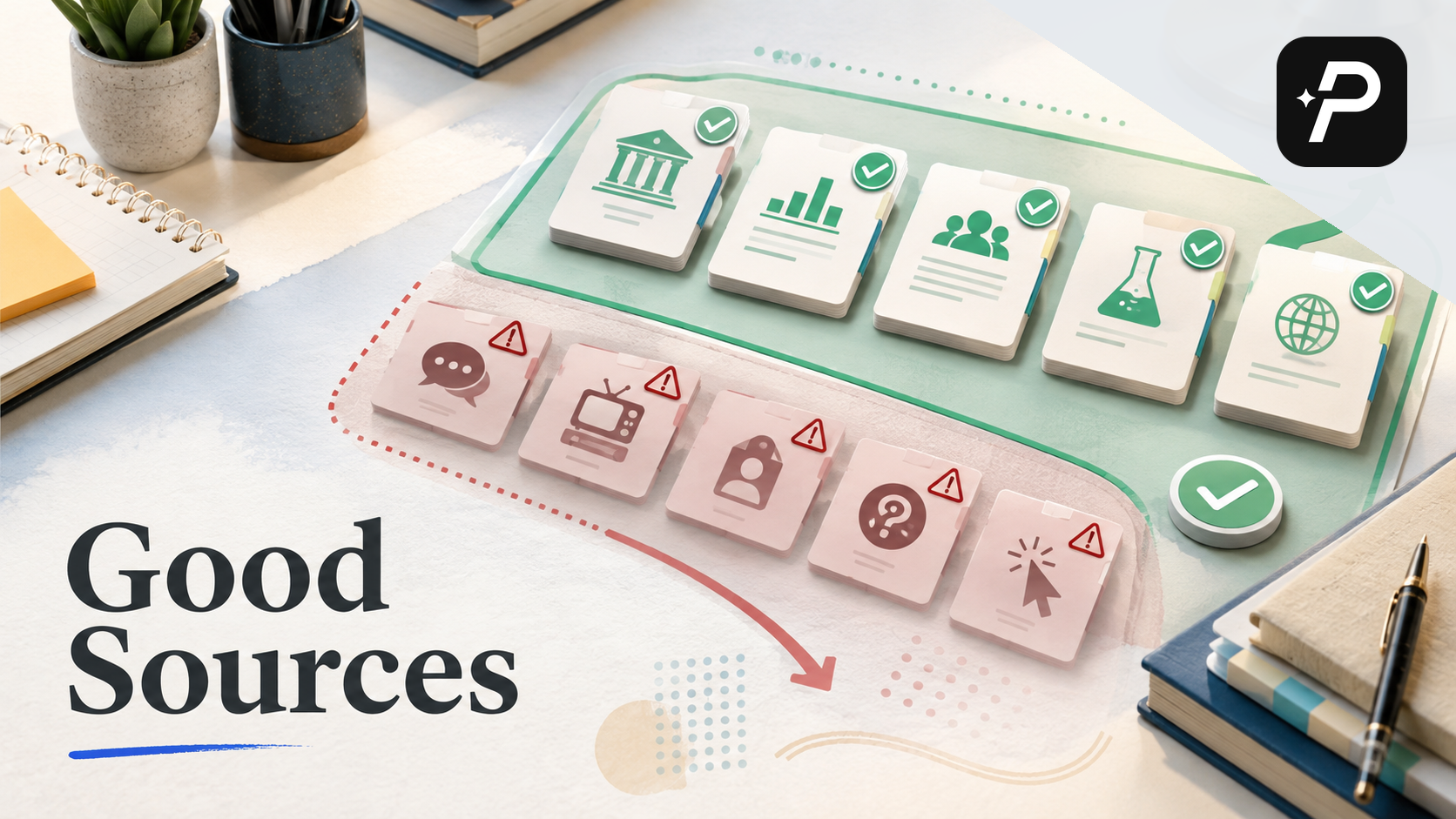
Good Sources for a College Research Paper: What Counts and What Does Not
You have a thesis, a deadline, and a blank page. The next step is finding sources, but the search results are overwhelming, and it is hard to tell what your professor will actually accept. A "good" source has to be accur