

Rayyan, Covidence, and ASReview all help with study screening, but they are built for different review cultures. Rayyan is a practical screening platform for researchers and teams. Covidence is a formal systematic review management tool. ASReview is an open-source active-learning tool for people who want more control over AI-assisted screening.
Choosing between them is less about which tool is "best" and more about what your review needs to prove. A student project, a hospital evidence synthesis, and an open-source methods experiment do not need the same software.
This guide compares Rayyan, Covidence, and ASReview by workflow, pricing signals, AI support, documentation needs, and team fit. If you are still at the search stage rather than the screening stage, start with a broader comparison of AI tools for literature review.
The Three Tools At A Glance
| Tool | Best for | Strongest advantage | Main caution |
|---|---|---|---|
| Rayyan | Title and abstract screening | Accessible review workspace with duplicate detection, AI relevance predictions, and reviewer workflows. | Some advanced AI and collaboration features require paid plans. |
| Covidence | Formal systematic review management | Strong process structure for teams, full review administration, and institutional workflows. | More expensive and more formal than many solo projects need. |
| ASReview | Active-learning screening | Open-source AI screening with simulation, benchmark, and local-control options. | Requires more methodological confidence and setup effort. |
If you already have a large reference set, these tools can help you screen it. If you are still collecting papers, you may need a search-and-triage workflow before importing records. A practical guide to screening 1000 papers can help separate search, screening, and deep reading.
What These Tools Are Actually Solving
Screening is the stage where a large reference set becomes a usable evidence base. You import records, remove duplicates, screen titles and abstracts, review full texts, resolve conflicts, and document decisions. For a formal review, that documentation matters as much as speed.
Rayyan, Covidence, and ASReview all reduce screening friction, but they do it differently:
- Rayyan gives researchers an accessible interface for screening and collaboration.
- Covidence gives teams a structured review management environment.
- ASReview gives users active-learning prioritization and open-source control.
The practical implication is simple: do not choose by feature count alone. Choose according to the review decisions and documentation requirements you need to defend.
Rayyan: Best For Accessible Screening Workflows
Rayyan positions itself as a systematic review platform. Its homepage says it is trusted by 1 million+ researchers, 20,000+ institutions, and users across 190+ countries. That scale matters because many supervisors, students, and review teams already recognize the workflow.
Rayyan's homepage describes a review process from import and organization to collaborator invitations, deduplication, title and abstract screening, full-text screening, data extraction, risk of bias, and reporting. For a researcher, that means Rayyan is not just a table of records. It is a workspace for making and tracking screening decisions.
Rayyan's pricing page lists a free plan that can create 3 active reviews, invite 2 free reviewers, use duplicate detection, get AI relevance predictions, and analyze records with 15+ workbench facets. The same page lists paid individual plans starting at $4.99 per seat/month, billed annually.
Where Rayyan Works Well
Rayyan works well when you need a screening workspace quickly. It is approachable enough for students, but structured enough for serious title-and-abstract screening. It also supports team roles and reviewer participation, which matters when screening decisions need more than one person.
Use Rayyan when:
- You have a reference set ready for screening.
- You need duplicate detection.
- You want AI relevance predictions but still need human decisions.
- You need several reviewers to participate.
- You want a lower-friction starting point than a full institutional platform.
Rayyan Limitations
Rayyan is not primarily a discovery engine. If your problem is finding papers from a research question, Rayyan is later in the workflow. You search elsewhere, import records, and then screen.
It also has plan boundaries. The free plan is useful, but larger reviews, more reviewers, PRISMA flow diagrams, and advanced AI features may require paid tiers.
Covidence: Best For Formal Review Management
Covidence is designed for formal systematic review management. Its homepage says users see an average 35% reduction in time spent per review and save an average 71 hours per review. Those are vendor claims, but they point to the product's position: structured review administration for serious evidence work.
Covidence is often a better fit when a university, hospital, guideline group, or evidence team needs a known process. It supports the rhythm of a full review: importing studies, screening, full-text review, extraction, quality assessment, and exportable outputs.
Pricing is a major difference. Covidence lists a Single plan at $339 USD/year for one review with unlimited collaborators and a Package plan at $907 USD/year for up to 3 reviews. It also offers a trial with 500 records.
Where Covidence Works Well
Covidence works well when process consistency matters. If your review will be audited, supervised by a methods team, or submitted as part of a high-stakes evidence product, the formal structure can be worth the cost.
Use Covidence when:
- Your institution already has access.
- You need an established systematic review workflow.
- You have multiple collaborators and need clear review stages.
- You expect to report methods in a manuscript or guideline.
- You want support and training around review management.
Covidence Limitations
Covidence may be too much for a solo student doing a narrative review or class project. The cost and structure make more sense when the review itself justifies a formal management platform.
It also does not replace search expertise. You still need a librarian, information specialist, or careful search strategy if the review is formal.
ASReview: Best For Open-Source Active Learning
ASReview is different from Rayyan and Covidence. It is an open-source AI-aided systematic review tool coordinated at Utrecht University. Its site describes ASReview as AI-aided systematic reviewing and highlights screening, AI, simulation, benchmarking, and crowdscreening.
The core idea is active learning. Instead of screening records in a static order, you label records, and the model learns which remaining records are more likely to be relevant. The ASReview GitHub page describes it as an open-source machine learning tool for efficient, transparent, and interactive screening of large textual datasets.
ASReview's website says it has 638,000+ installations, works with 100+ organizations, and has 800+ GitHub stars. Its GitHub repository also states that ASReview LAB is open source and that decisions are saved automatically.
Where ASReview Works Well
ASReview works well when you want active-learning control and transparency. It is attractive for methods-aware researchers, information specialists, data scientists, and teams comfortable with open-source tools.
Use ASReview when:
- You want an open-source screening tool.
- You understand active learning or can get methods support.
- You want to simulate and benchmark screening performance.
- You need more control over the screening model.
- You value local or transparent software workflows.
ASReview Limitations
ASReview has a steeper learning curve. Users need to understand what active learning is doing, how stopping decisions are made, and how to document the method. That can be powerful, but it is not always the fastest path for a student who simply needs to screen references.
ASReview also requires a different kind of confidence. With commercial platforms, the workflow is often more guided. With open-source active learning, the researcher carries more responsibility for method choices and documentation.
Rayyan vs Covidence vs ASReview: Feature Comparison
| Need | Rayyan | Covidence | ASReview |
|---|---|---|---|
| Easy entry for students | Strong | Medium | Medium |
| Formal review management | Medium | Strong | Medium |
| Active learning control | Medium | Limited | Strong |
| Open-source transparency | Limited | Limited | Strong |
| Team collaboration | Strong | Strong | Depends on setup |
| Duplicate handling | Strong | Strong | Available, but workflow-specific |
| Institutional workflow | Medium | Strong | Medium |
| Low-cost starting point | Strong | Limited | Strong |
| Methods experimentation | Medium | Limited | Strong |
The choice becomes clearer once you name the review type. A student screening project can start with Rayyan. A hospital evidence synthesis may justify Covidence. A methods team testing active learning may prefer ASReview.
Which Tool Should You Pick?
Pick Rayyan if you need a practical screening workbench:
- You want to start quickly.
- You need duplicate detection and AI relevance predictions.
- You have a small team.
- You want a free or lower-cost entry point.
Pick Covidence if you need formal review management:
- Your institution expects a known platform.
- Your review has multiple formal stages.
- You need collaborator structure and support.
- The budget matches the review's importance.
Pick ASReview if you need active-learning control:
- You want open-source software.
- You are comfortable with method decisions.
- You want simulation or benchmarking.
- You need transparent AI-assisted screening.
What If You Are Not Ready For A Screening Platform?
Rayyan, Covidence, and ASReview assume you already have a record set to screen. Many researchers are earlier than that. They have a research question, a few seed papers, and too many possible search terms.
At that stage, use search and first-pass triage before committing to a review platform. For early discovery, compare Elicit alternatives, SciSpace alternatives, and broader academic search workflows. For AI use in evidence synthesis, a separate guide to AI systematic review methods can help you decide what must be documented.
Where WisPaper Fits
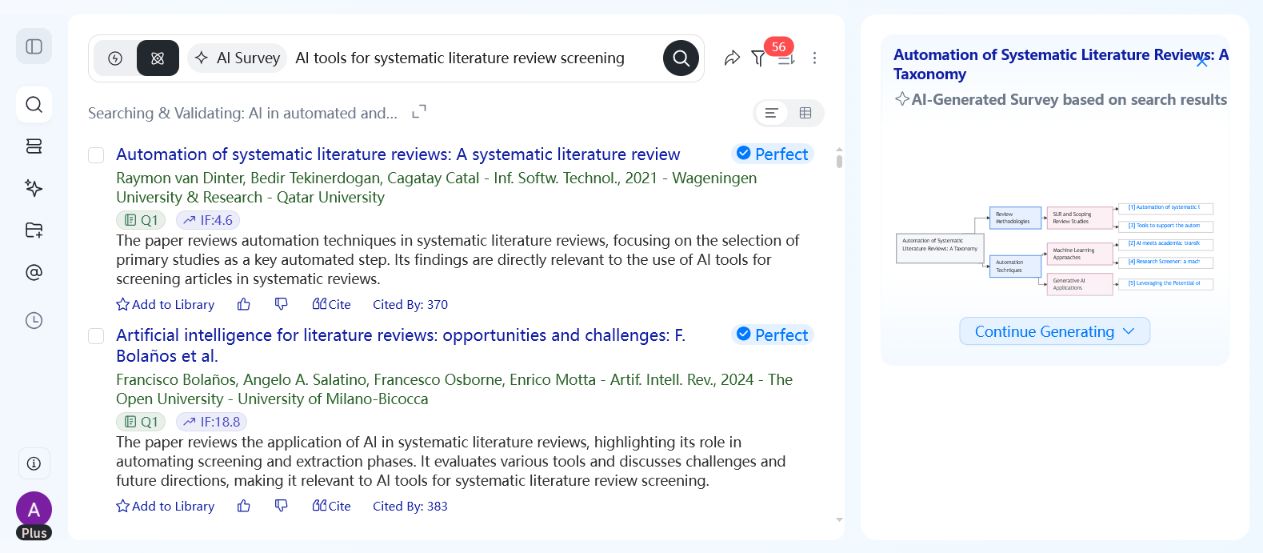
WisPaper helps researchers search and screen academic papers with AI. Its search workspace supports Deep Search, Scholar Agent, and Inspiration Discovery, while paper cards show source labels, summaries, and preview images so users can triage results before deciding what to read.
WisPaper also lets users build a paper library and ask questions against that library. Papers can be uploaded or added from search results, then used as the basis for library-specific QA.
FAQs
Keep Reading

Scholarly Sources for Assignments: Where to Find Them and How to Use Them
You have an assignment due, and the instructions say "use scholarly sources." That usually means peer-reviewed journal articles, academic books, or conference papers. But if you have ever typed your research question int
How to Find Peer-Reviewed Articles for a Research Paper
Your instructor wrote "peer-reviewed sources only" in the rubric. You need to find them, but you are not entirely sure what counts as peer reviewed or where to look. A quick Google Scholar search returns a mix of PDFs, p

Good Sources for a College Research Paper: What Counts and What Does Not
You have a thesis, a deadline, and a blank page. The next step is finding sources, but the search results are overwhelming, and it is hard to tell what your professor will actually accept. A "good" source has to be accur