

The best AI tool for a literature review depends on where your workflow breaks first. Some researchers need better search because keyword queries miss relevant papers. Others already have a large export from PubMed, Scopus, Web of Science, or Google Scholar and need faster title-and-abstract screening.
This guide compares the main AI literature review tools by the jobs that matter in real research work: search coverage, screening workflow, citation grounding, data extraction, library management, and price. The goal is not to crown one universal winner. The goal is to help you pick the tool that matches your review stage and your risk level.
How We Compared These Tools
We compared each tool against criteria that map to a real literature review workflow:
| Criterion | What we checked | Why it matters |
|---|---|---|
| Search coverage | Whether the tool searches a stated scholarly corpus, lets users search by research question, or connects to known academic indexes. | Poor coverage means the tool may produce tidy summaries from an incomplete paper set. |
| Screening depth | Whether the tool helps triage many papers, apply inclusion criteria, or organize decisions. | Screening is where literature reviews often lose weeks. |
| Citation grounding | Whether answers link back to source papers, citation contexts, or uploaded references. | A polished answer is not useful if you cannot verify where it came from. |
| Extraction and tables | Whether the tool can structure evidence into columns, reports, or review tables. | Review work usually ends in comparison, not just reading. |
| Workflow fit | Whether the tool fits individual discovery, systematic reviews, team screening, writing, or citation checking. | The best tool for mapping a field may be the wrong tool for a PRISMA-style review. |
We also checked pricing pages where they were public. Prices and usage limits change often, so treat them as selection signals rather than contract terms.
Quick Comparison Table
| Tool | Best for | Strongest fit | Current public signal | Main caution |
|---|---|---|---|---|
| WisPaper | Fast paper search and screening | Finding papers, triaging results, and moving useful papers into a library | WisPaper says users can screen 1000 papers in 5 minutes with AI to identify 20 must-read papers. | Screening quality still depends on the research question, source coverage, and the criteria used to judge relevance. |
| Elicit | Systematic review workflows | Search, screening, extraction, and evidence reports | Elicit says it searches more than 138 million papers and its Pro plan is listed at $49 per user/month, billed annually. | Strong for structured evidence work, but paid systematic-review depth may be more than a casual user needs. |
| SciSpace | Reading and understanding papers | PDF chat, literature review, AI writing, and data extraction | SciSpace says users can run literature reviews on 280M+ papers and lists paid pricing tiers on its pricing page. | Broad feature sets can feel busy if your only need is screening. |
| Consensus | Evidence Q&A | Question answering over peer-reviewed research | Consensus says over 5 million researchers, students, and clinicians trust the product. | Better for evidence lookup than full review project management. |
| Rayyan | Systematic review screening | Deduplication, blind screening, team workflows, and AI relevance predictions | Rayyan says its free plan supports 3 active reviews, 2 free reviewers, and AI relevance predictions. | It is built around review screening, not open-ended AI research chat. |
| scite | Citation context and claim checking | Seeing whether later papers support or contradict a claim | scite says it has indexed 1.6B+ citations, works with 30+ publishers, and serves 2M users. | It is strongest after you already have papers or claims to verify. |
| Semantic Scholar | Free scholarly search | Broad discovery, author pages, citation graph, and API access | Semantic Scholar says it searches 233,536,167 papers and is a free AI-powered research tool. | It is a discovery layer, not a guided review workspace. |
| ResearchRabbit | Citation mapping | Exploring related papers, authors, and research clusters visually | ResearchRabbit pricing lists free access across 310+ million articles and up to 50 seed articles. | Citation maps are excellent for discovery, but they do not replace screening criteria. |
| Covidence | Formal review management | Team-based systematic reviews, title/abstract screening, and review administration | Covidence lists a Single plan at $339 USD/year and a Package plan for up to 3 reviews. | More formal and costly than most solo literature-review needs. |
| Paperguide | All-in-one research workspace | Search, literature review agent, reference manager, PDF chat, extraction, and writing | Paperguide lists a free plan with 1000 AI credits/month and 20 AI searches/month. | Its wide scope means users need to verify which module is doing which job. |
The Tools Reviewed
WisPaper
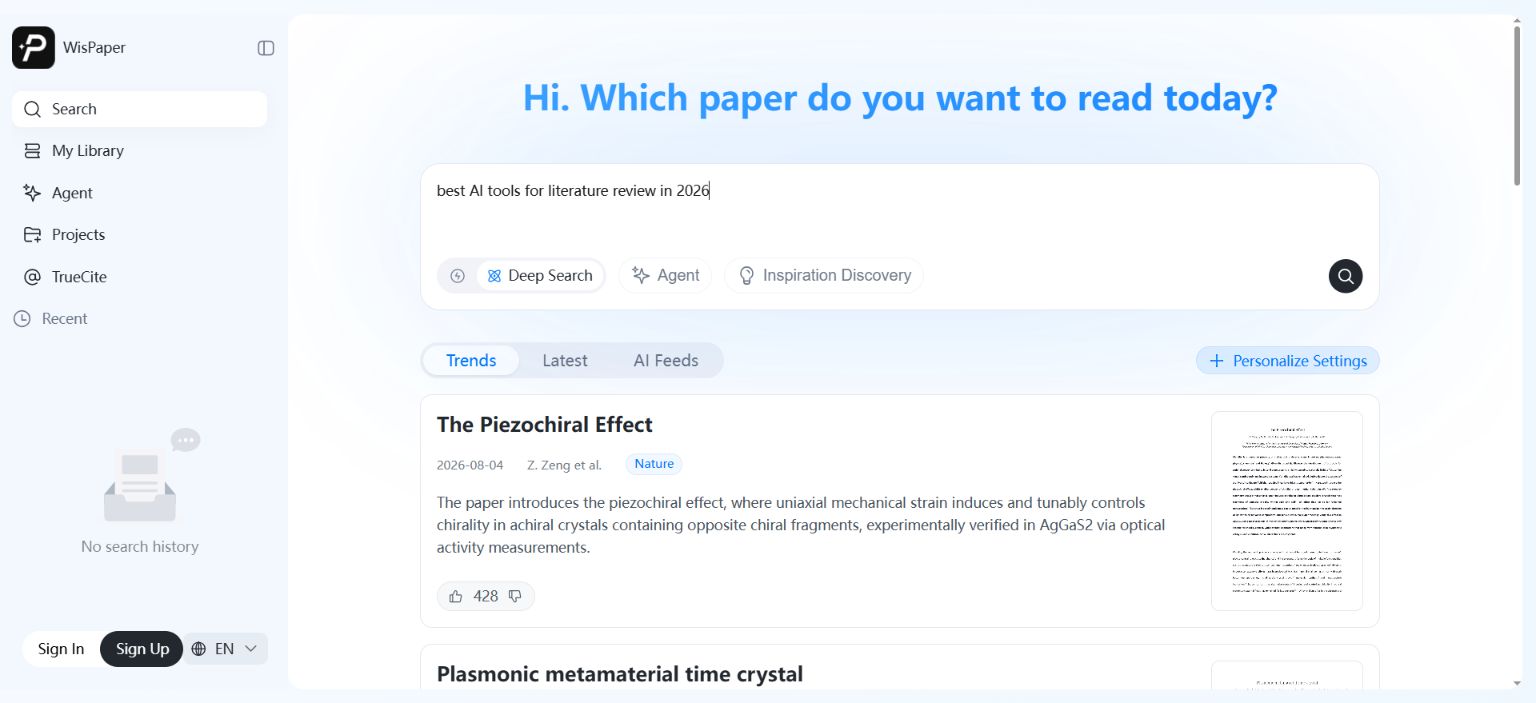
WisPaper is best for researchers who want to move quickly from a research question to a screened reading list. The search workspace includes Deep Search, Scholar Agent, and Inspiration Discovery, and paper cards show source labels, summaries, feedback buttons, and preview images.
The practical value is triage. WisPaper says users can screen 1000 papers in 5 minutes to identify 20 must-read papers. For researchers facing a large result set, the tool is designed to reduce the first-pass reading pile before deeper evaluation begins.
WisPaper also has a My Library area, upload support, library QA, Research Projects, and Scholar Agent. That makes it more than a search box: it can carry papers from discovery into a working library.
Best fit:
- Fast topic triage when you have too many papers and need a smaller reading set.
- Research-question search where keyword choice is still uncertain.
- Building a paper library and asking questions against that library.
Elicit
Elicit is one of the strongest options for structured evidence work. Its site says Elicit searches over 138 million academic papers and 545,000 clinical trials and can automate screening and data extraction for systematic literature reviews.
Elicit's strength is structure. It can search, build tables, extract information into columns, and support systematic review workflows. Its pricing page lists a free Basic plan and a Pro plan at $49 per user/month, billed annually, with a dedicated systematic review workflow.
Use Elicit when the output needs to become a table, extraction sheet, or evidence report. If you are only exploring a new topic, it may feel heavier than you need.
Best fit:
- Systematic or semi-systematic reviews.
- Evidence extraction across many papers.
- Researchers who need transparent source-backed tables.
SciSpace
SciSpace is best understood as an all-purpose AI research assistant. Its public page says it supports systematic literature reviews on 280M+ papers and includes product areas such as Chat with PDF, Literature Review, AI Writer, Find Topics, Citation Generator, and Extract Data.
The upside is breadth. A graduate student can use SciSpace to understand a dense PDF, ask follow-up questions, find related work, and draft research-adjacent text. That breadth is useful when the pain is not just search, but reading and comprehension.
The tradeoff is focus. If your main problem is screening a very large set against inclusion criteria, a specialized screening workflow may be easier to audit.
Best fit:
- Reading difficult papers.
- PDF explanation and follow-up questions.
- Researchers who want many academic AI utilities in one place.
For a deeper competitor-specific page, link readers to SciSpace alternatives once that article is live.
Consensus
Consensus is a good fit when your literature review begins with a focused evidence question. Its site positions the product as an AI academic search engine for peer-reviewed literature, and its pricing page says over 5 million researchers, students, and clinicians trust Consensus.
Consensus shines when a researcher asks, "What does the evidence say about X?" It is less about managing a full screening workflow and more about finding relevant peer-reviewed answers with citations.
Use it near the start of a review to understand the shape of the evidence. Then move into a more controlled search and screening workflow before making claims in a manuscript.
Best fit:
- Quick evidence checks.
- Early topic scoping.
- Clinicians, students, and researchers who need cited answers fast.
Rayyan
Rayyan is built for systematic review screening. Its pricing page says the free plan includes 3 active reviews, 2 free reviewers, duplicate detection, AI relevance predictions, and 15+ workbench facets.
The product makes the most sense when you already have references and need to screen them with a team. It is not trying to be a general AI writing assistant. That is a feature, not a flaw: review teams need traceable decisions more than they need conversational polish.
Rayyan is also widely used. The company says it is trusted by 1 million+ researchers, 20,000+ institutions, and users across 190+ countries.
Best fit:
- Title and abstract screening.
- Team review workflows.
- Projects where duplicate detection and reviewer assignment matter.
If your decision is specifically between old-line review platforms, build an internal path to Rayyan vs Covidence vs ASReview.
scite
scite is strongest when your literature review depends on citation context. Its site says Smart Citations show whether studies support or contradict a claim, and that scite has indexed 1.6B+ citations, partners with 30+ publishers, and serves 2M users.
That changes the job from "find papers" to "understand how this paper is being used." A paper with many citations can still be weak evidence if later work disputes it, uses it only as background, or cites it in a narrow context.
Use scite after you have candidate papers, key claims, or a draft bibliography. It is a verification and context layer, not a complete review workflow by itself.
Best fit:
- Citation context analysis.
- Claim checking.
- Deciding whether a highly cited paper is actually supported by later work.
For citation hygiene, connect this section to how to verify AI-generated citations.
Semantic Scholar
Semantic Scholar is the best free starting point for broad scholarly discovery. Its homepage says it is a free, AI-powered research tool and currently searches 233,536,167 papers from all fields of science.
The tool is useful because it sits close to the scholarly graph: papers, authors, citations, and recommendations. It also offers an API for teams that want to build their own scholarly tools.
Semantic Scholar is not a guided literature review system. You will still need your own screening criteria, extraction sheet, and writing workflow. For many researchers, though, it is a clean first pass before moving into a more structured review tool.
Best fit:
- Free academic search.
- Citation graph exploration.
- Finding papers, authors, and related work without committing to a paid tool.
ResearchRabbit
ResearchRabbit is best for visual discovery. Its homepage describes a workflow where users start from papers and explore related works, authors, and topic connections. Its pricing page lists a free plan with searches across 310+ million articles, unlimited libraries and collections, and up to 50 seed articles.
The tool is helpful when you do not yet know the field's structure. Citation maps make it easier to see clusters, adjacent authors, and papers that keyword search may not surface.
The limit is auditability. A citation map can help you find promising papers, but it does not apply inclusion and exclusion criteria for you.
Best fit:
- Citation-based discovery.
- Research gap exploration.
- Building a map of a field before formal screening.
Covidence
Covidence is a formal systematic review management platform. Its homepage says Covidence users see an average 35% reduction in time spent per review and save an average 71 hours per review.
The product is designed for review teams, not casual discovery. Its pricing page lists a Single plan at $339 USD/year and a Package plan at $907 USD/year for up to 3 reviews, with unlimited collaborators for those plans.
Pick Covidence when governance, collaboration, and review traceability are more important than cost. For an individual graduate student, the price and structure may be more than the project needs.
Best fit:
- Formal systematic reviews.
- Team screening and conflict resolution.
- Institutions that need a known review-management workflow.
Paperguide
Paperguide is an all-in-one research workspace. Its homepage highlights Deep Research, AI-backed writing from references, citation and reference management, Chat with PDF, and data extraction. Its pricing page lists a free plan with 1000 AI credits/month, 20 AI searches/month, and 500MB of reference storage.
The paid tiers are also clearly stated: Plus is listed at $12 per month, billed annually, and Pro at $24 per month, billed annually. That makes Paperguide attractive for researchers who want search, extraction, reference management, and writing support in one product.
The caution is the same as with any broad research suite: verify every citation and extraction before it enters your manuscript. More features do not remove the need for source checking.
Best fit:
- Students who want one research workspace.
- Reference management plus AI reading.
- Literature review reports and extraction tables.
Which Tool for Which Workflow
The fastest way to choose is to name the real bottleneck:
- If you have too many search results, start with WisPaper, Elicit, Rayyan, or Covidence depending on how formal the review is.
- If you need to understand hard PDFs, start with SciSpace or Paperguide.
- If you need evidence answers, start with Consensus, then verify the cited papers yourself.
- If you need citation context, use scite after you have candidate papers.
- If you need field mapping, use ResearchRabbit or Semantic Scholar before screening.
For a student with no budget, the practical stack is usually Semantic Scholar for search, ResearchRabbit for citation mapping, Consensus for early evidence checks, and a spreadsheet for manual extraction. Then add a dedicated screening tool when the paper set becomes too large. That free-stack topic deserves its own page, so point readers to free AI tools for literature review.
For a systematic review team, start from the audit trail. Rayyan, Covidence, and Elicit fit better than general chat tools because they focus on references, screening, extraction, and review documentation. If you are screening a large set, connect this decision to a practical workflow such as how to screen 1000 papers.
For researchers tempted to use a general AI chatbot as the whole review system, separate brainstorming from evidence work. General AI can help you clarify a question, but formal search and screening should happen in tools that expose sources and decisions. That is the bridge to ChatGPT Deep Research for literature review.
Where WisPaper Fits
WisPaper helps researchers search and screen academic papers with AI. Its search workspace supports Deep Search, Scholar Agent, and Inspiration Discovery, while paper cards show source labels, summaries, and preview images so users can triage results before deciding what to read.
WisPaper also lets users build a paper library and ask questions against that library. Papers can be uploaded or added from search results, then used as the basis for library-specific QA.
FAQs
Keep Reading

Scholarly Sources for Assignments: Where to Find Them and How to Use Them
You have an assignment due, and the instructions say "use scholarly sources." That usually means peer-reviewed journal articles, academic books, or conference papers. But if you have ever typed your research question int
How to Find Peer-Reviewed Articles for a Research Paper
Your instructor wrote "peer-reviewed sources only" in the rubric. You need to find them, but you are not entirely sure what counts as peer reviewed or where to look. A quick Google Scholar search returns a mix of PDFs, p

Good Sources for a College Research Paper: What Counts and What Does Not
You have a thesis, a deadline, and a blank page. The next step is finding sources, but the search results are overwhelming, and it is hard to tell what your professor will actually accept. A "good" source has to be accur